
A Lawyer With a 42+ Year Proven Track Record
Exclusively Practicing Only Colorado Criminal
Law - Defending Your Future
Exclusively Practicing Only Colorado Criminal
Law - Defending Your Future









Quick answer
A Colorado criminal defense lawyer represents people who are under investigation, arrested, or charged with a crime. The lawyer explains the charges and penalties, protects your constitutional rights, deals with police and prosecutors, argues for release on bond, investigates the evidence, files motions, negotiates, and tries the case when necessary.
You should contact one as early as possible: ideally before you speak with police, and certainly after an arrest, a summons, a warrant, a search of your home or phone, a DUI stop, a domestic violence call, or a plea offer.
Few people expect to need a criminal defense lawyer. Then a detective leaves a voicemail, an officer hands over a summons, or a traffic stop ends in handcuffs, and the decisions you make over the next few days matter more than you realize.
This guide explains in plain English what a Colorado criminal defense lawyer does, how a Colorado criminal case moves through the courts, and the specific moments when calling a lawyer is the wisest first step. It was written by H. Michael Steinberg, a Denver criminal defense attorney who has practiced Colorado criminal law for more than 42 years, including 13 years as a career prosecutor in Arapahoe and Douglas Counties.
In this article

A Colorado criminal defense lawyer is an attorney licensed by the Colorado Supreme Court who represents people accused of crimes. Defense lawyers appear in municipal courts, county courts, district courts, federal court, and the appellate courts, and they handle everything from a first-offense petty offense to the most serious felonies.
The role exists because the law guarantees it. The Sixth Amendment and Article II, Section 16 of the Colorado Constitution both protect an accused person’s right to defend himself or herself with the help of counsel. In Gideon v. Wainwright, the U.S. Supreme Court held that states must provide a lawyer to people who cannot afford one in serious criminal cases, and in Rothgery v. Gillespie County it confirmed that the right to counsel attaches at the first appearance before a judge.
There is a practical catch. The right to a lawyer in court does not stop police from questioning you before you ever see a judge. The most valuable work a defense lawyer does often happens before charges are filed, which is why timing matters so much.
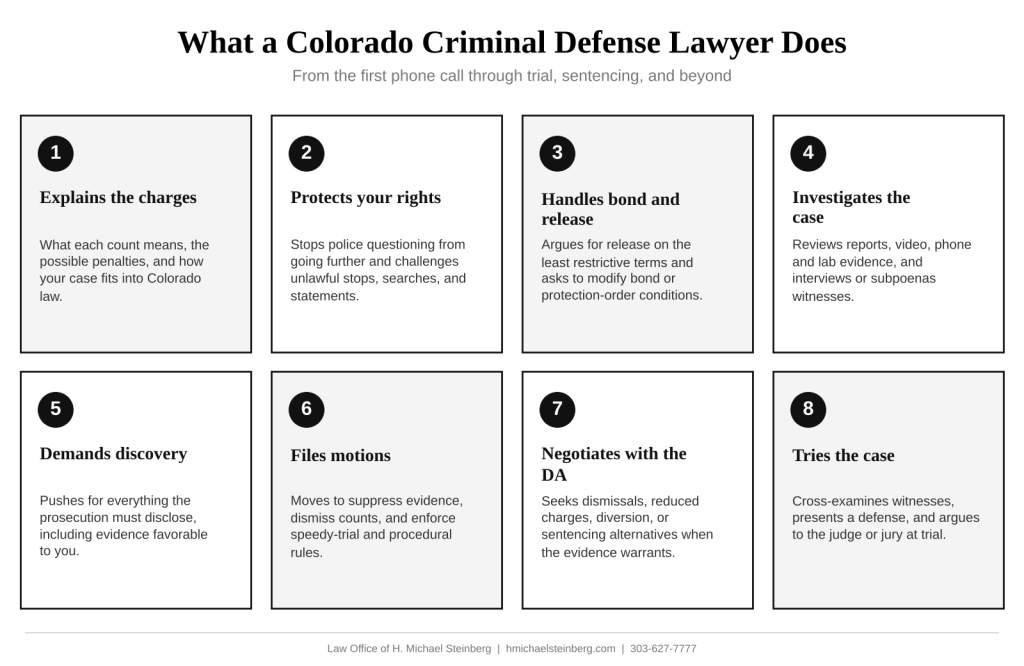
A defense lawyer’s job changes as your case moves forward. At every stage, the goal is the same: protect your rights, test the prosecution’s case, and pursue the best result the facts and the law allow.
Colorado divides felonies into six classes, and C.R.S. § 18-1.3-401 sets the presumptive prison range for each one. Misdemeanors are classified under C.R.S. § 18-1.3-501; for offenses committed on or after March 1, 2022, the statute creates two misdemeanor classes with maximum jail terms of 364 days and 120 days, while drug misdemeanors follow their own levels.
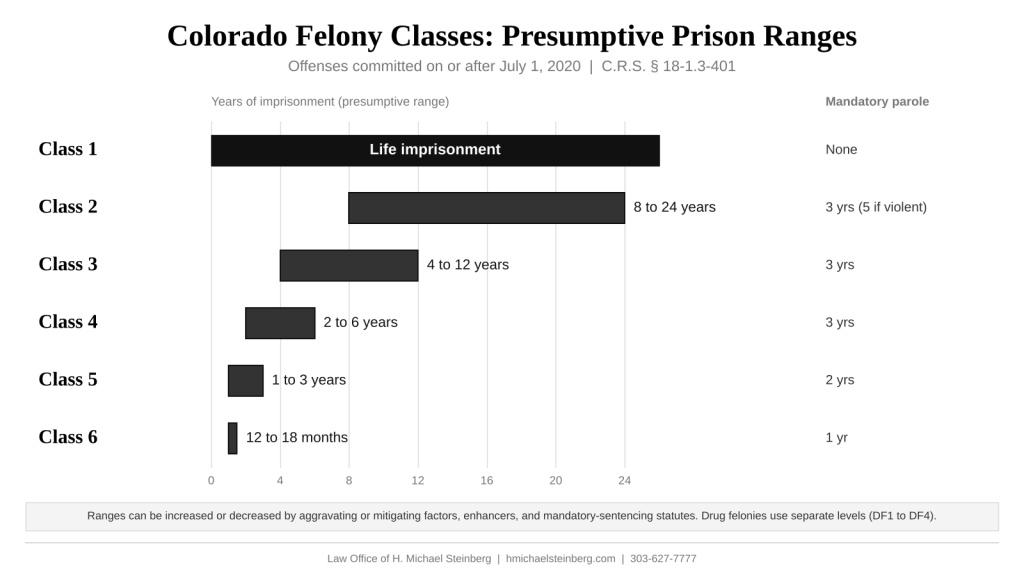
Numbers on a chart are only the beginning. A lawyer translates the complaint into real-world consequences: prison, probation, fines, restitution, and mandatory parole, but also the loss of firearm rights (see C.R.S. § 18-12-108 and 18 U.S.C. § 922(g)), professional licensing, housing, employment, and immigration. In Padilla v. Kentucky, the Supreme Court held that defense counsel must advise a noncitizen client about the deportation risk of a guilty plea.
The Fifth Amendment protects you from compelled self-incrimination, and Miranda v. Arizona requires warnings before custodial interrogation. The Fourth Amendment and the Colorado Constitution limit unreasonable searches and seizures. A defense lawyer can stand between you and investigators, decide whether any interview should happen at all, and later challenge whether a stop, a search, or a statement was lawful.
Many people are surprised how often innocent clients hurt themselves by explaining. Read why in Why Innocent People Sometimes Hurt Their Cases by Talking to Colorado Police. For an example of how traffic stops and K-9 searches shape drug and weapons cases, see our analysis of United States v. Ostertag.
At the first appearance the court decides the type of bond and the conditions of release. Under C.R.S. § 16-4-103, the court presumes that people in custody are eligible for release with the least restrictive conditions consistent with the law, unless the person is ineligible under Article II, Section 19 of the Colorado Constitution and C.R.S. § 16-4-101. Any monetary condition must be reasonable.
In addition, a mandatory protection order under C.R.S. § 18-1-1001 generally takes effect once you are advised of your rights at first appearance. It restrains you from harassing, intimidating, or retaliating against a victim or witness, and in domestic violence cases the court can add stay-away, no-contact, and firearm-relinquishment orders. Violating a protection order can be charged as a separate crime.
A lawyer works to set workable conditions and to modify them when circumstances change. For more on how these cases begin, read How Colorado Police Decide Who to Arrest in a Domestic Violence Case.
Defense counsel reviews police reports, body-camera and surveillance video, 911 audio, phone extractions, lab results, and witness statements, and may retain investigators or experts. Prosecutors have disclosure duties under Colorado Rule of Criminal Procedure 16 and under Brady v. Maryland, which requires the State to turn over evidence favorable to the accused that is material to guilt or punishment. A lawyer makes sure those obligations are met.
Digital evidence deserves special attention; see How Social Media Posts Become Evidence in Colorado Criminal Cases.
Motions are how a defense lawyer tests the State’s case before a jury ever hears it. Common examples include motions to suppress evidence from an unlawful stop or search, motions to suppress statements, and motions to dismiss.
Colorado’s speedy trial statute, C.R.S. § 18-1-405, generally requires trial within six months of a not guilty plea, subject to statutory exclusions such as defense-requested continuances, and the remedy for a violation is dismissal.
Under C.R.S. § 16-5-301, people charged with class 1, 2, or 3 felonies and level 1 or 2 drug felonies have the right to demand a preliminary hearing, where a judge decides whether probable cause supports the charge. For lower-level felonies the right is more limited and a dispositional hearing is used instead.
Most criminal cases end in a negotiated resolution rather than a trial. The U.S. Supreme Court has recognized plea bargaining as a critical stage where the right to effective counsel applies (Missouri v. Frye; Lafler v. Cooper). A skilled negotiator presents mitigation, exposes weaknesses in the evidence, and seeks dismissals, reduced charges, diversion, or sentencing alternatives when the facts support them.
Three of our related articles explain how this works from the inside: What Does a Prosecutor Look For Before Filing Criminal Charges?, DA Overcharging in Colorado: How Prosecutors Stack Charges, and Colorado Rule 410 and Plea Negotiations. I spent 13 years on the prosecution side of those conversations, and that experience shapes how I approach them for clients today.
If there is no fair resolution, you have the right to a jury trial (C.R.S. § 18-1-406). The prosecution carries the burden of proving every element beyond a reasonable doubt. Your lawyer selects the jury, cross-examines witnesses, presents evidence, makes and answers objections, and preserves issues for appeal.
Representation does not end with a verdict or a plea. A lawyer advocates at sentencing for probation, treatment, or other alternatives, defends probation violation cases, and, when appropriate, pursues an appeal. Later, some cases may qualify for sealing under C.R.S. § 24-72-705 (records other than convictions) or C.R.S. § 24-72-706 (conviction records). The Colorado Judicial Branch publishes a guide to sealing non-conviction records. Sealing is not the same as vacating a conviction, and eligibility depends on the offense, waiting periods, and other conditions.
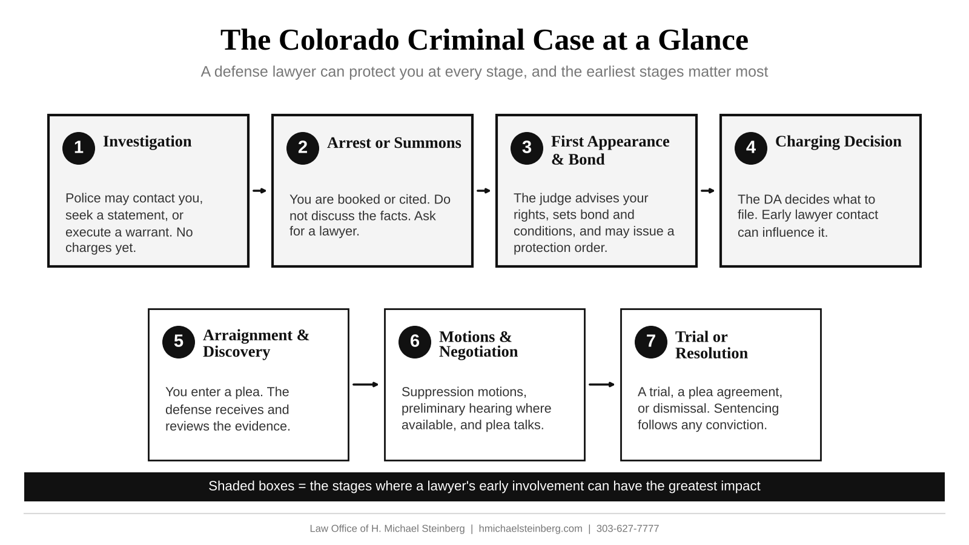
Knowing the road ahead makes it easier to see where a lawyer matters most. The early stages, which include police contact, arrest, bond, and the charging decision, are when evidence is gathered, statements are made, and options are still wide open. For a deeper walk-through, read The Colorado Criminal Case: From Investigation Through Trial.

The short answer is sooner than most people think. The safest moment is before you make a statement, sign anything, consent to a search, or respond to a plea offer. Here are the situations where calling right away makes the biggest difference.
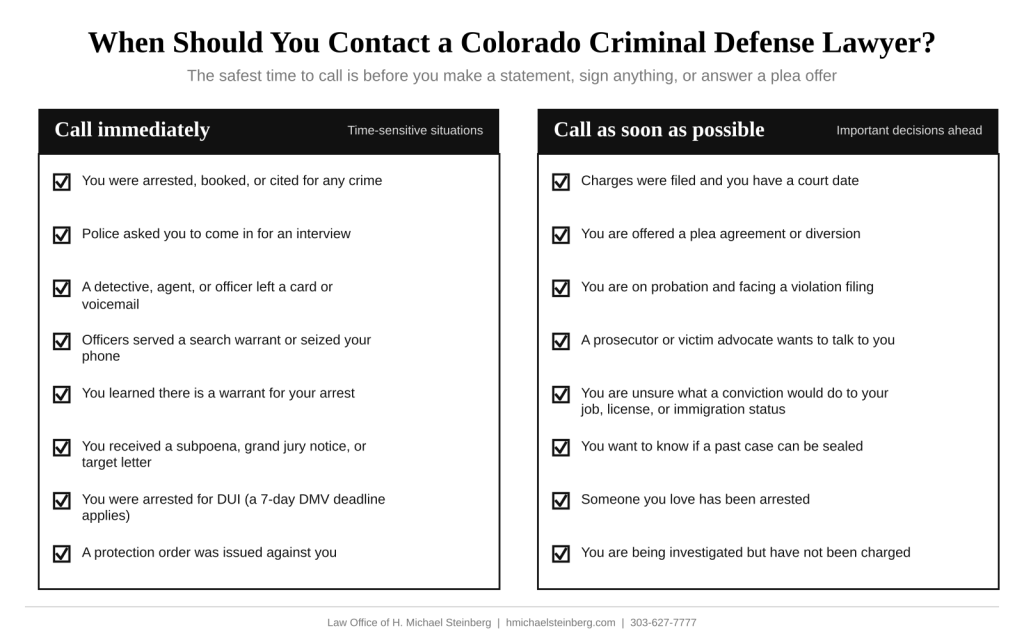
Detectives often call, text, or leave a card before any charge is filed. A voluntary interview is not required. A lawyer can learn whether you are a witness, a subject, or a target, and then decide whether to respond, how, and on what terms. Nothing you say can be taken back.
Do not discuss the facts with officers, cellmates, or on recorded jail calls. Ask for a lawyer. The first court appearance, where bond and conditions are set, comes quickly, and having counsel involved from the start can affect release terms, protection orders, and how the case is framed.
A warrant means investigators believe they have probable cause. A lawyer can review the warrant, advise you on what to say and not say, and begin evaluating whether it was properly issued and executed. Never delete, alter, or hide anything; tampering with evidence can be its own crime under C.R.S. § 18-8-610.
A DUI arrest starts two separate proceedings: the criminal case and an administrative license-revocation case with the DMV. Under C.R.S. § 42-2-126, you must request a hearing within seven days after you receive the notice of revocation, or the right to a hearing is generally waived. The Colorado Department of Revenue explains the process on its express consent cases page. For a first excess-BAC violation the statutory revocation period is nine months, and for a first refusal it is one year, so the deadline deserves immediate attention.
Colorado’s mandatory arrest law, C.R.S. § 18-6-803.6, pushes officers toward making an arrest when they find probable cause in a domestic violence call, and a protection order usually follows. You may be barred from your own home before you speak to anyone. Early legal help matters for bond, protection-order terms, and gathering evidence. See our domestic violence defense page and False, Exaggerated, or Mistaken Domestic Violence Allegations: How Are They Defended?.
Do not wait until the morning of court. Missing a court date can lead to a warrant and additional consequences. A lawyer can appear for you where the rules allow, receive discovery, and start building the defense while memories are fresh and evidence still exists.
A plea is a permanent decision with collateral consequences that are easy to miss: immigration status, firearm rights, professional licenses, sex offender registration under C.R.S. § 16-22-103, driving privileges, and future sentencing enhancements. Offers can expire. Have a lawyer evaluate the evidence, the alternatives, and the long-term cost before you answer.
Probation violations carry a different procedure and standard than a new case, and a violation can expose you to the original sentence. Early intervention can help. See our page on defending Colorado probation violations.
Innocent people are often the most reluctant to hire a lawyer, believing the truth will speak for itself. It does not always. Misidentification, exaggerated accusations, and misread evidence can build a case against a person who did nothing wrong, and a lawyer’s job is to make sure the whole story gets told through the proper channels.
Contact a lawyer if you want to know whether a past case can be sealed or whether post-conviction relief is available. These are separate, deadline-driven processes.
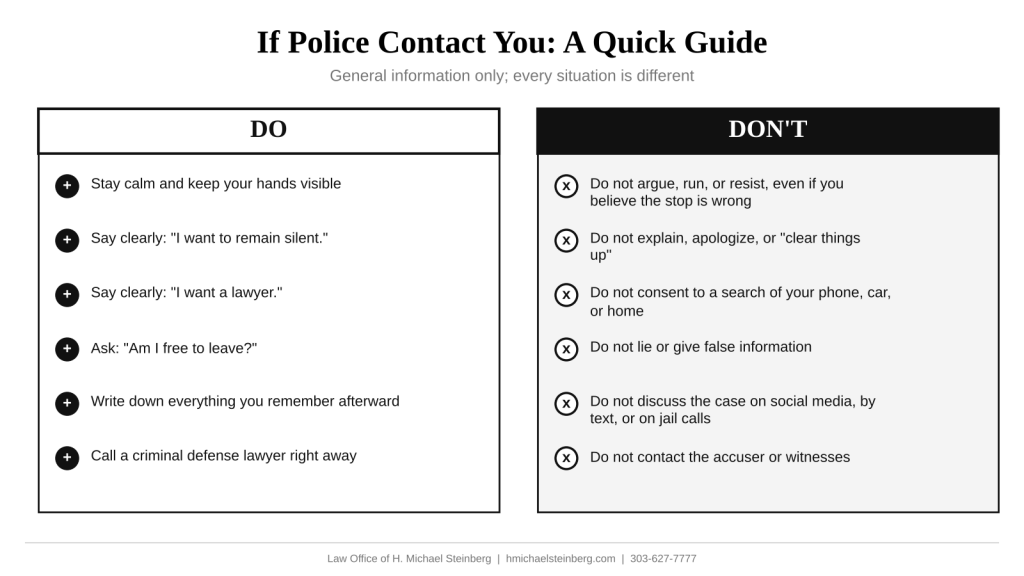
This general guide is not a substitute for advice about your own situation, but these basics apply in most encounters.
Invoke your rights clearly and calmly, and then stop talking. Do not physically resist, even if you believe the stop or arrest is unlawful; the time to challenge it is later, in court, through your lawyer.
A defense lawyer who focuses on criminal law can represent you across the full range of charges. Our firm’s practice areas include:
| Type of case | Examples | Learn more |
|---|---|---|
| DUI, DWAI, and DUID | Alcohol or drug driving charges and DMV hearings | DUI defense |
| Domestic violence | Mandatory arrest, protection orders, harassment, assault | Domestic violence defense |
| Drug crimes | Possession, distribution, manufacturing, K-9 and vehicle searches | Drug crimes defense |
| Sex crimes | Sexual assault, unlawful sexual contact, internet and image offenses | Sex crimes defense |
| Assault and battery | Third-degree assault through serious felony assault | Assault defense |
| Theft and property crimes | Shoplifting, theft, fraud, burglary, criminal mischief | Theft defense and property crimes |
| Weapons offenses | Possession by prohibited persons, carrying and transport issues | Colorado gun laws guide |
| Probation violations | Technical violations and new-offense allegations | Probation violation defense |
People who cannot afford a lawyer are entitled to appointed counsel in qualifying cases. In Colorado, the Office of the State Public Defender provides representation to eligible people accused of crimes, and its contact page explains how to apply. The office was created by C.R.S. § 21-1-101 to provide services to indigent people accused of crime that are commensurate with those available to people who can pay.
If you can retain counsel, hiring a private criminal defense lawyer lets you choose the attorney, discuss how much attention your case will receive, and decide who speaks for you at the earliest stages. Either way, the important point is to have a lawyer. Do not go through a criminal case alone.
The Law Office of H. Michael Steinberg focuses exclusively on Colorado criminal defense. H. Michael Steinberg has more than 42 years of Colorado criminal law experience on both sides of the courtroom, including 13 years as a career prosecutor in Arapahoe and Douglas Counties before opening his own firm in 1999. That background helps him anticipate how prosecutors evaluate a case and how to resolve it.
Past results do not guarantee a similar outcome in your case. Every case depends on its own facts.
What does a criminal defense lawyer do in Colorado?
A Colorado criminal defense lawyer explains the charges and penalties, protects your constitutional rights, handles bond and protection orders, investigates the evidence, demands discovery, files motions, negotiates with prosecutors, tries the case if needed, and advocates at sentencing and on appeal.When should I hire a criminal defense lawyer in Colorado?
As early as possible. Ideally contact a lawyer before you speak with police, and immediately after an arrest, a summons, a warrant, a search, a DUI stop, a domestic violence call, a probation violation filing, or a plea offer.Should I talk to the police before I call a lawyer?
Generally, no. You are not required to give a voluntary interview, and statements cannot be taken back. Politely say that you want to remain silent and want a lawyer, then call one. Read more in Why Innocent People Sometimes Hurt Their Cases by Talking to Colorado Police.Can a lawyer help if I have not been charged yet?
Yes. Many cases are shaped before charges are filed. A lawyer can communicate with investigators, learn whether you are a witness or a target, and, where appropriate, present information to the prosecutor before a charging decision.How long do I have to request a DMV hearing after a DUI arrest in Colorado?
Generally seven days after you receive the notice of revocation. See C.R.S. § 42-2-126 and the Colorado Department of Revenue’s express consent page. The DMV case is separate from the criminal case.What is the difference between a felony and a misdemeanor in Colorado?
Felonies are the more serious crimes and carry potential prison sentences, classified from class 1 through class 6 under C.R.S. § 18-1.3-401. Misdemeanors carry jail time and fines under C.R.S. § 18-1.3-501. Both can carry lasting consequences.How much does a Colorado criminal defense lawyer cost?
Fees depend on the charge, the court, the complexity of the evidence, and whether trial is likely. Ask for a written fee agreement and a clear explanation of what it covers. This firm offers a free consultation.Will a defense lawyer get my case dismissed?
No lawyer can promise a result. A lawyer can evaluate the evidence, challenge what is unlawful or unreliable, and pursue the best available outcome, which may be a dismissal, a reduction, diversion, an acquittal at trial, or a favorable sentence.
If you have been arrested, contacted by police, or charged with a crime, do not wait. Call for a free consultation and learn your options before you make a decision you cannot undo.
Main: 303-627-7777 | Cell: 720-220-2277 | Free consultation form
About the author. H. Michael Steinberg is a Denver criminal defense attorney with more than 42 years of experience in Colorado criminal law, including 13 years as a career prosecutor in Arapahoe and Douglas Counties. He is the founder of the Law Office of H. Michael Steinberg and publishes the Colorado Criminal Lawyer Blog.
This article is general information about Colorado criminal law and is not legal advice. Reading it does not create an attorney-client relationship. Laws and court rules change, and every case turns on its own facts, so speak with a licensed Colorado attorney about your situation. Please do not send confidential information through a contact form, text message, or voicemail. See the firm’s full disclaimer.