A Lawyer With a 42+ Year Proven Track Record
Exclusively Practicing Only Colorado Criminal
Law - Defending Your Future
Exclusively Practicing Only Colorado Criminal
Law - Defending Your Future











COLORADO CRIMINAL LAWYER BLOG • DOMESTIC VIOLENCE / PROTECTION ORDERS
What a Colorado court can order, what it cannot, and how to challenge an order that goes too far
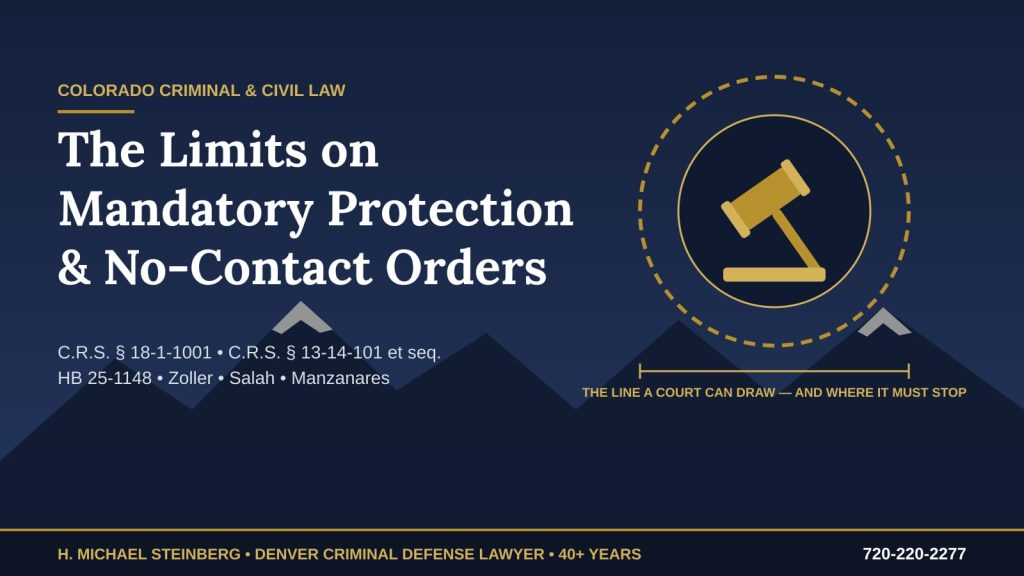
By H. Michael Steinberg, Denver Criminal Defense Lawyer | November 18, 2026
Every week in Denver courtrooms, people walk out of a first appearance carrying a piece of paper that changes their lives. It tells them they cannot go home. It tells them they cannot speak to their spouse, sometimes not even to their own children. It tells them to surrender their firearms within days. Most of them assume the order is absolute — that a judge can write anything into it, for as long as the judge likes.
That assumption is wrong. In more than forty years of defending Coloradans charged with domestic violence and other crimes, I have seen protection orders used appropriately, and I have seen them stretched far beyond what the law allows. Colorado’s protection order statutes are powerful, but they have edges — statutory limits written by the General Assembly and constitutional limits enforced by our appellate courts. This article maps those edges for both the criminal mandatory protection order (MPO) and the civil protection order.
KEY TAKEAWAYS
Colorado law expressly creates two tracks. The legislative declaration in C.R.S. § 13-14-100.2 calls for “a simplified civil process and a mandatory criminal process.” They overlap, they are frequently in force at the same time against the same person, and both are enforced through the same crime — violation of a protection order, C.R.S. § 18-6-803.5. But they are created differently, they last for different periods, and they are changed by different procedures.
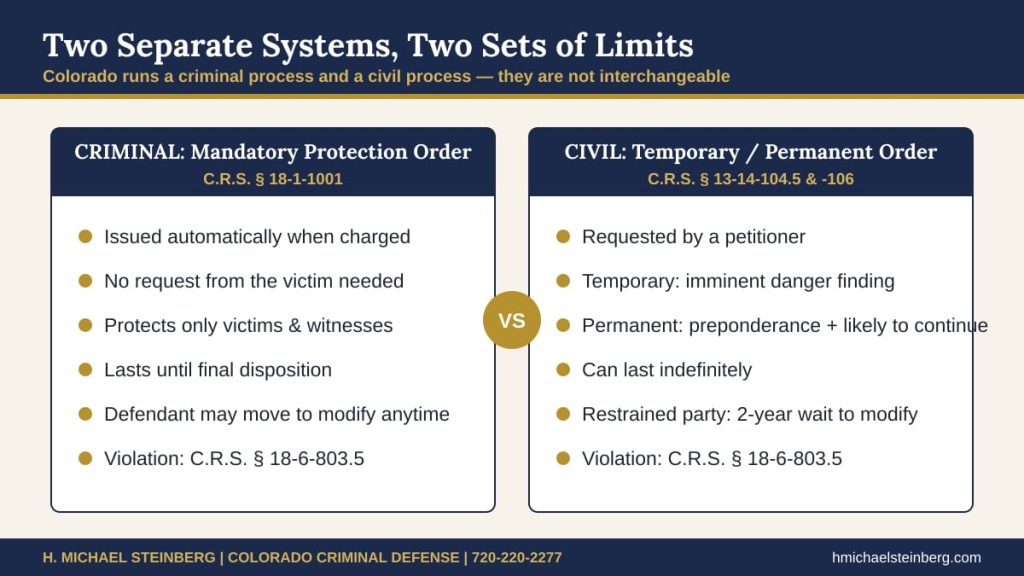
| Feature | Criminal MPO (§ 18-1-1001) | Civil Order (§§ 13-14-104.5, -106) |
|---|---|---|
| How it starts | Automatically when a person is charged and advised at first appearance | A petitioner files a verified complaint |
| Who is protected | Victims and witnesses only | The petitioner (and others named, such as children) |
| Standard of proof | None — it attaches by operation of law | Temporary: imminent danger. Permanent: preponderance + likely to continue |
| How long it lasts | Until final disposition (sentence completion) | Temporary until hearing; permanent may be indefinite |
| Who may seek modification | Defendant, at any time; prosecutor on victim’s behalf | Protected party any time; restrained party after 2 years |
Under C.R.S. § 18-1-1001(1), a mandatory protection order is created against any person charged with a Title 18 offense. It takes effect when the defendant is advised of rights at arraignment or first appearance. No one has to ask for it, and no evidence has to be presented. The baseline order prohibits the defendant from harassing, molesting, intimidating, retaliating against, or tampering with any witness or victim. In most cases the court then adds a full no-contact provision and often an order to stay away from the shared home. The order is entered on the standardized JDF 440 form.
The MPO is tied to the life of the criminal case. It remains in effect until final disposition — and § 18-1-1001(8)(b) defines that point, for a defendant who is sentenced, as the completion of the sentence. In People v. Zoller, the Court of Appeals noted that for a defendant sentenced to prison, final disposition arrives only on discharge from parole supervision. If the charges are dismissed or the defendant is acquitted, the case is over and the order ends with it.
A critical warning: do not decide for yourself that an order has expired. In People v. Delfeld, 2021 COA, the defendant argued his MPO should have been void because his underlying sentence was illegal. The Court of Appeals disagreed. Until a court actually vacates the conviction, enters a new sentence, or modifies or dismisses the order, the MPO stays in force — and the defendant’s new conviction for violating it stood.
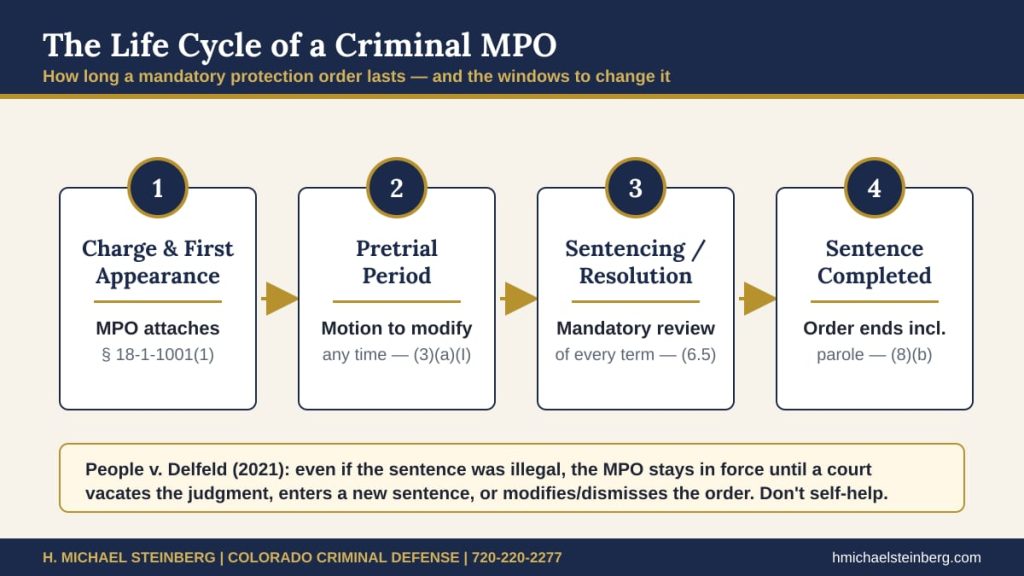
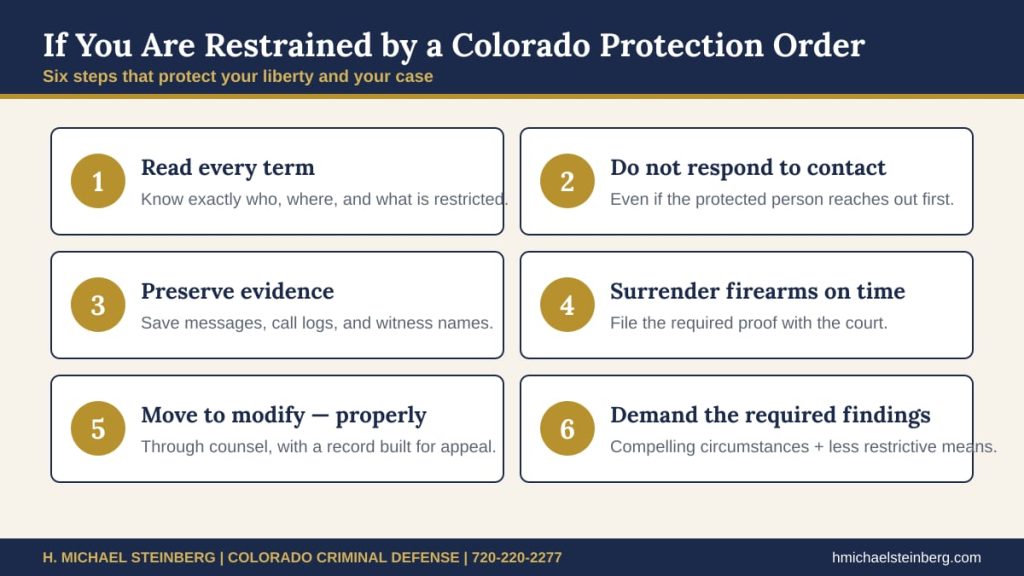
The court retains jurisdiction to enforce, modify, or dismiss the order until final disposition, and the defendant may move to modify or dismiss at any time — § 18-1-1001(3)(a)(I). In domestic violence, stalking, and unlawful sexual behavior cases, the prosecutor may also request a hearing to modify the order, typically at the protected person’s request, with notice to the victim. Practically, that means a defense lawyer can — and often should — ask early to allow limited contact for shared parenting, the retrieval of belongings, or communication through counsel.
In 2025 the General Assembly passed HB 25-1148 (Session Law, Chapter 154), which took effect July 1, 2025, and applies to protection orders issued for offenses committed on or after that date. For the first time, the statute itself says what an MPO is not allowed to do. The changes are among the most significant limits on criminal protection orders in a generation.
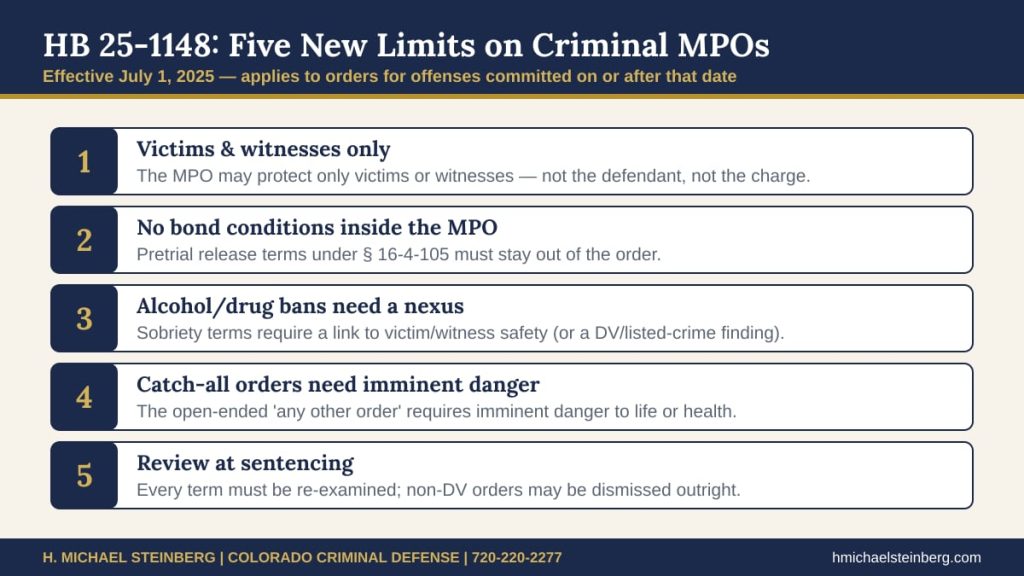
PRACTICE NOTE: THE OTHER SIDE OF HB 25-1148
The same bill tightened enforcement. A sentence for violating a protection order in a domestic violence or listed-crime case must run consecutively to the sentence for the underlying crime, and violating an order’s alcohol or drug prohibition is now expressly a violation under § 18-6-803.5. At the same time, officers were given discretion — rather than a mandatory-arrest duty — for certain lower-level violations in non-domestic cases.
The most important judicial limit on no-contact orders comes from the Due Process Clause. A parent’s right to the care and companionship of his or her child is a fundamental right. When a protection order cuts a parent off from a child, the order must survive heightened scrutiny — and Colorado’s appellate courts have been increasingly explicit about what that requires.
“A no-contact order that separates a parent from a child is not a routine form to be checked. It is an infringement on one of the oldest fundamental rights we recognize, and the court must justify it on the record.”
— H. Michael Steinberg
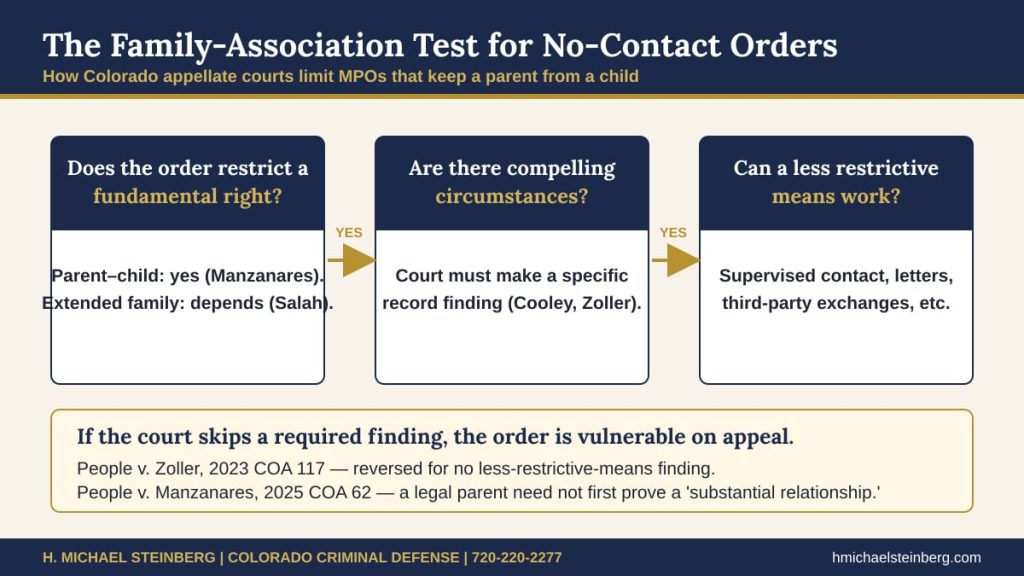
Less restrictive alternatives are often available: supervised parenting time, contact limited to letters or a parenting app, exchanges through a third party, or an exception for court-ordered family therapy. When a motion to modify is litigated well, the record will show the court exactly which alternatives were proposed and why — or whether — each was rejected.
A protection order restrains conduct directed at a protected person. It is not a general license to punish speech about that person. The Colorado Supreme Court in People v. Moreno, 2022 CO 15, struck down a portion of the harassment statute as substantially overbroad, and the U.S. Supreme Court in Counterman v. Colorado, 600 U.S. 66 (2023), required proof of at least recklessness before speech can be punished as a true threat. Those cases do not invalidate no-contact orders, but they inform how broadly an order — and a charged violation — can be read.
Courts generally interpret protection orders as limits on contact, not on public expression.
In July 2026, the Tenth Circuit in Drexler v. Weiser rejected a long-running federal challenge to Colorado’s civil protection order scheme in part because the order at issue, by its own terms, did not restrict the restrained person’s First Amendment activity.
When a prosecution rests on a social media post or a public statement rather than a communication directed to the protected person, the scope of the order’s language — and the First Amendment — become central defense questions.
Civil protection orders are requested by a petitioner — a spouse, partner, neighbor, coworker, or anyone else who claims to need protection. They do not require a criminal charge, and a petitioner may seek one even when an MPO is already in place.
Under C.R.S. § 13-14-104.5, a temporary civil protection order may be issued only if the judge or magistrate finds that an imminent danger exists to the person seeking protection. A temporary order is typically issued ex parte — without the respondent present — so the law requires that it be personally served and that the respondent be ordered to appear and show cause why it should not be made permanent.
At the permanent order hearing under C.R.S. § 13-14-106, the court must find by a preponderance of the evidence that the respondent committed acts constituting grounds for the order and that, unless restrained, the respondent will continue to commit those acts or acts designed to intimidate or retaliate. Imminent danger is not required at this stage — but the forward-looking finding is. A single, isolated incident with no realistic likelihood of recurrence is a legitimate defense theme.
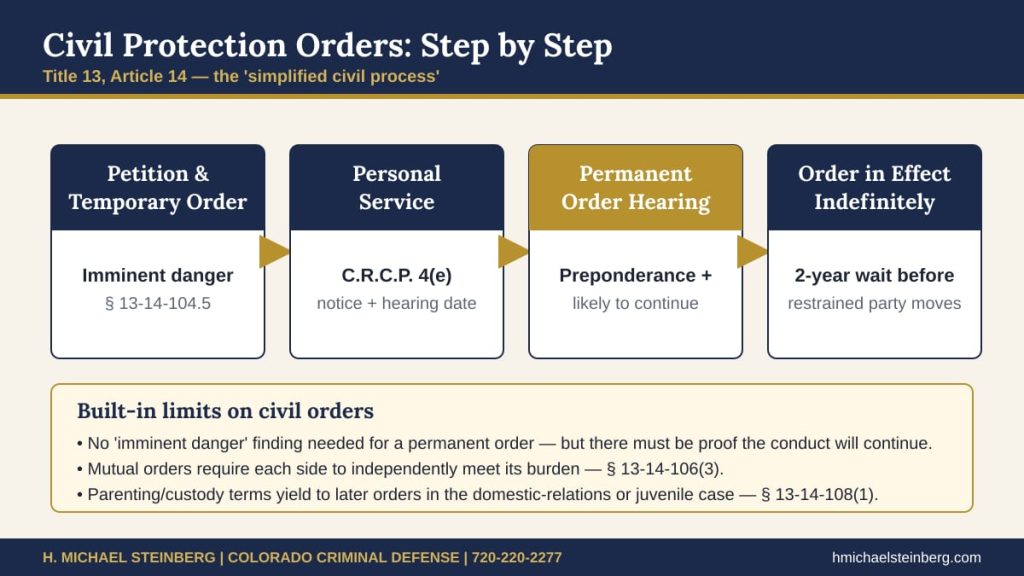
Other limits written into the civil statutes are frequently overlooked:
A permanent civil order can last indefinitely, but it is not necessarily permanent in the ordinary sense of the word. C.R.S. § 13-14-108 sets the rules, using the court’s JDF 397 motion form:
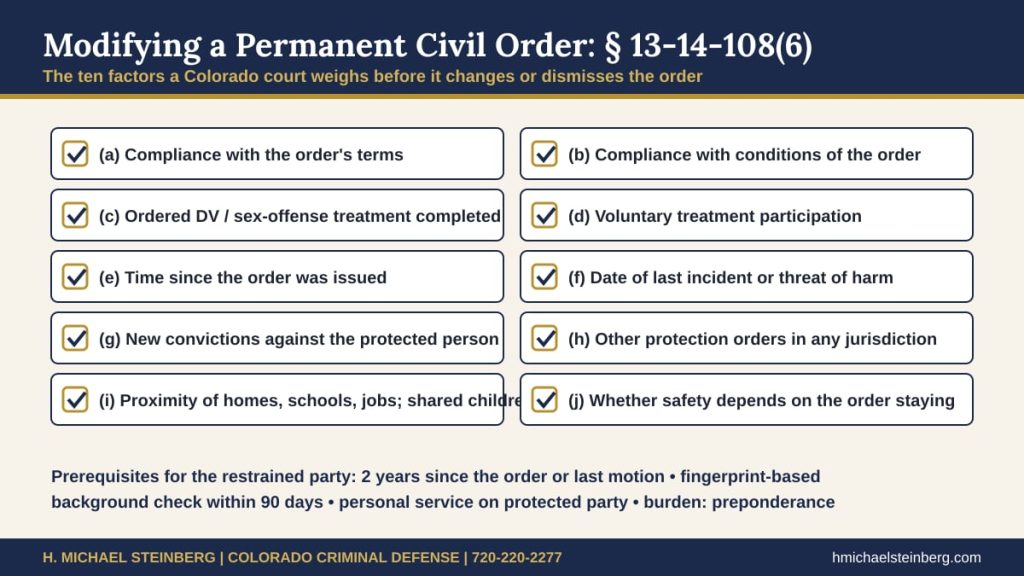
A well-prepared motion addresses every one of the ten statutory factors with documentation: proof of compliance, completed treatment, the time elapsed, the absence of any new incidents, and changed living and working circumstances. Judges see many of these motions filed without evidence. The ones that succeed look like a trial notebook.
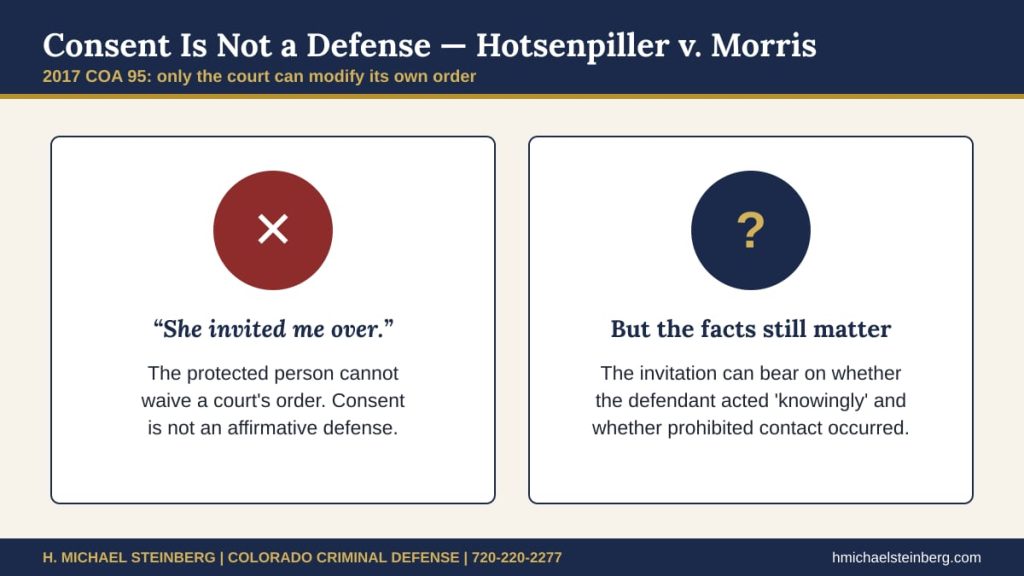
One of the most common — and most dangerous — misunderstandings is that if the protected person invites contact, there is no violation. In Hotsenpiller v. Morris, 2017 COA 95, the Court of Appeals rejected that argument. A protection order is an order of the court, not of the protected person, and only the court can modify it. The protected person’s assent is not an affirmative defense.
That said, the facts surrounding an invitation are not irrelevant. The court in Hotsenpiller recognized that the protected person’s conduct may bear on whether the defendant acted knowingly — a required element under § 18-6-803.5 — or on whether prohibited contact occurred at all. The lesson for anyone under an order is simple: if contact needs to happen, get the order modified first.
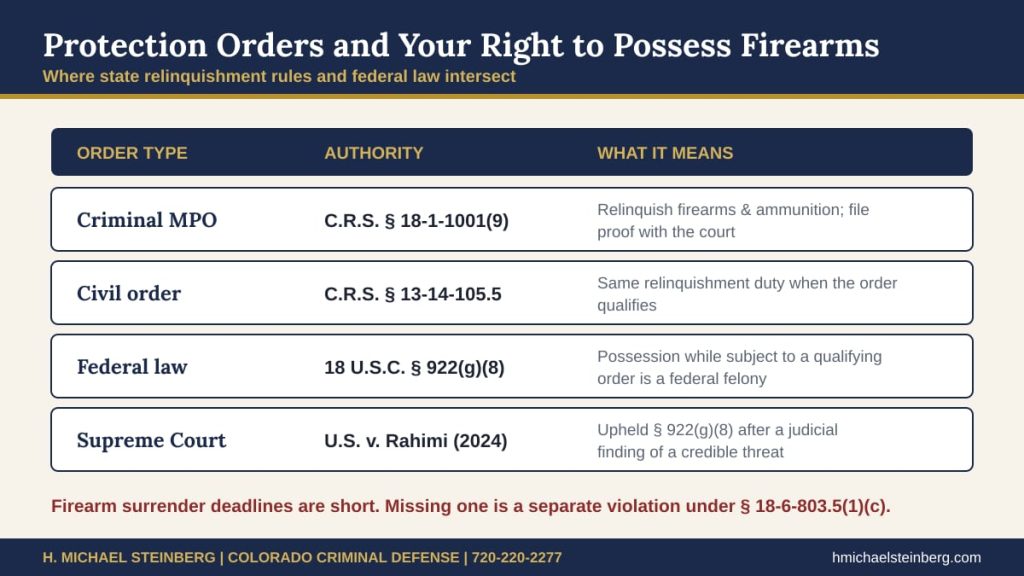
When a criminal MPO qualifies as an order described in federal law, § 18-1-1001(9) requires the court to order the defendant to relinquish firearms and ammunition and to file proof of relinquishment. Civil orders carry parallel duties under C.R.S. § 13-14-105.5. Federal law, 18 U.S.C. § 922(g)(8), separately makes it a felony to possess a firearm while subject to a qualifying order — and in United States v. Rahimi, 602 U.S. 680 (2024), the U.S. Supreme Court upheld that prohibition as applied to a person a court has found to pose a credible threat. For a broader overview, see my guide to Colorado gun laws.
A person commits the crime of violation of a protection order when, after being personally served or otherwise acquiring actual knowledge of the order, he or she knowingly contacts or approaches a protected person, enters an excluded area, possesses a firearm in violation of the order, or violates another listed term.
Violating a criminal MPO is generally charged as a class 1 misdemeanor; violating a civil order is generally a class 2 misdemeanor on a first offense, with enhancement for prior convictions. A violation also routinely triggers bond revocation, new charges, and in domestic violence cases a sentence that must run consecutively. If the violation occurs while on supervision, it can also become a probation violation.
The defenses are real: lack of service or actual knowledge, ambiguity in the order’s terms, contact that falls outside the order’s scope, accidental or incidental encounters, and fabricated or exaggerated allegations made for leverage in a divorce or custody dispute. Each turns on careful, early investigation.
No. A criminal MPO is an order of the court, not of the alleged victim. The protected person can ask the prosecutor to request a modification hearing, and the defendant can move to modify at any time, but only a judge can change or dismiss it.
Until final disposition of the criminal case. If the case is dismissed or ends in acquittal, the order ends. If the defendant is sentenced, it generally lasts until the sentence — including any parole — is completed, unless the court modifies or dismisses it sooner.
It can, but when it does, Colorado appellate courts require the judge to find compelling circumstances and that no less restrictive means — such as supervised contact — would protect the child. People v. Zoller (2023) and People v. Manzanares (2025) set out that requirement.
A restrained party generally must wait two years after the permanent order or after the last motion to modify or dismiss, must obtain a fingerprint-based background check within 90 days of filing, and must prove by a preponderance of the evidence that modification or dismissal is appropriate under the ten statutory factors.
Yes, it can be. Hotsenpiller v. Morris (2017) held that the protected person’s consent is not a defense. Only the court can modify its order, so get the order changed before any contact occurs.
TALK TO A COLORADO PROTECTION ORDER DEFENSE LAWYER
If you are restrained by a mandatory protection order or a civil protection order — or charged with violating one — the limits described in this article may be the difference between losing contact with your family for years and getting your life back. H. Michael Steinberg has defended people in Denver and throughout the metro area for more than forty years, including in domestic violence, assault, and sex crime cases where protection orders are central. Review representative case results, read more on the Colorado Criminal Lawyer Blog, or contact the firm today.
Disclaimer: This article is for general informational purposes only and is not legal advice. Reading it does not create an attorney-client relationship. Statutes and case law change; consult a licensed Colorado attorney about your specific situation. Law Office of H. Michael Steinberg, Denver, Colorado.