A Lawyer With a 42+ Year Proven Track Record
Exclusively Practicing Only Colorado Criminal
Law - Defending Your Future
Exclusively Practicing Only Colorado Criminal
Law - Defending Your Future






COLORADO DRUG CRIMES | HB26-1020
What Colorado’s new colorimetric field-test law means when a color-changing pouch is the only “proof” that you had fentanyl, cocaine, or methamphetamine
By H. Michael Steinberg, Colorado Criminal Defense Lawyer | Law Office of H. Michael Steinberg, Denver
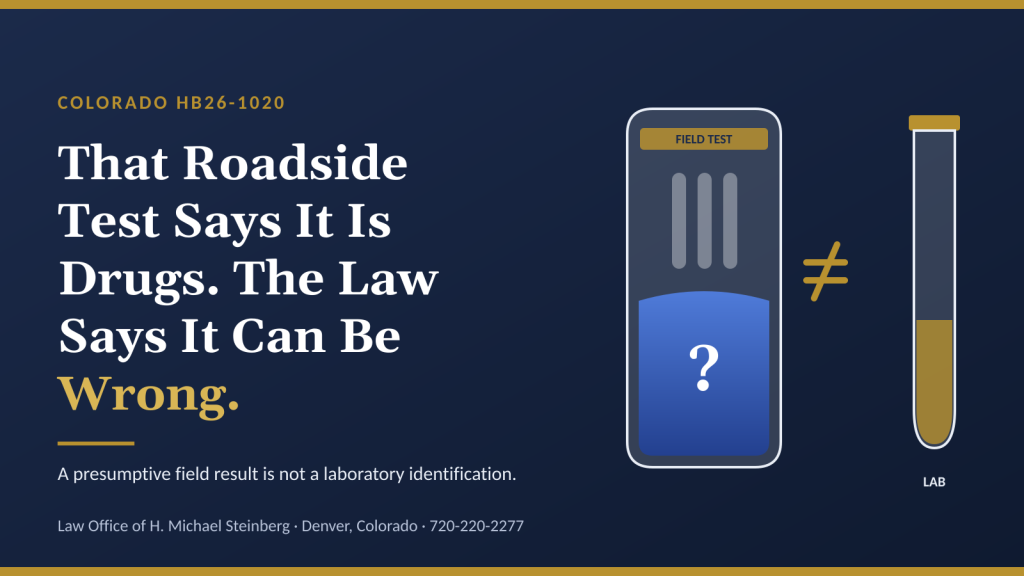
It usually happens fast. A traffic stop or a street contact turns into a search. The officer finds a small baggie, a bit of powder, a pill, or residue in a pipe. He drops a sample into a plastic pouch, breaks the glass ampoules inside, and shakes it. The liquid turns blue, or purple, or orange. “That’s cocaine,” he says. Or meth. Or fentanyl.
For most people, that color change feels like the end of the argument. It looks scientific. It came from a test. And the officer said it out loud with total confidence.
Here is what the person in that moment needs to hear: in Colorado, the law now formally recognizes that the roadside test can be wrong. In 2026, Colorado became the first state in the nation to limit arrests that rest solely on these tests and to require judges to warn defendants about them before accepting a plea. In more than forty years of defending drug cases in Colorado, I have watched people plead guilty to “drugs” that no laboratory ever confirmed.
This law is aimed squarely at that problem.
Colorado now defines the term in the drug code itself. Under C.R.S. § 18-18-102(4.5), a “colorimetric field drug test” is a presumptive chemical screening method performed outside a forensic laboratory, by someone other than a forensic chemist, using one or more reagents that produce a color change suggesting the possible presence of a controlled substance.
Every part of that definition matters for your defense:
These kits are popular because they are cheap and instant. Reporting on the new law notes that each test typically costs under $10. The trade-off is reliability. Reagents react to chemical families, not to a single drug, so ordinary substances can trigger the same color. Published reports over the years describe false positives on items such as sugar, soap, vitamins, over-the-counter medications, donut glaze, cotton candy, and even bird droppings.
Nobody knows the exact number, and that uncertainty is part of the problem.
Research cited during the Colorado debate, including work from the University of Pennsylvania, has estimated error rates for these tests in roughly the 15% to 38% range in some settings, and has estimated that tens of thousands of Americans may be wrongly arrested each year based on faulty field results. One of the bill’s sponsors estimated that about 300 Coloradans a year are wrongly arrested on drug charges in jurisdictions that still rely on the kits. Some Colorado agencies, including Denver, Centennial, and Castle Pines, had already moved away from them.
Why do so many errors go unnoticed? Because most drug-possession cases end in a plea, and the substance is often never sent to a lab unless the case heads toward trial. A working group created by the legislature in 2025 surveyed Colorado prosecutors and found that lab confirmation typically happens only when a case is going to trial—which can take a long time.
Without lab testing, a false positive is invisible. The person pleads, the case closes, and no one ever learns the “cocaine” was something else.
House Bill 26-1020 passed both chambers unanimously and was signed by Governor Polis on March 26, 2026 (Session Laws 2026, ch. 12). It applies to offenses committed on or after its effective date.
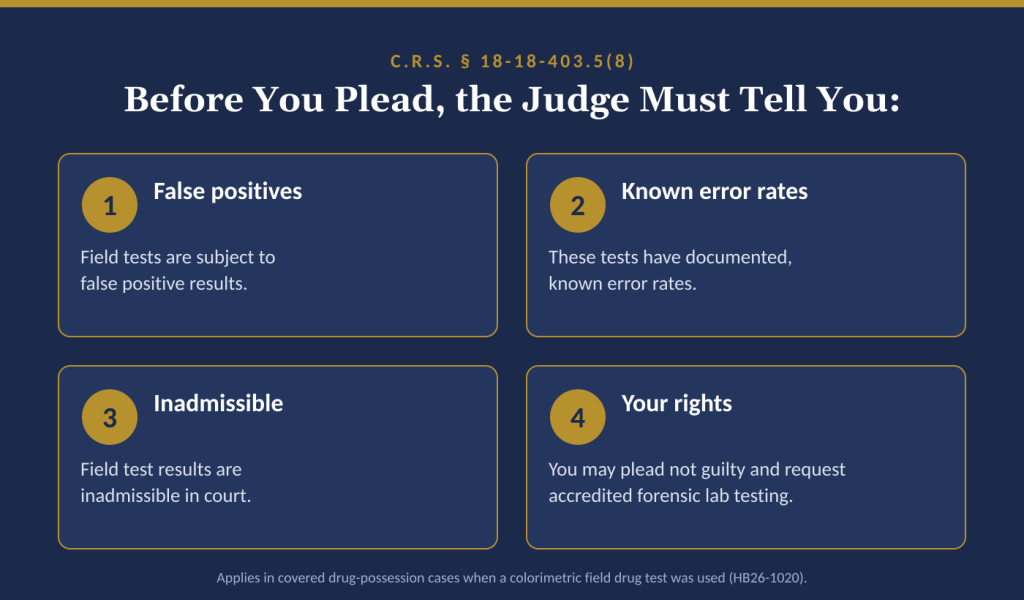
The first major change is in a new subsection of the possession statute, C.R.S. § 18-18-403.5(7). When a colorimetric field drug test was used, a peace officer shall not arrest a person when the sole basis for the arrest is:
Instead, the officer must issue a summons and complaint. The legislature reinforced this in three procedural statutes: the summons statute, C.R.S. § 16-2-104; the release-by-arresting-authority statute, C.R.S. § 16-3-105; and the summons-instead-of-warrant statute, C.R.S. § 16-5-206. In other words, in a covered case, the officer cannot take you to jail and cannot seek an arrest warrant based on that field test alone.
C.R.S. § 18-18-102(4.5) — defines “colorimetric field drug test.”
C.R.S. § 18-18-403.5(7) — no arrest when the sole basis is covered level 1 drug misdemeanor or municipal possession and a field test was used; summons required.
C.R.S. § 18-18-403.5(8) — mandatory court advisement before accepting a plea.
C.R.S. §§ 16-2-104, 16-3-105, 16-5-206 — summons, release, and no-warrant provisions.
HB26-1020, signed March 26, 2026; applies to offenses committed on or after the effective date.
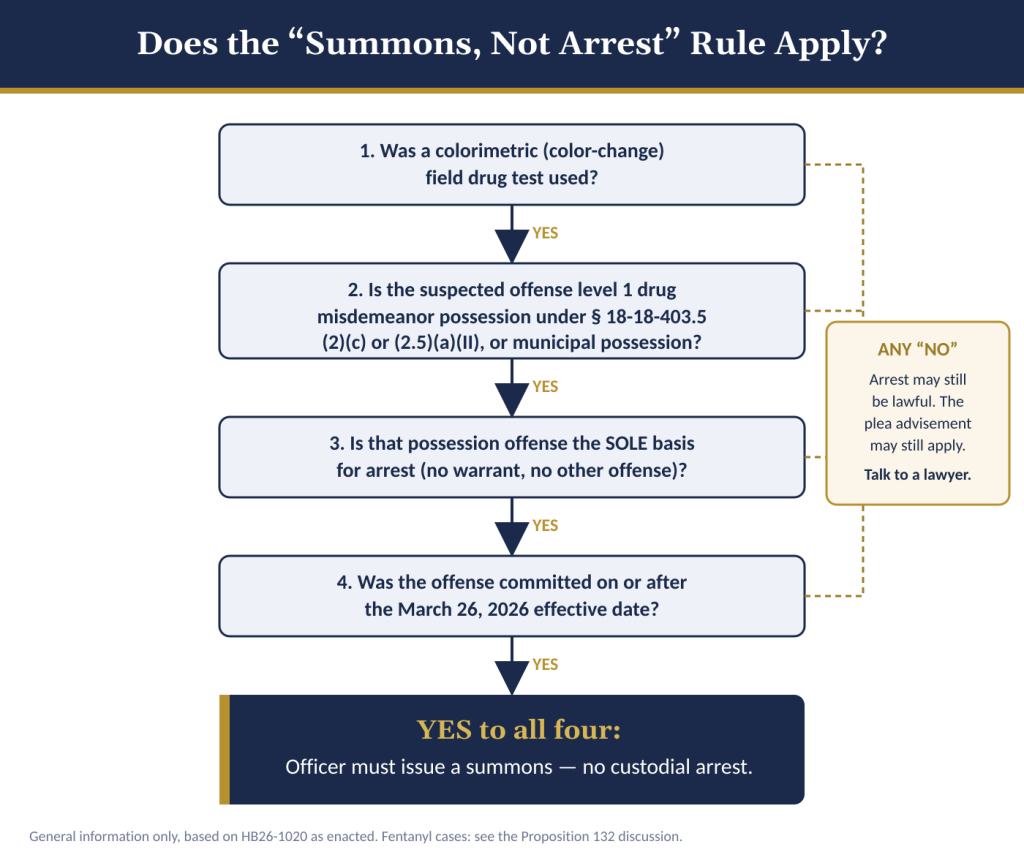
The second change may matter even more. Under new C.R.S. § 18-18-403.5(8), when a colorimetric field drug test was used, the trial judge must give a specific advisement before accepting a plea from a person charged with drug possession under the state statute (the legislature’s summary describes this as level 4 drug felony possession and lower) or with municipal drug possession. The required advisement begins: “The court cannot accept a plea without first advising the defendant…” and then tells the defendant that:
Think about what it means for a judge to say that out loud, on the record, to the person standing in front of the bench. The court itself is telling you that the evidence the officer relied on is unreliable, that it cannot be used to prove your case at trial, and that you are entitled to insist on real testing first. That advisement reaches further than the summons rule: it applies to felony-level possession up through level 4, not just misdemeanors.
The core message of this law is that two very different things are often treated as if they were the same:
| Roadside Colorimetric Test | Accredited Forensic Laboratory | |
|---|---|---|
| Who performs it | Usually a patrol officer | A trained forensic chemist |
| Where | Roadside, street, or station | Controlled laboratory environment |
| What it shows | A color change “suggesting” a possible drug class | Identification of a specific controlled substance |
| Weight | Often estimated, sometimes including packaging | Measured on calibrated equipment |
| Quality control | Limited or none | Accreditation standards, documented procedures |
| Admissible to prove the drug at trial? | No—and the court must say so before a plea in covered cases | Generally the evidence the prosecution relies on |
If you have read my discussion of breath testing versus blood testing in DUI cases, the logic will feel familiar. A screening tool and a confirmatory test serve different purposes. The defense starts by refusing to let the prosecution blur that line.
Clients deserve straight answers, and the honest answer is that HB26-1020 is important but narrow. It does not:
That last point is worth emphasizing. Many drug cases are won or lost on how the police got to the substance in the first place. If the stop or search was unlawful, the substance—and the field test—may never come into evidence. See my discussion of when Colorado police can detain and search you and the firm’s collection of search and seizure articles.
Fentanyl is where clients are most frightened—and where the law is changing fastest. Under the possession statute as it stood when HB26-1020 passed, possession of not more than one gram of a fentanyl compound is a level 1 drug misdemeanor, which is why fentanyl cases at that weight fall within the summons rule.
In November 2026, Colorado voters approved Proposition 132, which makes possession of any amount of fentanyl a felony, with a treatment-based path back to a misdemeanor for some under-one-gram cases. An initiated statute takes effect when the Governor proclaims the official vote. Once Proposition 132 is in force, small-quantity fentanyl possession will no longer be a level 1 drug misdemeanor for new offenses, so the summons-instead-of-arrest protection may no longer reach those cases. How the plea advisement interacts with the reorganized fentanyl penalties is an open question that courts will have to work out.
What does not change is the science. A field kit that “says” fentanyl is still a presumptive screen. Higher stakes make lab confirmation more important, not less.
When a field test is the backbone of the prosecution’s case, an experienced defense lawyer will typically:
Drug charges also often intersect with treatment needs and personal circumstances. Those issues can shape the right resolution of a case; see the impact of substance-abuse issues in Colorado criminal cases.
No. A colorimetric field test is a presumptive screen. In covered possession cases, Colorado judges must now advise defendants that these results are inadmissible in court and subject to false positives. To prove what a substance is, the prosecution generally needs laboratory identification.
If the only basis for arrest is level 1 drug misdemeanor possession or municipal drug possession and a colorimetric field test was used, the officer must issue a summons instead. If there is another basis for arrest—such as a warrant, a separate offense, or a felony-weight quantity—an arrest may still be lawful.
Before accepting a plea in a covered drug-possession case where a field test was used, the judge must tell the defendant that the tests are subject to false positives, have known error rates, and are inadmissible in court, and that the defendant may plead not guilty and request testing by an accredited forensic laboratory.
The act applies to offenses committed on or after its March 2026 effective date. If your case or conviction is older and rested on a field test alone, a lawyer can review whether other remedies may be available.
Under the statute as it stood when the law passed, possession of one gram or less of a fentanyl compound was a level 1 drug misdemeanor covered by the summons rule. Proposition 132, approved in November 2026, makes possession of any amount of fentanyl a felony once it takes effect, which may remove new small-quantity fentanyl cases from the summons rule. Lab confirmation remains essential either way.
A color change in a plastic pouch should never be the reason someone accepts a criminal conviction. Colorado’s legislature has now said so in plain terms. If you or someone you love was charged after a roadside drug test anywhere in the Denver metro area—including cases at the Lindsey-Flanigan Courthouse and in the surrounding counties—I can review the evidence, insist on proper laboratory testing, and fight the case on every available front.
H. Michael Steinberg has practiced criminal law in Colorado for over forty years. Call 720-220-2277 or contact the Law Office of H. Michael Steinberg for a confidential consultation.
Disclaimer: This article is for general informational purposes only and is not legal advice. Reading it does not create an attorney-client relationship. Colorado law changes, and the application of HB26-1020 and Proposition 132 to any particular case depends on its specific facts and on how Colorado courts interpret these provisions. Consult a qualified Colorado criminal defense attorney about your situation.