A Lawyer With a 42+ Year Proven Track Record
Exclusively Practicing Only Colorado Criminal
Law - Defending Your Future
Exclusively Practicing Only Colorado Criminal
Law - Defending Your Future





Law Office of H. Michael Steinberg
Colorado Criminal Defense | Denver, Colorado | 720-220-2277
COLORADO DRUG CRIMES DEFENSE
By H. Michael Steinberg, Colorado Criminal Defense Lawyer | November 14, 2026
The Short Answer
Simple possession under C.R.S. § 18-18-403.5 punishes knowingly having a controlled substance. Possession with intent to distribute under C.R.S. § 18-18-405 punishes having that same substance with the purpose of selling it or passing it to someone else. The drug can be identical. The weight can be identical. The difference is what the prosecution can prove was in the person’s mind, and that difference is often the gap between a misdemeanor and years in prison.
In more than forty years of defending drug cases in Denver and across Colorado, I have watched the same scene play out again and again. A person is stopped, a small quantity of drugs is found, and what should have been a possession case is filed as a distribution felony because of a scale, a few baggies, or a text message read in the worst possible light.
If you or someone you care about is facing a drug charge, understanding exactly where Colorado law draws this line is the first step in fighting it.
Colorado splits these offenses into separate statutes. Section 18-18-403.5 makes it unlawful to knowingly possess a controlled substance. Section 18-18-405 makes it unlawful to knowingly manufacture, dispense, sell, or distribute a controlled substance, or to possess one with intent to do any of those things.
Notice what the second statute does. It treats a person who merely intends to distribute exactly like a person who actually completed a sale. No hand-to-hand transaction is required. No buyer needs to exist. If the prosecution can convince a jury of intent, the penalties for an actual drug deal apply.
Possession with intent to distribute is punished the same as an actual sale. No buyer, no money, and no transaction are required.
Both crimes begin with possession, and possession is more complicated than having something in your pocket. Colorado recognizes actual possession (on your person) and constructive possession (in a place you control, such as a car, a bedroom, or a backpack).
In People v. Poe, 2012 COA 166, the Colorado Court of Appeals explained that a person possesses a drug when he knows it is there, it is immediately accessible, and he exercises dominion and control over it. The court also repeated a rule that matters in every shared car and shared apartment case: mere presence near drugs, without some additional link, will not sustain a conviction.
Knowledge is the heart of it. In Richardson v. People, 25 P.3d 54 (Colo. 2001), the Colorado Supreme Court held that when the amount is less than a usable quantity, the prosecution must produce evidence beyond the mere fact of possession to prove the person knew what he had.
Here is what surprises most people: Colorado has no minimum quantity for a distribution charge. There is no statutory weight below which a case is automatically “personal use.” Weight determines the level of the offense, not whether intent exists.
It also does not take a sale. Under C.R.S. § 18-18-102(11), to “distribute” means to deliver a controlled substance “with or without remuneration.” Handing drugs to a friend for free is distribution under Colorado law.
Because almost no one announces an intent to sell, prosecutors build these cases on circumstantial evidence. The possession statute itself invites this. Subsection (5) of § 18-18-403.5 says a person may be charged with distribution or possession with intent “if supported by the evidence,” and that the amount possessed may be part of that evidence.
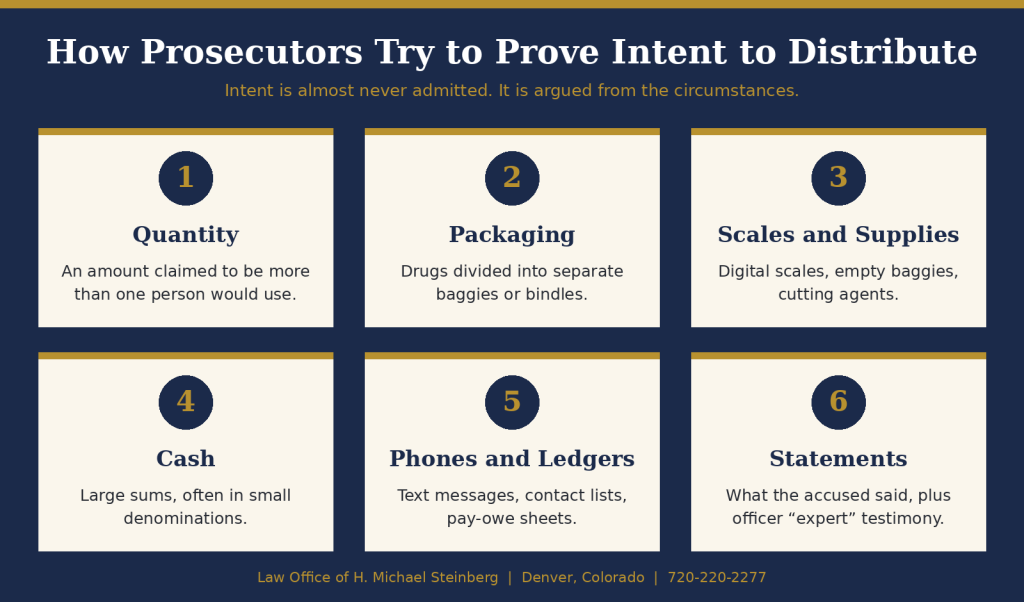
The usual list looks like this:
Colorado appellate courts have upheld convictions on thin versions of this evidence. In People v. Atencio, 140 P.3d 73 (Colo. App. 2005), roughly 109 grams of methamphetamine and cocaine divided among four baggies was enough to prove intent, and a narcotics sergeant was allowed to testify about how much a typical user consumes. In People v. Douglas, 2015 COA 155, the quantity of marijuana, the sophistication of the grow, and the presence of cash and guns supported the inference.
Every item on the prosecution’s list has an innocent explanation. Heavy users buy in bulk because it is cheaper and safer than repeated purchases. Drugs are often bought in multiple baggies, which says something about the seller and nothing about the buyer. Users own scales so they are not cheated. Cash is legal to carry. A skilled defense forces the jury to see that evidence “consistent with” dealing is just as consistent with using.
Since 2020, simple possession of four grams or less of most schedule I and II drugs has been a level 1 drug misdemeanor. Under C.R.S. § 18-1.3-501, that carries up to 180 days in county jail or up to two years of probation, and a fine of up to $1,000. Add intent to distribute, and that same four grams becomes a level 3 drug felony with a presumptive range of two to four years in prison under C.R.S. § 18-1.3-401.5.
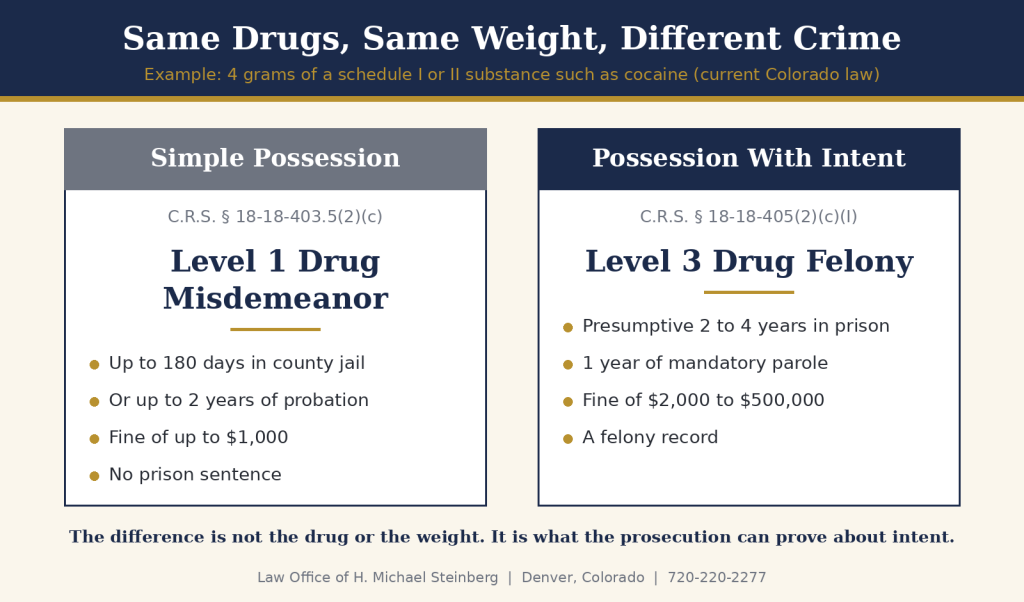
The distribution statute then climbs steeply with weight:
| Offense level (§ 18-18-405) | Schedule I or II drugs | Meth, heroin, ketamine, cathinones | Presumptive prison range |
|---|---|---|---|
| Level 3 drug felony | 14 grams or less | 7 grams or less | 2 to 4 years |
| Level 2 drug felony | More than 14, up to 225 grams | More than 7, up to 112 grams | 4 to 8 years |
| Level 1 drug felony | More than 225 grams | More than 112 grams | 8 to 32 years, mandatory prison |
Current law. Aggravating factors and special offender findings can increase these ranges. Marijuana offenses are governed by a separate statute.
Simple possession is not always a misdemeanor. Possessing more than four grams of a schedule I or II substance, or any amount of flunitrazepam, ketamine, GHB, or cathinones, is a level 4 drug felony. So is a fourth or subsequent misdemeanor possession offense.
The collateral damage is just as lopsided. A level 4 felony possession conviction can sometimes be reduced to a misdemeanor after successful probation under Colorado’s “wobbler” statute, C.R.S. § 18-1.3-103.5. Most distribution convictions cannot. A felony distribution record follows a person into every job application, lease, professional license, and immigration proceeding for the rest of his life.
Colorado law carves out a narrow middle ground. Under § 18-18-405(2)(d)(II), a transfer made so that the drugs can be consumed together at substantially the same time is a level 4 drug felony rather than a level 3, but only for four grams or less of a schedule I or II substance, or two grams or less of methamphetamine, heroin, ketamine, or cathinones. It is still a felony. It is, however, the one distribution offense listed in the wobbler statute as eligible for reduction to a misdemeanor.
On November 3, 2026, Colorado voters approved Proposition 132 with just under 53 percent of the vote. By the terms of its final text, the measure takes effect January 1, 2027, and it rewrites both statutes discussed in this article for fentanyl, carfentanil, benzimidazole opiates, and their analogs.
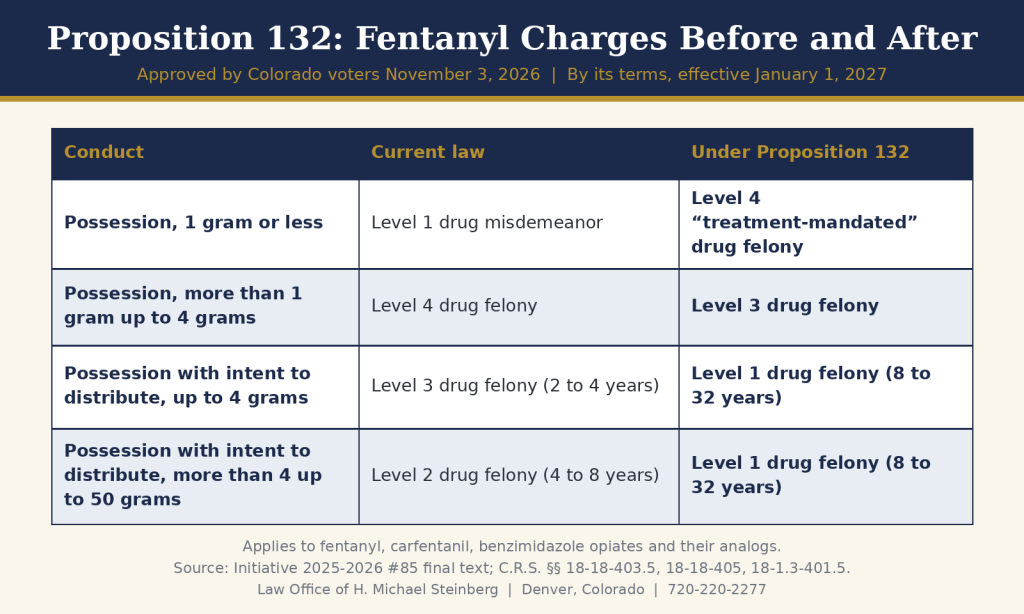
For fentanyl, this makes the line between possession and intent to distribute the single most important question in the case. Under the new law, a person holding half a gram faces a treatment-track felony if the charge is possession, and a mandatory prison sentence of at least eight years if the prosecutor adds the words “with intent to distribute.” Many people who use fentanyl also share it or sell small amounts to support their own use. Those are the people now standing closest to the cliff.
Under Proposition 132, the words “with intent to distribute” can turn half a gram of fentanyl into a minimum of eight years in prison.
Two cautions. First, conduct before January 1, 2027, should be charged and sentenced under current law. Second, Governor-elect Phil Weiser has amend a statutory initiative. Expect this area to keep moving in the 2027 session.
Earlier this year the legislature passed House Bill 26-1020, signed March 26, 2026. When a roadside colorimetric field test is the basis for a misdemeanor possession charge, officers must now issue a summons rather than make an arrest, and before accepting a guilty plea the judge must advise the accused that these tests produce false positives, are not admissible at trial, and that he may plead not guilty and ask for testing by an accredited laboratory.
Because Proposition 132 repeals and reenacts the possession statute, how these protections carry forward after January 1, 2027 is a question to watch closely.
Every one of these cases is different, but the defense generally works on four fronts.
When the evidence of possession is strong but the evidence of intent is weak, the realistic goal is often a conviction, by plea or by verdict, for simple possession rather than distribution. The Colorado Supreme Court’s decision in People v. Abiodun, 111 P.3d 462 (Colo. 2005) is also useful. It held that § 18-18-405 defines a single offense that can be committed in several ways, which limits the prosecution’s ability to stack multiple convictions on one transaction.
There is no set number. Any amount can support the charge if other evidence suggests an intent to sell or share. Weight sets the felony level, not the existence of intent.
Yes. The statute punishes the intent, not a completed sale, and giving drugs away counts as distribution.
Nearly always. The narrow exceptions under current law involve schedule V substances and unpaid transfers of four grams or less of a schedule III or IV substance, which are level 1 drug misdemeanors.
Often, yes, when the proof of intent is weak. That result usually comes from pretrial litigation and negotiation by a lawyer who is prepared to try the case.
Charged With a Drug Crime in Colorado?
The difference between possession and possession with intent to distribute is decided early, often by what is said to the police in the first hour. Do not explain. Do not consent to a search of your phone. Ask for a lawyer.
H. Michael Steinberg has defended drug cases in Denver and throughout Colorado for more than forty years. Call 720-220-2277, or learn more at www.hmichaelsteinberg.com and the Colorado Criminal Lawyer Blog.
Disclaimer. This article is general information about Colorado law as of November 14, 2026. It is not legal advice and does not create an attorney-client relationship. Drug statutes and sentencing rules change often, and the outcome of any case depends on its specific facts. If you are under investigation or charged with a crime, speak with a qualified Colorado criminal defense lawyer about your situation.