A Lawyer With a 42+ Year Proven Track Record
Exclusively Practicing Only Colorado Criminal
Law - Defending Your Future
Exclusively Practicing Only Colorado Criminal
Law - Defending Your Future








THE LAW OFFICE OF H. MICHAEL STEINBERG
Colorado Criminal Defense • Denver, Colorado • 720-220-2277
What People v. Perez, 2026 COA 72 means when the evidence against you came from someone else’s interrogation.
By H. Michael Steinberg, Colorado Criminal Defense Lawyer — Denver, Colorado
A client sits across from me and says, “My co-defendant only turned on me because the detectives scared him. They told him he’d go to prison for life unless he gave them my name. That has to be illegal, right?”
It is one of the most common questions I hear, and the honest answer is more complicated than most people expect. Pressure on a witness — even heavy pressure — does not automatically make that witness’s statement inadmissible.
A favorable plea offer does not automatically do it either.
On September 24, 2026, the Colorado Court of Appeals spelled out exactly what the defense has to show in People v. Perez, 2026 COA 72, and the bar is real.
The case arose from a Jefferson County homicide. According to the opinion, Ricardo Gonzalez Perez killed Gail Wilson in the home they shared with Wilson’s daughter, Savannah, and Perez’s friend, Griffith. Savannah saw the killing; Griffith saw the body afterward. The three concealed the body and evidence and reported Wilson missing (Colorado Lawyer case summary).
Savannah and Griffith first told police a cover story. Later, while in custody and represented by their own lawyers, they gave recorded statements implicating Perez. Each eventually pleaded guilty to accessory-type offenses in exchange for truthful testimony, with recommended probation. (For background on accessory liability, see What Is an Accessory to a Crime in Colorado? C.R.S. § 18-8-105.)
Before trial, Perez moved to suppress both witnesses’ statements as coerced by “promises for leniency” and asked for an evidentiary hearing. The trial judge reviewed the extensive record, heard argument, and denied the motion without taking testimony — finding the witnesses were “incentivized, but they weren’t coerced.” Perez was convicted of first degree murder and related charges and was sentenced to life without parole.
A three-judge division (Judge Johnson writing, with Judges Freyre and Berger concurring) affirmed.
“General offers of leniency do not amount to coercion.”
— People v. Perez, 2026 COA 72 (Johnson, J.)
Colorado appellate courts had not previously addressed this question in a published opinion, so the division borrowed from federal and California decisions, including the Tenth Circuit’s United States v. Gonzales, 164 F.3d 1285 (10th Cir. 1999), the Fifth Circuit’s United States v. Merkt, 794 F.2d 950 (5th Cir. 1986), and the California Supreme Court’s People v. Badgett, 895 P.2d 877 (Cal. 1995) and People v. Clark, 372 P.3d 811 (Cal. 2016).
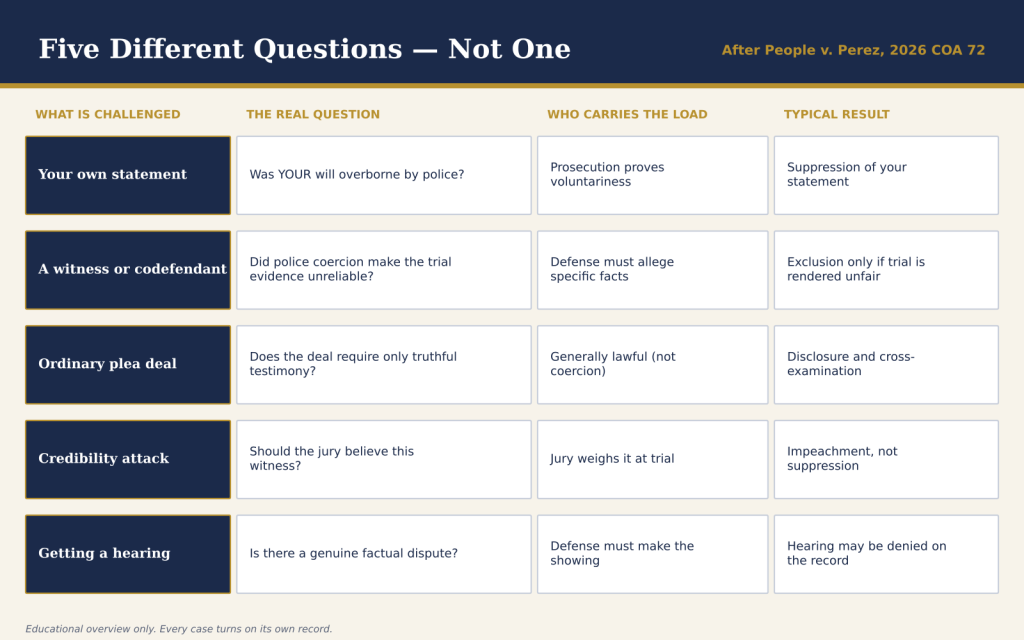
The most useful thing Perez does is force a careful separation of issues that clients — and sometimes lawyers — tend to blend together. Each of the following is a different legal question with a different burden and a different remedy.
When police coerce you, the rules are the most protective. Under the Due Process Clause and article II, section 25 of the Colorado Constitution, an involuntary statement cannot be used against you. Once you make an initial showing that your statement was involuntary, the prosecution must prove voluntariness by a preponderance of the evidence (People v. Zadran, 2013 CO 69M; People v. Ramadon, 2013 CO 68).
There must be coercive police conduct — a defendant’s own mental state alone is not enough (Colorado v. Connelly, 479 U.S. 157 (1986)). But threats and promises can qualify. In Ramadon, the Colorado Supreme Court upheld suppression where a detective exploited the suspect’s fear of deportation, and in People v. Springsted, 2016 COA 188, a division found later interviews involuntary after cumulative threats, promises, and psychological pressure. I discuss this in more depth in What Happens When the Police Make Promises? and Understanding the Miranda Rule.
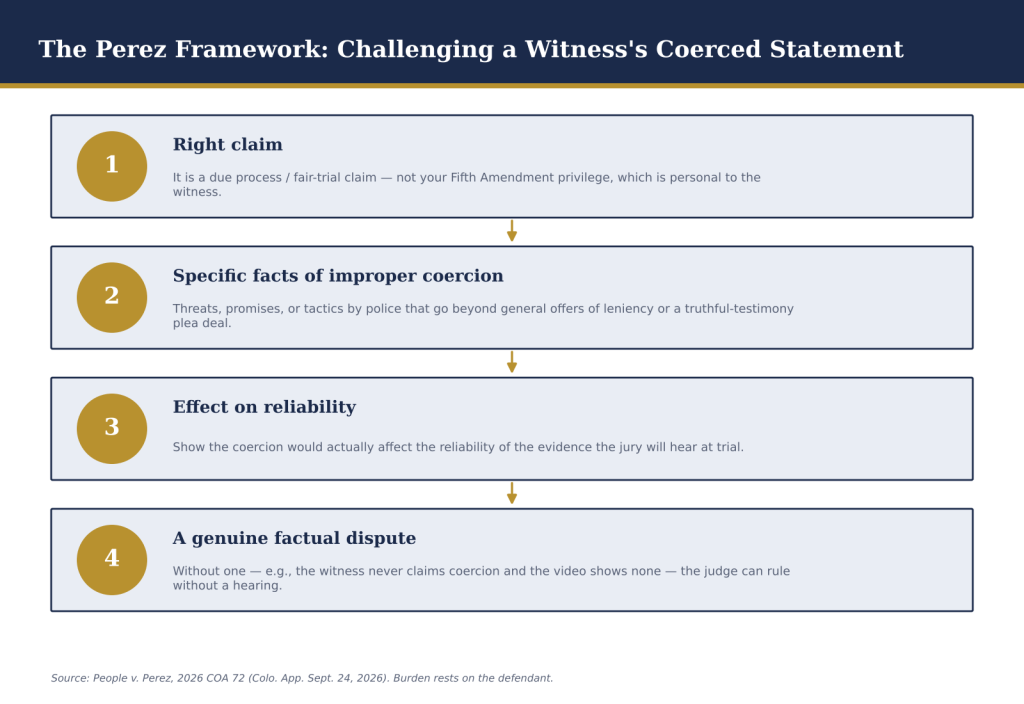
This is where Perez changes the analysis. You have no standing to assert the witness’s privilege against self-incrimination. What you do have is your own right to a fair trial.
That right is violated when the government coerces a witness into a false or unreliable statement and then uses it against you — the Tenth Circuit has recognized exactly that in Clanton v. Cooper, 129 F.3d 1147 (10th Cir. 1997) and Gonzales.
The focus, however, is not on whether the witness was treated unfairly. It is on whether the evidence you face at trial is unreliable. California’s Badgett line of cases, which Perez followed, makes the point sharply: an allegation that pressure produced an involuntary statement before trial is not enough by itself. The question is the reliability of what the jury will actually hear.
The question is not whether the witness was treated badly. It is whether police misconduct produced evidence so unreliable that you cannot get a fair trial.
Prosecutors routinely offer co-defendants reduced charges in exchange for testimony. Perez confirms that this is not, standing alone, coercion. Every plea agreement involves some compulsion, but an agreement that requires only full and truthful testimony is valid.
In Perez, the witnesses were represented by counsel, their proffer agreement disclaimed promises of leniency, and the defense identified no specific promise made to either witness at the time of the statements.
The line is crossed when a deal pressures a witness to deliver a particular story rather than the truth. California courts — whose framework Perez adopted — have distinguished agreements that bind a witness to repeat an earlier version of events from agreements requiring only truthful testimony. That distinction is worth examining in any cooperation agreement. See The Nature and Law of Plea Agreements and Plea Bargaining — Am I Safe When Talking to the District Attorney?.
Losing a suppression motion is not the end of the issue. A witness who changed stories after being offered probation on a murder-related case has an obvious motive to please the prosecution, and the jury is entitled to hear all of it. The prosecution must disclose cooperation deals and promises (Giglio v. United States, 405 U.S. 150 (1972)) and may not let false testimony about them stand uncorrected (Napue v. Illinois, 360 U.S. 264 (1959)).
In Perez, the plea deals reportedly would not take effect until after the defendant’s trial — a fact a defense lawyer would want every juror to understand. The trial court actually viewed differences between the two witnesses’ accounts as a sign they were not rehearsed. Cross-examination is where that inference gets tested. F
or more, see The Right to Confront Witnesses, What Lawyers Look For to See If a Witness Is Lying, and Motivations for False Allegations in Colorado Criminal Cases.
When a defendant challenges his own statement, a factual dispute is almost built in: the defendant says it was coerced, the prosecution says it was voluntary. Perez holds that the same is not true for a third-party witness. If the witness does not claim coercion, the defense must allege specific facts creating a genuine dispute — and the court does not have to accept those allegations if the record shows the statement was voluntary.
The division compared the facts to Merkt, where more aggressive agent conduct had still been found insufficient, and concluded the conduct in Perez was milder. Because the interviews were videotaped, the appellate court watched them itself and stood in the same position as the trial judge. A conclusory motion stood no chance against that record.
Building that record requires aggressive investigation and full discovery of every interview, note, and agreement. See Making Discovery Under Colorado Law and Understanding Prosecutorial Misconduct.
| Issue | Legal Source | Who Bears the Burden | Remedy |
|---|---|---|---|
| Your own coerced statement | Due process; Colo. Const. art. II, § 25 | Prosecution must prove voluntariness | Suppression |
| Coerced witness / codefendant | Your due process right to a fair trial | Defense must allege specific facts | Exclusion only if reliability and fairness are compromised |
| Plea deal for truthful testimony | Plea-bargaining law; due process | Generally lawful | Disclosure and cross-examination |
| Witness credibility | Confrontation; rules of evidence | Jury decides | Impeachment at trial |
| Evidentiary hearing | Perez framework | Defense must show a genuine dispute | Hearing may be denied on the record |
Perez does not hold that a coerced witness statement can never be excluded. It holds that the defense must do the work of proving it.
A case with a witness who recants, unrecorded threats, or a deal that rewards a particular story may come out very differently. The opinion also leaves room for the defense to attack the same facts at trial even after losing the motion.
Possibly, but not just because there was pressure. Under Perez, you must show specific facts of improper police coercion and that it affected the reliability of the evidence used at your trial.
No. An agreement requiring only full and truthful testimony is valid. A deal that pressures the witness to repeat a particular version of events raises a more serious question.
No. If the witness does not claim coercion and the record — such as a recorded interview — shows none, the court may deny the motion without an evidentiary hearing.
Yes. Deals, promises, and changed stories are classic grounds for cross-examination, and the prosecution must disclose them.
Talk to an Experienced Colorado Criminal Defense Lawyer
If the case against you depends on a witness who changed his story after police pressure or a cooperation deal, the time to build the record is now — before the motions deadline. H. Michael Steinberg has defended Colorado criminal cases for over forty years. Call 720-220-2277 or contact the Law Office of H. Michael Steinberg for a free consultation. More analysis is available on the Colorado Criminal Lawyer Blog.
DISCLAIMER
This article is for general educational purposes only and is not legal advice. Reading it does not create an attorney-client relationship. The law changes, slip opinions may be modified, and every case depends on its specific facts. Consult a qualified Colorado criminal defense attorney about your situation.