A Lawyer With a 42+ Year Proven Track Record
Exclusively Practicing Only Colorado Criminal
Law - Defending Your Future
Exclusively Practicing Only Colorado Criminal
Law - Defending Your Future





Law Office of H. Michael Steinberg
Colorado Criminal Defense Lawyer | Over 40 Years of Experience
By H. Michael Steinberg, Colorado Criminal Defense Lawyer
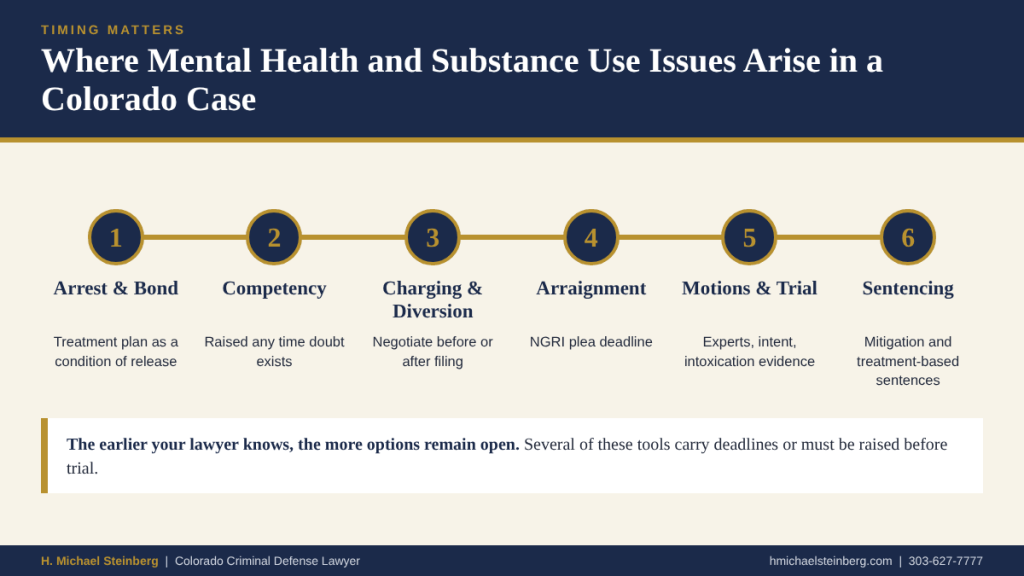
A person’s mental health or substance use at the time of an alleged crime can affect almost every stage of a Colorado criminal case. It can stop the case while competency is restored, support a plea of not guilty by reason of insanity, undercut the prosecution’s proof of intent, open the door to diversion or a treatment court, and reduce the sentence.
It is rarely a simple excuse, and each of these tools has strict rules and deadlines. That is where an experienced Colorado criminal defense lawyer earns his keep.
Many people facing criminal charges were in the worst stretch of their lives when they were arrested. Some were off their medication. Some were in a manic episode, in psychosis, or deep in an addiction. They and their families ask the same question: does any of that matter to the court?
It does, but not always in the way people expect. Colorado law does not treat mental illness or intoxication as one single defense. It treats them as several separate legal questions, each with its own statute, its own procedure and its own risks. This article walks through all of them.
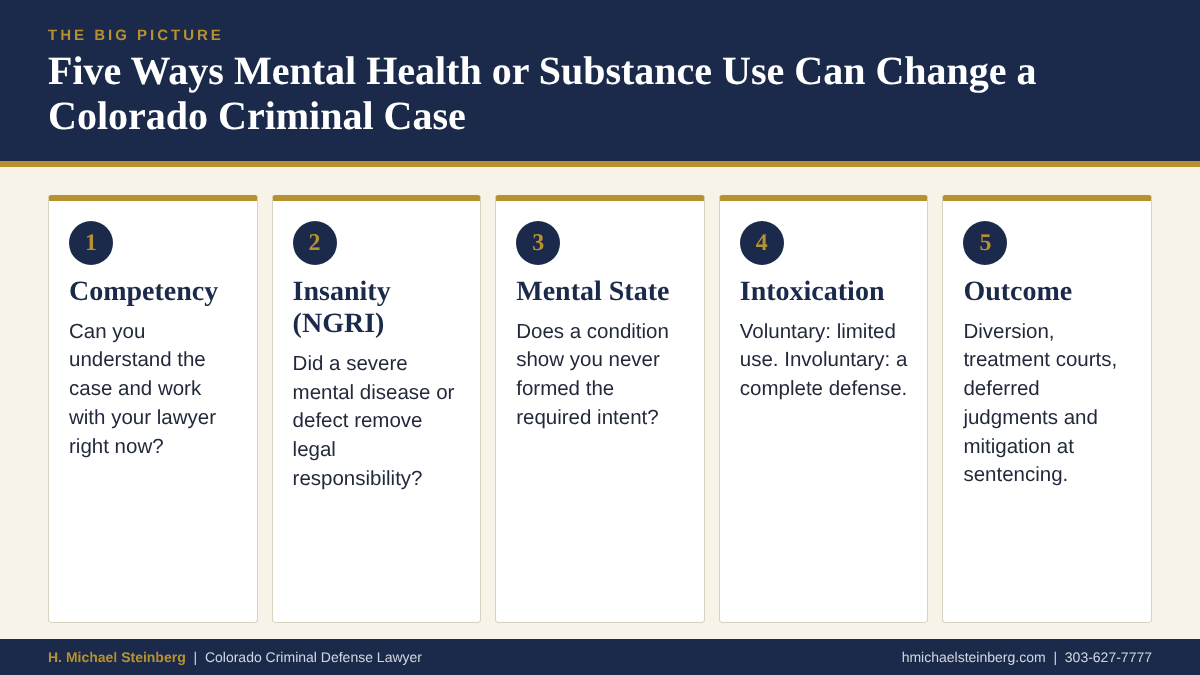
A single case can involve more than one. A client with bipolar disorder who was also drinking heavily may raise competency, mental state and mitigation questions at the same time.
Competency is about the present. Under Dusky v. United States and Title 16, Article 8.5 of the Colorado Revised Statutes, a person cannot be tried, plead guilty or be sentenced unless he or she has a rational and factual understanding of the proceedings and can consult with defense counsel with a reasonable degree of rational understanding.
The judge, the defense or the prosecution may raise the issue under C.R.S. § 16-8.5-102. When that happens the criminal case stops. The court orders an evaluation. If the person is found incompetent, the court orders restoration services, which may be outpatient or inpatient. Depending on the level of charge, the time involved and whether restoration is likely, Colorado law can require dismissal.
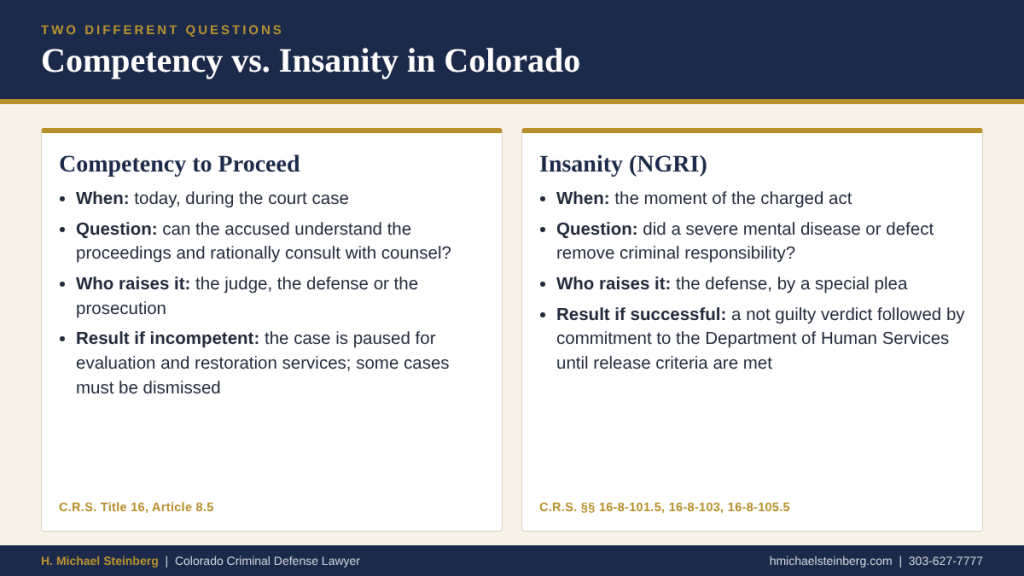
Competency is not a defense to the charge. A person can be competent today and still have been legally insane on the day of the offense, and the reverse is also true. But competency has to be settled first, because nothing else in the case can go forward without it.
Colorado defines insanity in C.R.S. § 16-8-101.5. Since 1995 the statute has combined two older defenses into one. A person is legally insane if, at the time of the act, either of the following is true:
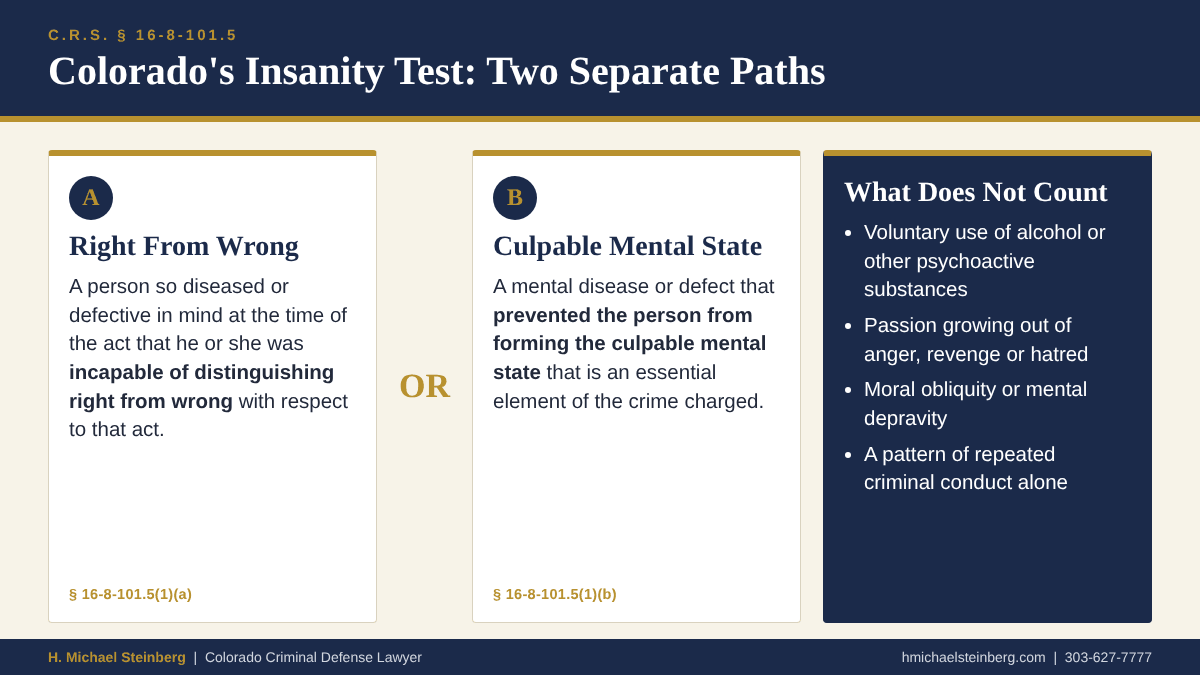
The definition is narrow. A mental disease or defect means only a severely abnormal mental condition that grossly and demonstrably impairs a person’s perception or understanding of reality. Conditions caused by the voluntary ingestion of alcohol or any other psychoactive substance do not qualify. Neither does passion growing out of anger, revenge or hatred.
Placing your mental condition at issue has a cost. Under C.R.S. § 16-8-103.6, a defendant who raises these defenses waives the confidentiality of communications with physicians and psychologists about that condition. Decades of treatment records can become available to the prosecution. This decision should be made with a lawyer, never alone.
Most people with depression, PTSD, anxiety, autism, an intellectual disability or a brain injury are not legally insane. Their condition may still explain what happened. Colorado allows that evidence in limited circumstances.
Under C.R.S. § 16-8-107(3)(b), a defendant who has not pleaded insanity may offer expert testimony about his or her mental condition only after giving notice to the court and the prosecution and undergoing a court-ordered examination.
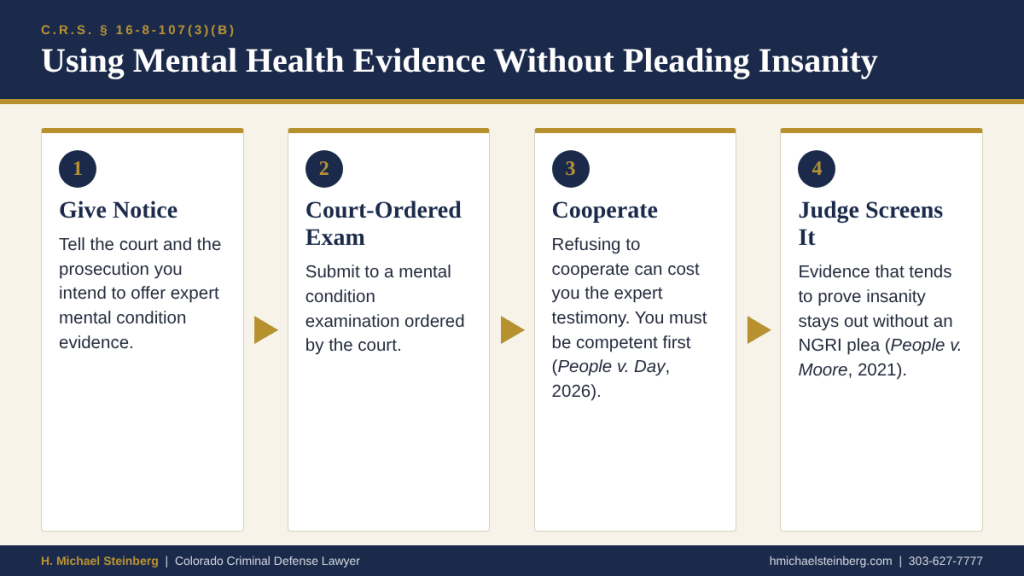
Three Colorado Supreme Court decisions set the boundaries:
The line between evidence that explains a state of mind and evidence that proves insanity is thin. Where your lawyer draws it can decide whether the jury ever hears from your doctor.
Drugs and alcohol are involved in a large share of criminal cases, from DUI and drug charges to assault, domestic violence and theft. Colorado’s rule is in C.R.S. § 18-1-804, and it separates two very different situations.
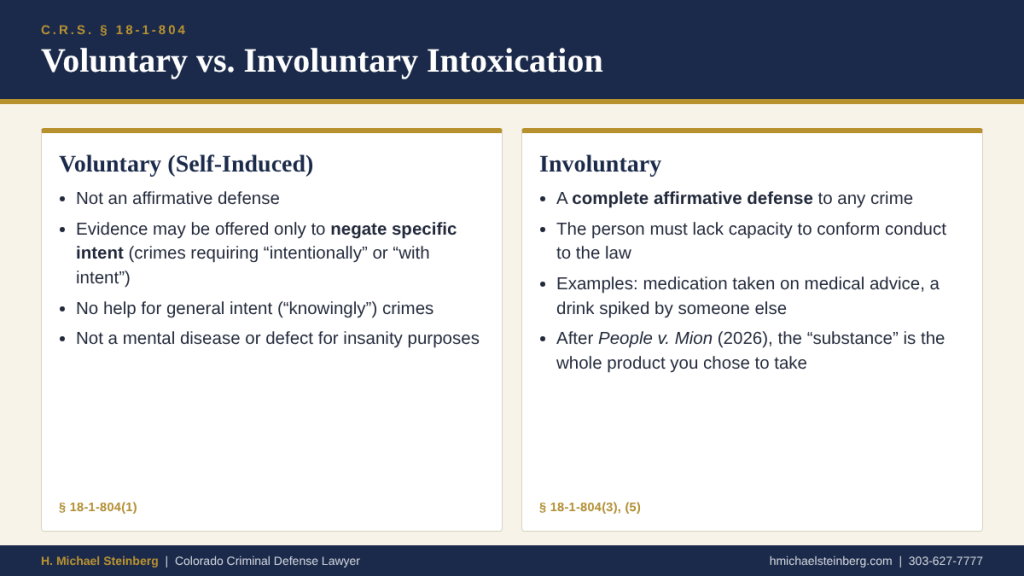
Getting drunk or high on purpose is not a defense. The statute allows evidence of self-induced intoxication for one purpose only: to negate specific intent when that intent is an element of the crime. Under C.R.S. § 18-1-501, specific intent crimes are those that use the words “intentionally” or “with intent.” First degree murder after deliberation is the classic example.
For general intent crimes, which use the word “knowingly,” voluntary intoxication is irrelevant to guilt. The Court of Appeals confirmed this in People v. Stone, 2020 COA 23. The second degree murder statute, C.R.S. § 18-3-103, says outright that diminished responsibility from self-induced intoxication is not a defense.
Long-term drug use that damages the mind does not create an insanity defense either. The Colorado Supreme Court rejected the “settled insanity” theory in Bieber v. People, 856 P.2d 811 (Colo. 1993).
Involuntary intoxication is different. It is a complete affirmative defense to any crime if, because of the intoxication, the person lacked the capacity to conform his or her conduct to the law. It covers substances taken on medical advice and substances a person did not know he or she was ingesting, such as a drink spiked by someone else. Once the defense is properly raised, C.R.S. § 18-1-407 requires the prosecution to disprove it beyond a reasonable doubt.
In practice the defense most often arises from unexpected reactions to prescription medication, drug interactions, and sleep medications.
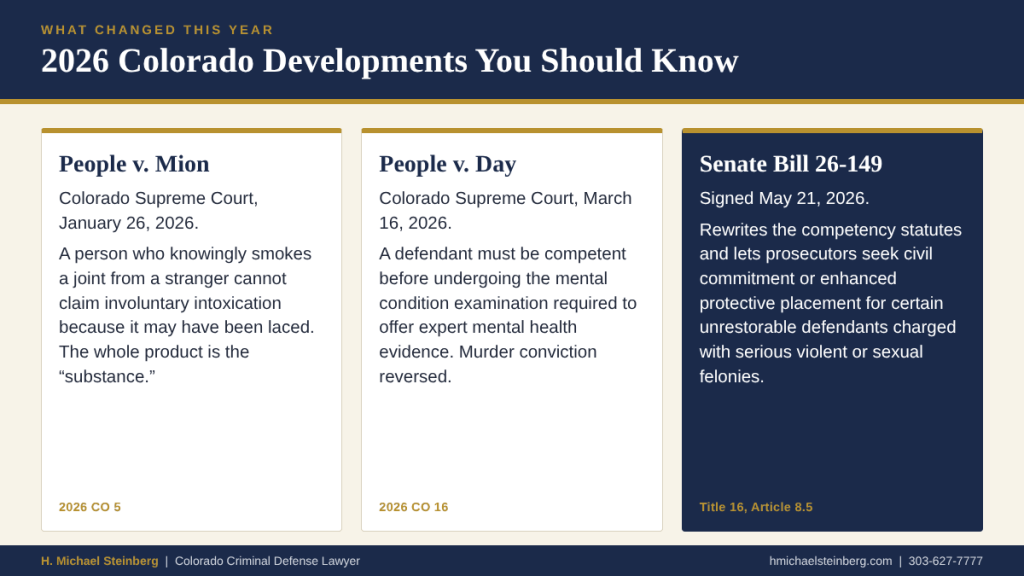
In People v. Mion, 2026 CO 5, decided January 26, 2026, the defendant testified that he took two hits from a joint a stranger gave him, then became paranoid and blacked out. He argued the joint must have been laced with something he did not know about. The Colorado Supreme Court held that when a product may contain several intoxicants, the “substance” under the statute is the whole product. Because he knowingly smoked a joint from a stranger and should have known it was intoxicating, his intoxication was self-induced. The defense remains available for true trickery, such as a spiked drink.
In People v. Day, 2026 CO 16, decided March 16, 2026, the trial court barred defense expert testimony because the defendant had not cooperated with the required state examination. She had been incompetent for part of that time. The Supreme Court held that a defendant must be competent before undergoing a mental condition examination under section 16-8-107(3)(b), and that the trial court should have enforced its examination order before excluding the evidence. The court affirmed the reversal of her second degree murder conviction.
Governor Polis signed Senate Bill 26-149 on May 21, 2026. The act reorganizes the competency statutes. Its most significant change concerns defendants who are found incompetent and unlikely to be restored. For certain defendants charged with homicide, a crime of violence or a felony sex offense, the district attorney may now ask the court to stay the dismissal and order civil commitment or an enhanced protective placement, with a trial to be set within 91 days of the notice. The prosecution must prove its case by clear and convincing evidence.
For defense lawyers this means a competency finding in a serious case no longer leads simply to dismissal. It can lead to a second, civil proceeding with its own hearings and its own stakes.
For many clients the best result is not a trial verdict. It is a resolution that treats the condition that caused the problem and keeps a conviction off the record.
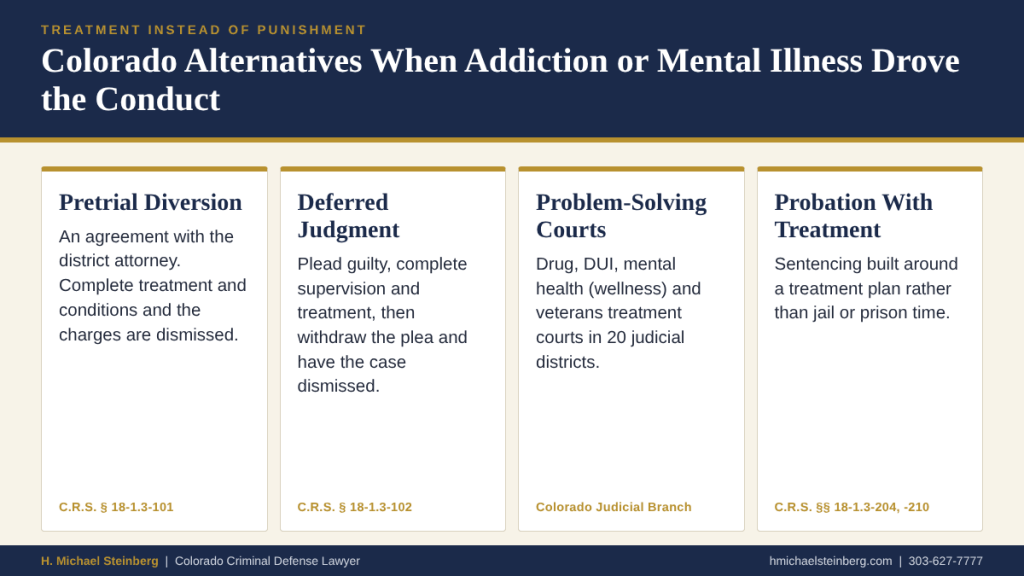
None of these is automatic. Each depends on the charge, the person’s record, the judicial district and the prosecutor. Each also depends on how well the defense documents the diagnosis, the treatment already under way and the plan going forward.
When a conviction cannot be avoided, mental illness and addiction are among the strongest mitigating facts a judge can hear. For felonies, C.R.S. § 18-1.3-401 allows a sentence below the presumptive range when the court finds extraordinary mitigating circumstances.
Effective mitigation is evidence, not argument. It means treatment records, an independent evaluation, proof of sobriety and engagement in treatment since the arrest, and a concrete plan the judge can order. The same material matters after sentencing, in probation violation hearings where a relapse or a missed appointment is the alleged violation.
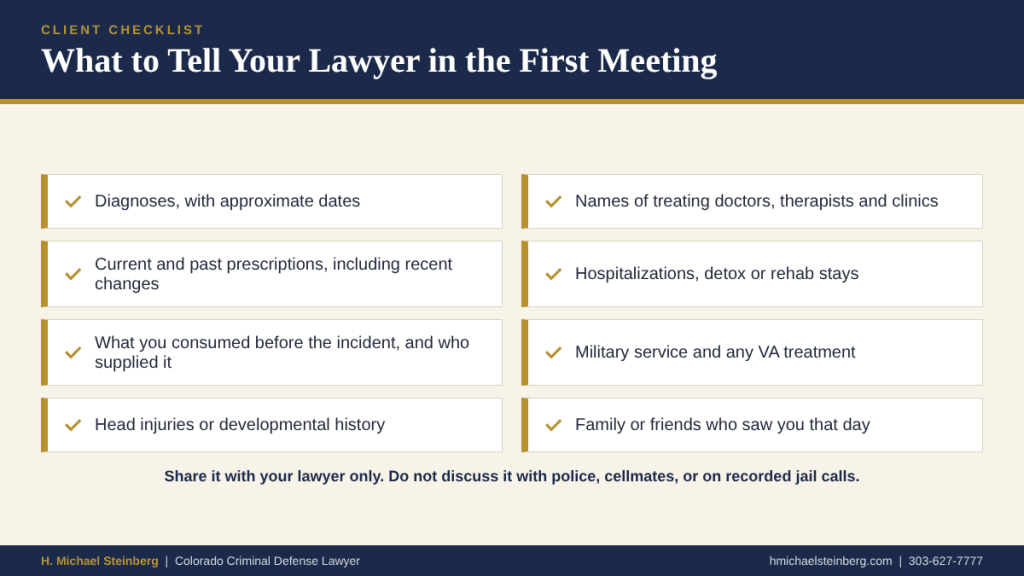
Do not explain your diagnosis, your medications or what you took that night to the police, to a pretrial officer, or on a recorded jail phone call. Statements meant to explain can supply the proof of intent or knowledge the prosecution needs. Tell your lawyer first.
Not by itself. A mental illness becomes a legal defense only if it meets the insanity definition in C.R.S. § 16-8-101.5, or if it is properly offered as mental condition evidence on the question of intent. It is far more often used to obtain diversion, treatment-based sentencing or a reduced sentence.
Only in a limited way. Under C.R.S. § 18-1-804, voluntary intoxication can be offered to negate specific intent. It does not apply to general intent crimes and it is never a complete defense.
Involuntary intoxication is a complete affirmative defense if it left you unable to conform your conduct to the law. After People v. Mion, knowingly taking a product you should have known was intoxicating will not qualify, even if it contained something unexpected.
Competency concerns your mental condition now and whether the case can proceed. Insanity concerns your mental condition at the time of the alleged offense and whether you are criminally responsible.
No. The court commits you to the Department of Human Services until you meet the statutory criteria for release. That period is indefinite.
They can become available to the prosecution. Raising insanity or mental condition waives the privilege for communications with treatment providers about that condition under C.R.S. § 16-8-103.6.
Possibly. Eligibility depends on the judicial district, the charge and your history, and admission usually requires the agreement of the prosecutor and the treatment court team.
In most cases, yes. Voluntary treatment that begins early and is well documented is often the single most persuasive fact in negotiation and at sentencing. Talk with your lawyer first about how to do it without creating harmful evidence.
If you or someone in your family is facing charges and mental health or substance use was part of what happened, the decisions made in the first weeks matter most. I have practiced Colorado criminal law for more than forty years, in Denver, Arapahoe, Adams, Douglas, Jefferson and the surrounding counties.
Free Consultation
Call 303-627-7777 or my cell at 720-220-2277, or contact the office online.
Related pages: Practice Areas | Drug Crimes | DUI Defense | Domestic Violence | Sex Crimes | Case Results | Client Reviews | Colorado Criminal Lawyer Blog
Disclaimer: This article is general information about Colorado law as of November 2026. It is not legal advice and does not create an attorney-client relationship. Statutes and court decisions change, and every case depends on its own facts. Consult a qualified Colorado criminal defense lawyer about your situation.