
A Lawyer With a 42+ Year Proven Track Record
Exclusively Practicing Only Colorado Criminal
Law - Defending Your Future
Exclusively Practicing Only Colorado Criminal
Law - Defending Your Future













By H. Michael Steinberg, Colorado Criminal Defense Attorney, Denver | Published October 13, 2026

An arrest is frightening enough. Then comes the question every family asks first: how much will it cost to get them out? In Colorado the answer is not a fixed price list. A judge, or a bond hearing officer, decides the type of bond and the conditions of release, and that decision can be challenged and changed.
In Colorado, a judge sets bail at the first court appearance by weighing the risk that you will miss court and the risk to public safety, using the factors in C.R.S. 16-4-103. The law presumes you are eligible for release on the least restrictive conditions that will do the job.
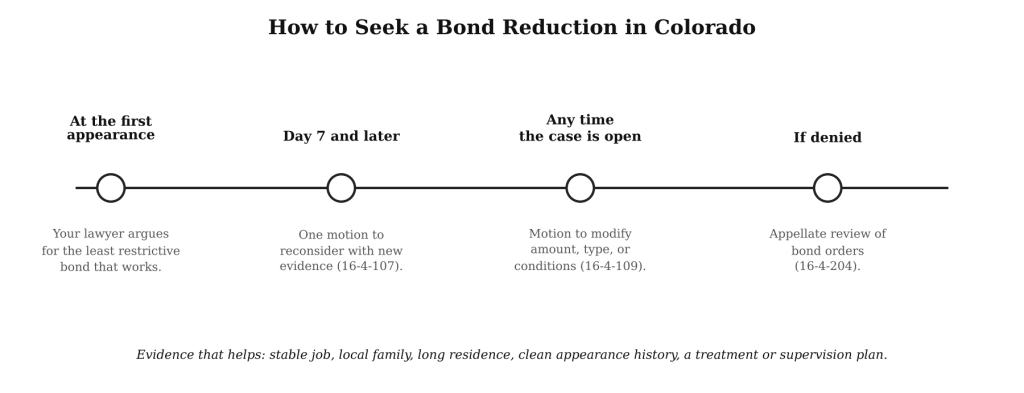
Yes, bail can be reduced. You can file a one-time motion to reconsider after seven days in custody, and you can ask the court to modify the amount, the type of bond, or the conditions at any point while the case is pending.
Article II, Section 19 of the Colorado Constitution gives most people accused of a crime a right to be released on bail while the case is pending. The exceptions are narrow and are discussed below. Colorado law also directs courts to hold a bond hearing for anyone in custody who has not already had bond set.
Colorado has moved away from treating bail as a price tag attached to the charge. Under C.R.S. 16-4-103, the court must presume that people in custody are eligible for release with the least restrictive conditions that reasonably ensure appearance and safety. Any money condition must be reasonable, and any non-mandatory condition of conduct must be tailored to a specific concern. Colorado did not abolish cash bail, but the statute limits when money should be the tool.
Reform came in stages. The legislature barred cash bail for traffic, petty, and similar municipal offenses (HB19-1225), set timelines for bond hearings and release (SB19-191), and required bond hearings within 48 hours (HB21-1280). A person charged with an offense punishable by a fine only cannot be required to post more than the maximum fine.
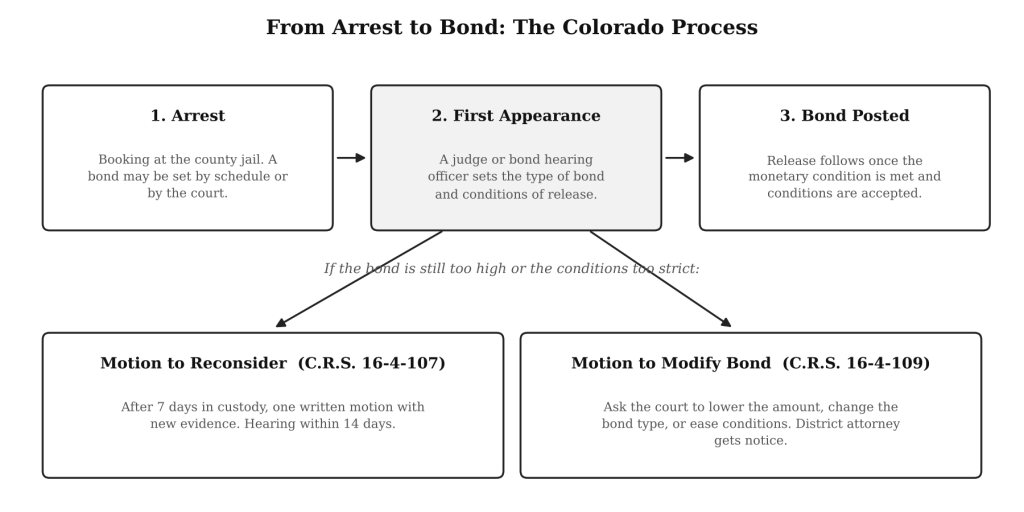
At the first appearance, the court (or a person the court designates) determines the type of bond and the conditions of release. The defendant has the right to counsel at this initial hearing, and the court must notify the public defender beforehand. The prosecutor also has the right to appear and state a position. Both sides must receive any pretrial services report the judge will see. These rules are set out in C.R.S. 16-4-104.
Timing matters. C.R.S. 16-4-102 calls for an individualized bond hearing within 48 hours of arriving at the jail. For weekends and holidays, a statewide bond hearing officer can conduct hearings by video for participating districts. Someone arrested for DUI cannot attend the bail hearing until no longer intoxicated.
Many counties also use a bond schedule or written guidelines for initial bonds. The law says any schedule must account for individual risk and circumstances, not solely the level of the offense. For example, the chief judge of Colorado’s Eighteenth Judicial District, which covers Arapahoe, Douglas, Elbert, and Lincoln counties, issued bond guidelines that state they are not a bond schedule and keep the presumption of release in place. A guideline is a starting point. It does not bind the judge, and it is exactly what a defense lawyer argues against when the number does not fit the person.
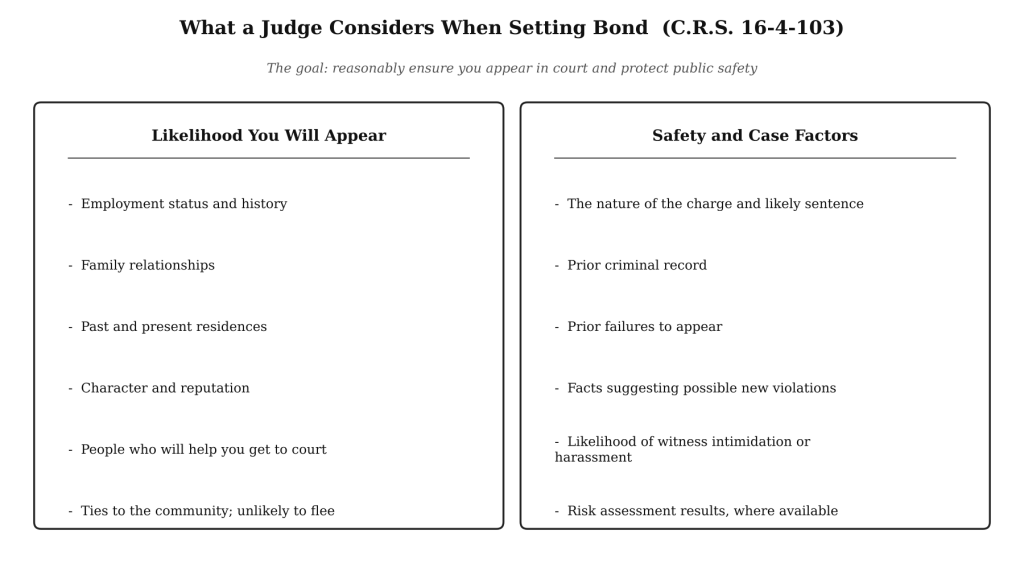
The bond must be sufficient to reasonably ensure you appear in court and to protect the safety of any person or the community, taking into account your individual characteristics, including your financial condition. Where available, the court is directed to use an empirically developed risk assessment tool. The statute then lists criteria the court may consider:
A court must also consider the pregnancy or postpartum status of a defendant who has given the required notice. The full list appears in C.R.S. 16-4-103(5).
In practice, the first group of factors is about stability. A judge hears that you have lived in Colorado for years, hold a steady job, and have family who will make sure you appear. The second group is about the allegation and your history. The charge matters, but it is not supposed to be the whole story.
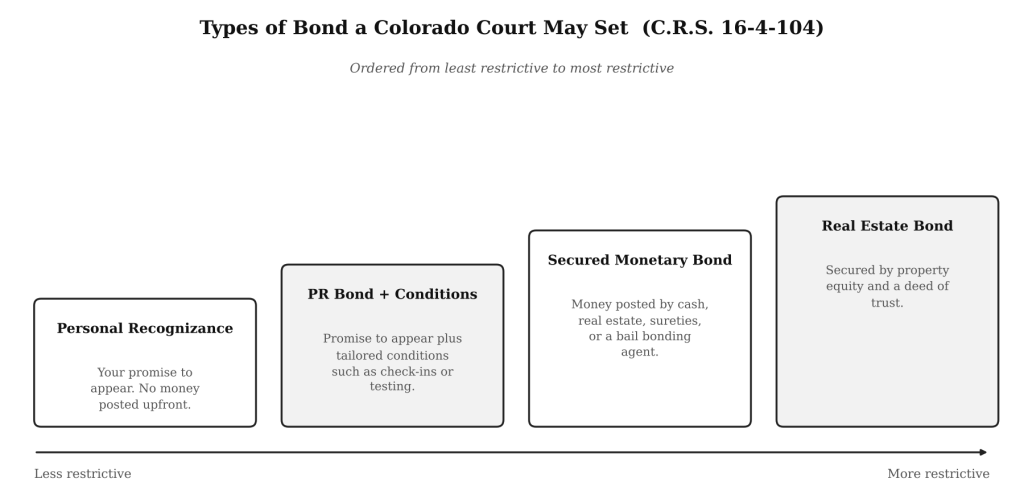
C.R.S. 16-4-104 lists the bond types a court may choose from:
| Bond type | How it works |
|---|---|
| Unsecured personal recognizance (PR) bond | You promise to appear in a stated amount. No money is posted up front. The court may add co-obligors. |
| PR bond with non-monetary conditions | The same promise, plus conditions designed to ensure appearance and safety, such as check-ins or testing. |
| Secured monetary bond | Used when reasonable and necessary. You may generally choose the method: a cash deposit with the clerk, real estate equity, sureties, or a licensed bail bonding agent, unless the judge makes findings that a particular method is required. |
| Secured real estate bond | Used when an unsecured bond will not do. Requires property equity, title evidence, and a deed of trust securing one and one-half times the bond amount. |

A PR bond is not automatic. Unless the district attorney consents or the court adds individualized conditions, the statute bars an unsecured PR bond if you are already free on another felony or class 1 misdemeanor bond, were convicted of a class 1 misdemeanor within two years or a felony within five years, or willfully failed to appear in a felony or class 1 misdemeanor case within the last five years.
Money is only one part of a bond. C.R.S. 16-4-105 sets the conditions that come with release. Some are mandatory:
The court may add others, including pretrial services supervision, phone or office check-ins, home visits, treatment, alcohol or drug testing, electronic or GPS monitoring, and pretrial work release. These alternatives are often the key to a lower money bond, because they answer the judge’s concern without keeping someone in jail. If you are facing a charge that carries a protection order, our pages on domestic violence defense and DUI defense explain how those conditions affect your case.
Denial of bail is the exception. Under C.R.S. 16-4-101 and the state constitution, a court can deny bail only in limited situations:
If bail is denied outside a capital case, trial must begin within a set period or the court must hold a bail hearing and set an amount. The constitution says 90 days, and the statute says 91. Delay attributable to the defense does not count.
Yes. A bond is not permanent. Colorado law gives you more than one way to challenge it.
| Option | When | What to know |
|---|---|---|
| Argue at the first appearance | Initial bond hearing | The best chance to avoid a high bond altogether. A lawyer present at this hearing can present your ties, work history, and a supervision plan. |
| Motion to reconsider (16-4-107) | After seven days in custody on a money bond you cannot meet | Filed once per case, in writing, with evidence the court did not fully consider. A hearing must occur within 14 days, though the court may deny it summarily if no new evidence is shown. |
| Motion to modify bond (16-4-109) | Any time while the case is pending | Either side may ask the court to raise or lower the financial conditions, change security, or alter conditions. The other side receives reasonable notice, and the district attorney may appear and be heard. |
| Appellate review (16-4-204) | After a denial or unfavorable ruling | A written petition to the appellate court is the method of review, and bond determinations are reviewed for abuse of discretion, as the Court of Appeals described in 2026 COA 48. |
Two cautions. First, the same statute that lets you ask for a reduction lets the prosecution ask for an increase, for example by alleging a violation of a bond condition. A careless motion can make things worse. Second, a bond that is set so high it operates as a denial of bail raises constitutional concerns under Article II, Section 20 of the Colorado Constitution and the Eighth Amendment. That argument belongs in front of the judge, framed by a lawyer who knows the local court.
Judges respond to specifics. Useful evidence includes:
A judge or bond hearing officer sets it at the first appearance after weighing the statutory factors in C.R.S. 16-4-103, including your ties to the community, record, the nature of the charge, and your financial condition. The court starts from a presumption of release on the least restrictive conditions that will work.
Yes, but with limits. Cash or other secured bonds are allowed when reasonable and necessary, and they are barred for certain low-level traffic, petty, and municipal offenses. For fine-only offenses, the money condition cannot exceed the maximum fine.
Yes. After seven days in custody on an unaffordable money bond, you may file one motion to reconsider. Either party may also ask the court to modify the bond under C.R.S. 16-4-109 at any time while the case is pending.
Colorado law calls for an individualized bond hearing within 48 hours of arrival at the jail. Weekends, holidays, and other holds can affect timing, so confirm the date with the court or jail.
People use the terms interchangeably. Technically, bail is the right to release pending trial, and the bond is the instrument or promise, with its amount and conditions, that secures release.
Only in narrow cases, such as first-degree murder where the proof is evident or the presumption is great (for offenses on or after December 17, 2024), or specified violent and sexual offenses after a hearing and a finding of significant peril to the public.
You have the right to counsel at the initial hearing. An experienced criminal defense lawyer can present evidence, propose supervision alternatives, and respond to the prosecution, which often makes the difference between staying in custody and going home.
If you or someone you love is in custody in Colorado, speed matters. H. Michael Steinberg has practiced Colorado criminal law for more than forty years, including thirteen years as a career prosecutor in Arapahoe and Douglas counties before opening his own firm. He has argued bond and bail issues across the Denver metro area and the Front Range. Learn more about his background or review the firm’s practice areas, including drug crimes and sex crimes.
Free consultation: call 303-627-7777 or 720-220-2277, or contact the firm online.
Law Office of H. Michael Steinberg, The Edwards Building, 8400 E Prentice Ave, Penthouse 1500, Greenwood Village, CO 80111.
For more articles from the firm, visit the Colorado Criminal Lawyer Blog.
This article is general information about Colorado law as of October 13, 2026, not legal advice. Bond practices vary by county and judge, and laws change. Reading this article does not create an attorney-client relationship. Do not send confidential information through the website’s contact form. Contact a Colorado criminal defense lawyer about your specific situation.