
A Lawyer With a 42+ Year Proven Track Record
Exclusively Practicing Only Colorado Criminal
Law - Defending Your Future
Exclusively Practicing Only Colorado Criminal
Law - Defending Your Future












By H. Michael Steinberg, Denver Criminal Defense Attorney | October 19, 2026

An experienced criminal defense lawyer separates decisions that belong to you, the client (plea, jury waiver, testifying, appeal, and the objective of the defense) from tactical decisions that belong to the lawyer after consultation.
The lawyer then gives you only the information you need to make each decision, in plain language, with a recommendation, enough time, and a clear record. Colorado’s Rules of Professional Conduct require communication that is “reasonably necessary” to permit informed decisions. They do not require a data dump.
IN THIS ARTICLE
If you are facing criminal charges in Denver or elsewhere in Colorado, two fears often show up at once. One is being left in the dark while someone else controls your future. The other is being buried in statutes, motions, and legal jargon you cannot realistically absorb. A well-run defense avoids both. Below is how a thoughtful criminal defense lawyer keeps you in the driver’s seat on the decisions that are yours, without turning every meeting into a law school lecture.
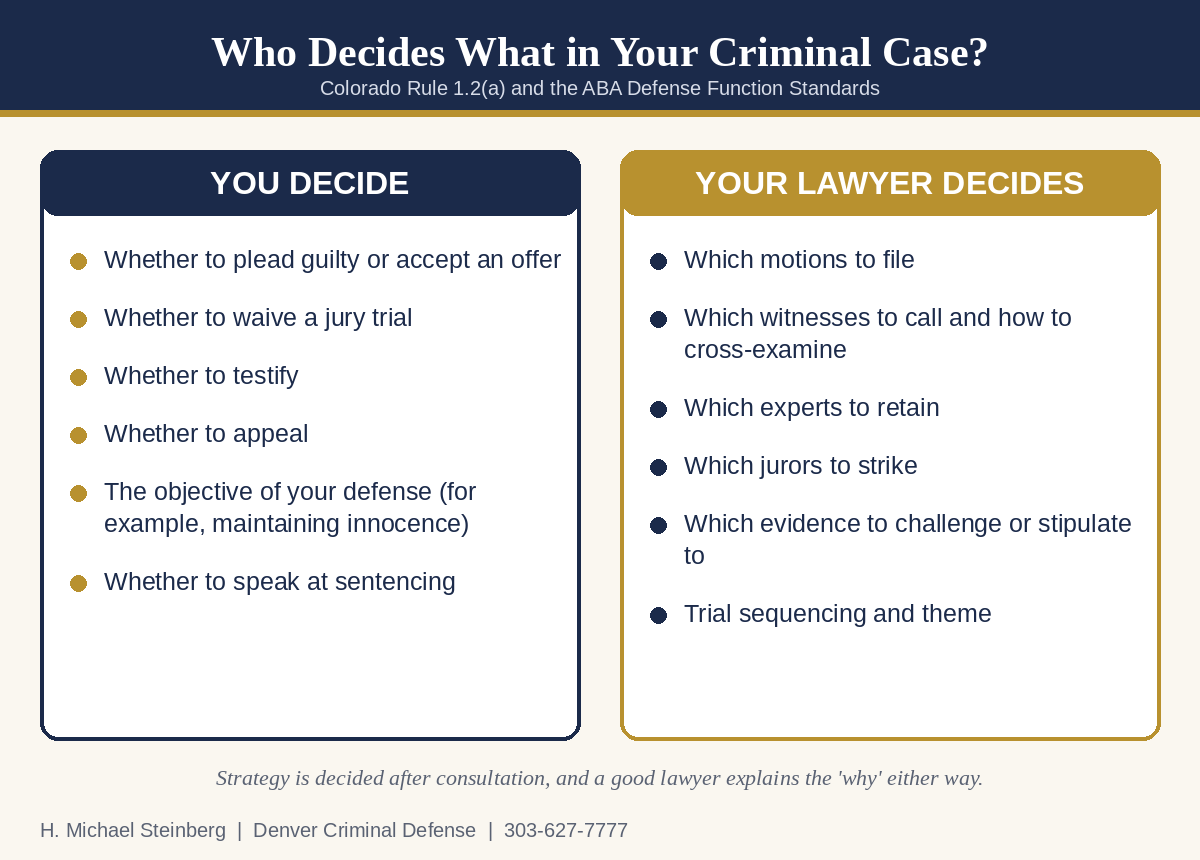
The first step in meaningful involvement is clarity about roles. Under Colorado Rule of Professional Conduct 1.2(a) (see the Colorado Bar’s published rules and the parallel ABA Model Rule 1.2), a lawyer must abide by the client’s decisions about the objectives of the representation and must consult with the client about the means.
In a criminal case, the lawyer must also abide by the client’s decision, after consulting with the lawyer, about what plea to enter, whether to waive a jury trial, and whether the client will testify.
The ABA Criminal Justice Standards for the Defense Function add detail. They treat the client as the decision-maker on the plea, jury waiver, testifying, and appeal, and they treat the lawyer as responsible for strategic and tactical choices after consulting the client where feasible.
The U.S. Supreme Court has reinforced this division. In McCoy v. Louisiana, the Court held that the Sixth Amendment guarantees a defendant the right to choose the objective of the defense and to insist that counsel not concede guilt, even when counsel believes conceding is the best path.
In Florida v. Nixon, the Court explained that counsel generally has authority over strategy, while certain fundamental choices remain with the accused. And in Jones v. Barnes, the Court recognized that counsel, not the client, decides which issues to press on appeal, while the client keeps the ultimate decisions on matters such as whether to take an appeal.
AUTHORITY AT A GLANCE
Client decides: plea, jury waiver, whether to testify, whether to appeal, the objective of the defense.
Lawyer decides (after consulting you): motions, witnesses, cross-examination, experts, jury selection, and trial strategy.
Colorado Rule 1.4 requires a lawyer to keep the client reasonably informed about the status of the matter, promptly comply with reasonable requests for information, and explain a matter “to the extent reasonably necessary to permit the client to make informed decisions regarding the representation.” Read closely, that standard is a built-in guard against overload. The measure is what you need to decide well, not everything the lawyer knows.
Several principles in the ABA Defense Function Standards point the same way:
It is tempting for lawyers to show diligence by sharing everything.
It has been my experience that, in practice, a flood of detail can make a stressed client freeze, defer reflexively to the lawyer, or fixate on the least important issue. That is not informed consent. It is noise.
H. Michael Steinberg
Informed consent is about relevance, not volume. The best client conversations answer three questions: What are my options? What are the realistic outcomes? What do you recommend, and why?
The goal is the opposite of both extremes. A lawyer who decides everything and says little leaves the client unable to exercise rights that belong to them. A lawyer who explains everything leaves the client unable to use the information. The right approach is calibrated: detailed where the client must decide, brief where the lawyer is handling the work.
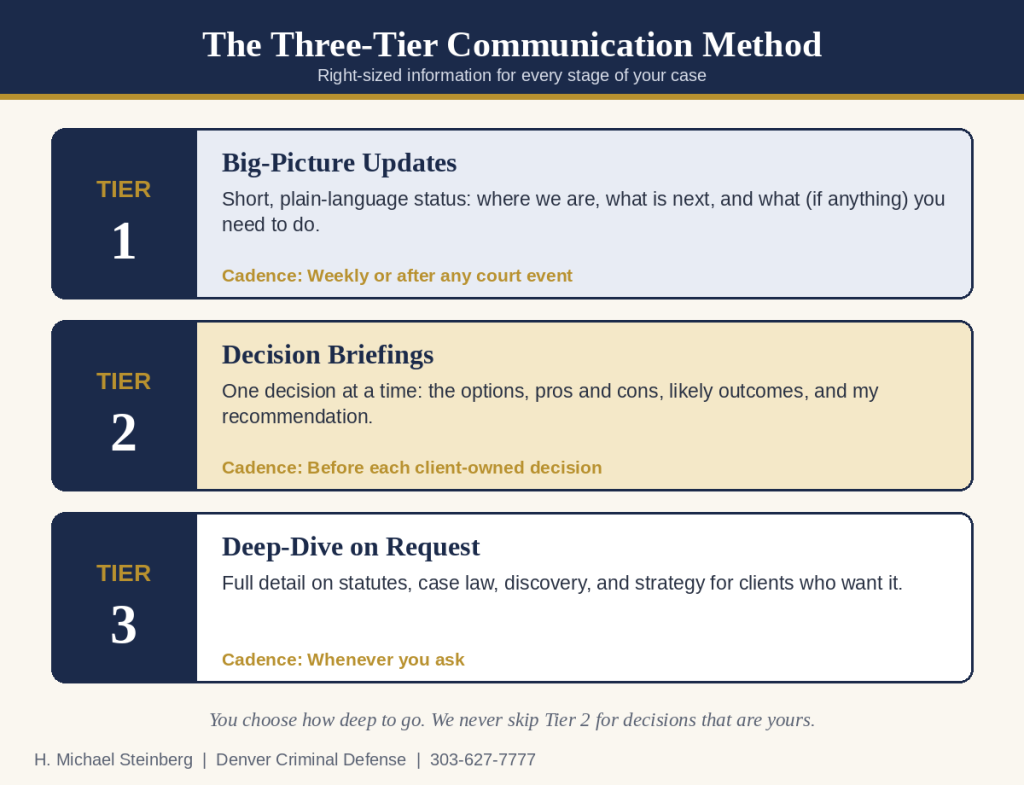
One practical way to do this is to sort communication into tiers, so each message matches its purpose.

Short, plain-language status reports: where the case is, what happens next, and whether the client needs to do anything. These can go by text, email, or a quick call after every court date or significant development.
When a client-owned decision approaches, the lawyer slows down and focuses on that one decision. A strong briefing covers the options, the realistic best and worst outcomes, the lawyer’s recommendation and reasoning, any deadline, and any collateral consequences. Many lawyers put this on a single page so the client can reread it and discuss it with family.
Some clients want the statutes, the police reports, and the case law. Others want none of it. The lawyer should be ready to go as deep as the client wishes, and the client should know that option exists. The Tier 3 door stays open, but no one is forced through it.
Along the way, a lawyer can ask the client early how they like to receive information: written summaries or phone calls, daily contact or weekly, family involved or not. Capturing those preferences at the start, and revisiting them as the case changes, is one of the simplest ways to keep communication useful.
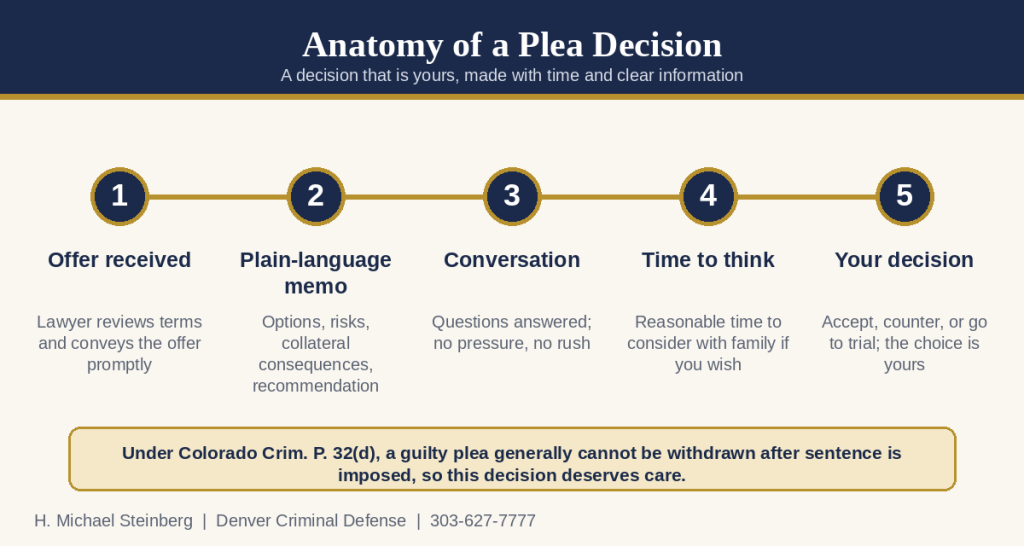
The plea decision is the clearest example. The lawyer’s duties here are well established. In Missouri v. Frye, the Supreme Court held that defense counsel generally has a duty to communicate formal plea offers from the prosecution, and in Lafler v. Cooper, it held that bad advice leading to rejection of a plea offer can violate the Sixth Amendment right to effective counsel. The general framework for evaluating counsel’s performance comes from Strickland v. Washington.
In Colorado, the court accepting a guilty plea must be satisfied that it is knowing and voluntary. See Crim. P. 11 and the plea-agreement provisions of C.R.S. § 16-7-301 and C.R.S. § 16-7-302; see also C.R.S. § 16-7-207 on the court’s duties. Federal law reflects the same principle in Boykin v. Alabama, which requires an affirmative showing that a guilty plea is intelligent and voluntary.
Under Crim. P. 32(d), a guilty plea generally can be withdrawn only before sentence is imposed, so the time to understand the offer is before you accept it. A good lawyer will not rush you, and will not let a deadline substitute for understanding.
What does an appropriately sized plea conversation look like? Usually the lawyer explains the offer in plain terms (charge, sentence range or stipulation, and conditions), describes what the case looks like at trial, identifies the risks of each path, flags collateral consequences, gives a recommendation, and then stops talking.
The decision belongs to the client. If you want to see how overcharging and charge stacking affect that calculus, see this related post on DA overcharging in Colorado.
The right to testify is personal to the defendant, and the lawyer’s job is to advise, not to override. Colorado courts have long required that a defendant’s decision about testifying be made knowingly and voluntarily, and trial judges often give an advisement on the subject outside the jury’s presence.
This practice traces to People v. Curtis, 681 P.2d 504 (Colo. 1984), and the Colorado Supreme Court’s later discussions of it, for example in People v. Harding. A lawyer typically previews this decision well before trial, because the answer depends on how the evidence develops.
Jury waivers work similarly. Under Crim. P. 23, the right to a jury trial is protected and a waiver must be knowing and voluntary. The Sixth Amendment’s jury trial and counsel guarantees also protect the choice to represent yourself, which the Supreme Court recognized in Faretta v. California. In every one of these decisions, the pattern is the same: brief the client on the choice, give a recommendation, allow time, and respect the decision.
Not sure whether to speak with police at all? Read why innocent people sometimes hurt their cases by talking to Colorado police before any interview.
Disagreement is not a sign of a failing relationship. It is a sign the process is working. If the disagreement concerns a client-owned decision, the lawyer should explain the reasons for the recommendation, confirm the client understands the consequences, and then follow the client’s choice. If it concerns trial tactics, the lawyer should listen carefully, explain why a different approach is preferred, and consider whether the client’s input improves the plan.
A prudent lawyer also memorializes important decisions and disagreements in a short follow-up email or letter. That protects both of you and prevents later confusion about who chose what. If the disagreement is truly irreconcilable, the client may consider whether a different lawyer is a better fit, but that choice should be made deliberately, and promptly, given court deadlines.
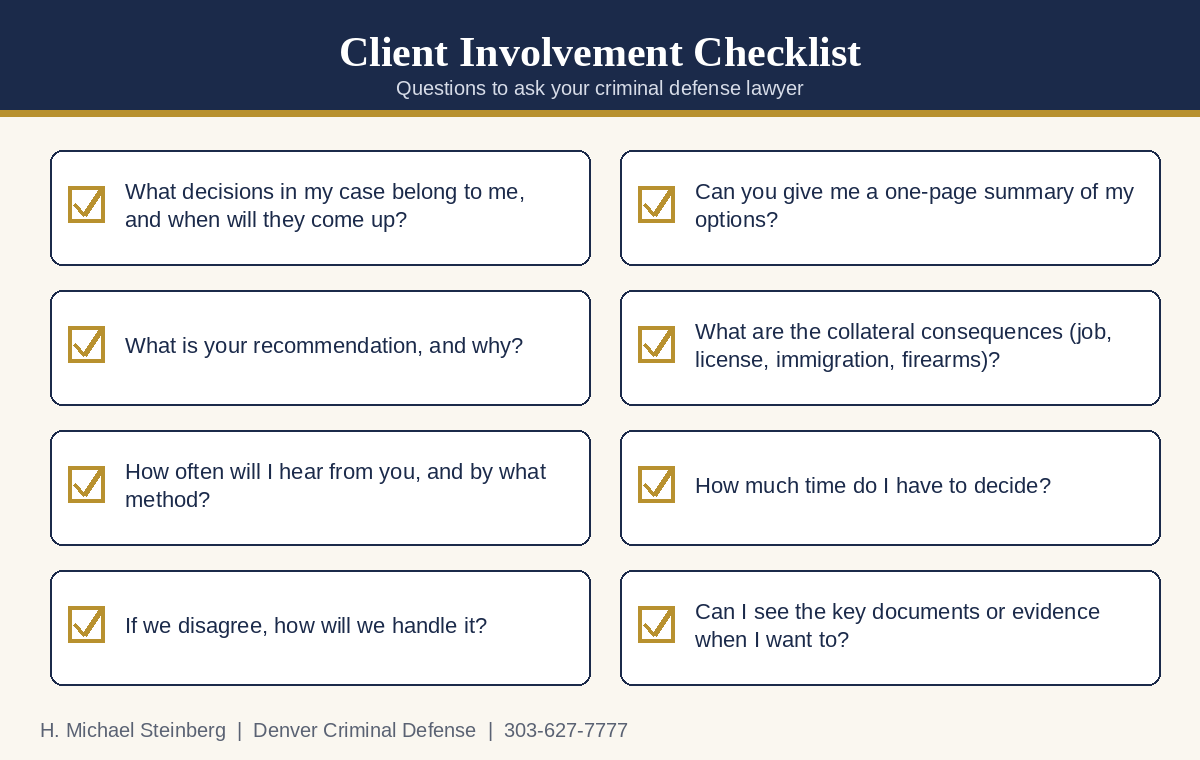
If you are interviewing a lawyer or evaluating the one you have, these questions help set expectations from day one.

No. Whether to plead guilty is the client’s decision. A lawyer may negotiate and recommend, but may not accept an offer on the client’s behalf without the client’s authority.
No. You need to understand your options, the realistic consequences of each, and your lawyer’s recommendation. The ethics rules measure the explanation by what is reasonably necessary to make an informed decision.
You do, after consulting with your lawyer. The lawyer advises on risks and benefits, and the court may confirm your decision on the record.
Say so. A good lawyer adjusts. Some clients want written summaries and full discovery access, while others prefer short phone updates and a clear recommendation.
It depends on the offer’s deadline, but a lawyer should explain the deadline as early as possible and make sure you have a reasonable opportunity to consider the offer. If the time is too short, your lawyer can ask the prosecutor for more.
Tell your lawyer. Strategic decisions are generally the lawyer’s call after consultation, but your input matters, and on client-owned decisions your choice controls. See the discussion of authority and disagreements above.
At the Law Office of H. Michael Steinberg, clients are informed, consulted, and respected, without being overwhelmed. Learn more about attorney H. Michael Steinberg, explore our criminal defense practice areas, read client reviews, or contact us for a consultation.
Call 303-627-7777 or 720-220-2277
More Colorado criminal defense articles are available on the Colorado Criminal Lawyer Blog, including how false, exaggerated, or mistaken domestic violence allegations are defended. You can also verify any Colorado lawyer through the Colorado Bar Association’s Find a Lawyer directory.
This article is for general information only and is not legal advice. Reading it does not create an attorney-client relationship. Every case is different, and laws and rules change. Consult a licensed Colorado criminal defense attorney about your specific situation.