
A Lawyer With a 42+ Year Proven Track Record
Exclusively Practicing Only Colorado Criminal
Law - Defending Your Future
Exclusively Practicing Only Colorado Criminal
Law - Defending Your Future







By H. Michael Steinberg, Law Office of H. Michael Steinberg | October 30, 2026
Waiting is one of the hardest parts of a criminal case. Court dates move, prosecutors send offers, and every day without news can feel like a verdict. A common worry for people charged with a crime is simple:
Will my lawyer tell me what is happening?
A Colorado criminal lawyer keeps clients informed through duties set by the Colorado Rules of Professional Conduct, constitutional protections that surround plea offers, and practical habits: prompt answers, plain-language explanations at every stage, and honest advice about the decisions that belong to you.
This article explains what the law requires, what you should expect as your case moves forward, and what to do if the updates stop.
A good Colorado criminal defense lawyer keeps you informed by:
(1) telling you about every significant development, including new filings, court dates, discovery, and plea offers;
(2) explaining what each development means in plain language;
(3) consulting you before major decisions; and
(4) answering your questions promptly.
None of this is a courtesy. It is an ethical obligation and, in the plea context, also a constitutional one.
The Colorado Supreme Court regulates lawyers through the Colorado Rules of Professional Conduct. Colo. RPC 1.4 (read the official PDF) is the communication rule.
Under this rule, a lawyer must:
Rule 1.4(b) adds that a lawyer must explain a matter to the extent reasonably necessary for the client to make informed decisions.
In a criminal case, that means more than reciting a court date. It means explaining the charges, the possible penalties, the strengths and weaknesses of the evidence, and the realistic options.
Colo. RPC 1.4(a)(3)–(4) and 1.4(b): keep the client reasonably informed about the status of the matter, promptly comply with reasonable requests for information, and explain matters well enough for the client to make informed decisions. Read Rule 1.4.
Informed clients make better decisions, and better decisions lead to better outcomes.
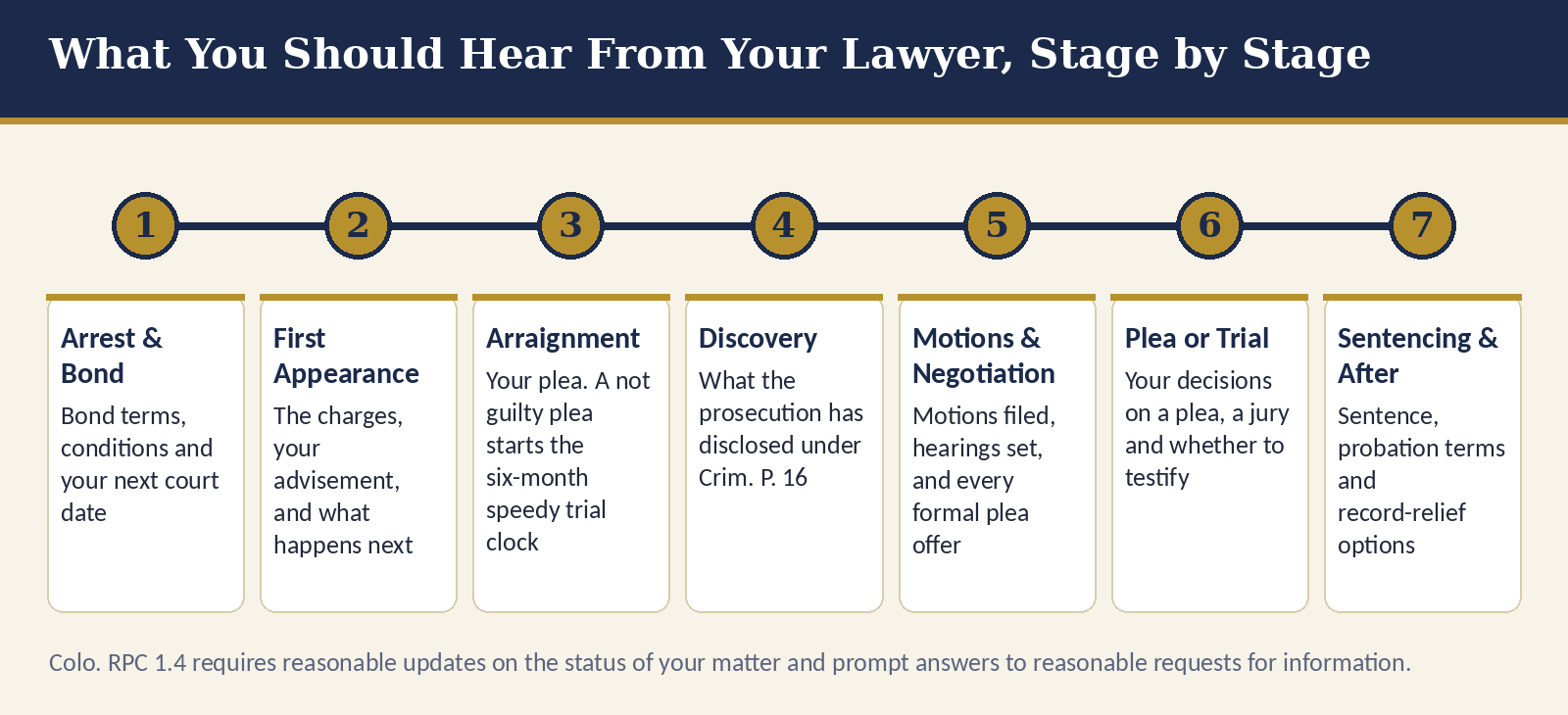
Every case follows its own path, but most Colorado criminal cases move through recognizable stages. Here is what you should expect to hear about at each one.
| Stage | What your lawyer should tell you | Why it matters |
|---|---|---|
| Arrest and bond | Bond terms and conditions, your next court date, and what not to say to police or on jail phones. | Violating bond conditions can create new problems on top of the original charge. |
| First appearance | The charges filed, the possible penalties, and any conditions the court imposes. | You cannot weigh your options until you understand your exposure. |
| Arraignment | The plea you will enter and what it sets in motion. | A not guilty plea starts the six-month period under § 18-1-405. |
| Discovery | What the prosecution has produced, what appears to be missing, and what the evidence shows. | Crim. P. 16 governs the exchange, and discovery shapes both strategy and negotiation. |
| Motions and negotiation | Motions filed and their outcomes, hearing dates, and every formal plea offer. | Offers can carry deadlines, and the duty to communicate them is constitutional. |
| Plea or trial | The consequences of each path, and your decisions on a plea, a jury and testifying. | These choices belong to you under Colo. RPC 1.2(a). |
| Sentencing and beyond | The sentencing range, probation terms, deadlines, and options after judgment. | Terms and deadlines after a plea or verdict can be unforgiving. |
In Missouri v. Frye, 566 U.S. 134 (2012) (also available as the Court’s opinion), the U.S. Supreme Court held that, as a general rule, defense counsel has a duty to communicate formal prosecution offers to accept a plea on terms that may be favorable to the accused.
The same day, in Lafler v. Cooper, 566 U.S. 156 (2012) (opinion text), the Court addressed a different problem: a defendant who rejects a plea offer because of ineffective advice and then receives a harsher result after trial.
A third case, Padilla v. Kentucky, 559 U.S. 356 (2010), held that counsel must advise a noncitizen client about the deportation risk of a guilty plea. All three decisions rest on the two-part test from Strickland v. Washington, 466 U.S. 668 (1984), the foundation of ineffective-assistance claims. In plain terms: your lawyer must tell you an offer exists, explain what it means, and give you candid advice about it.
Colorado adds another layer. Under Crim. P. 11, a judge must advise you of certain consequences before accepting a guilty plea. The Colorado Supreme Court has found advisement errors, for example where a defendant was not told that a prison sentence carries mandatory parole, in Dawson v. People (Colo. 2001). A lawyer who prepares you for that hearing helps ensure the plea is truly knowing and voluntary.

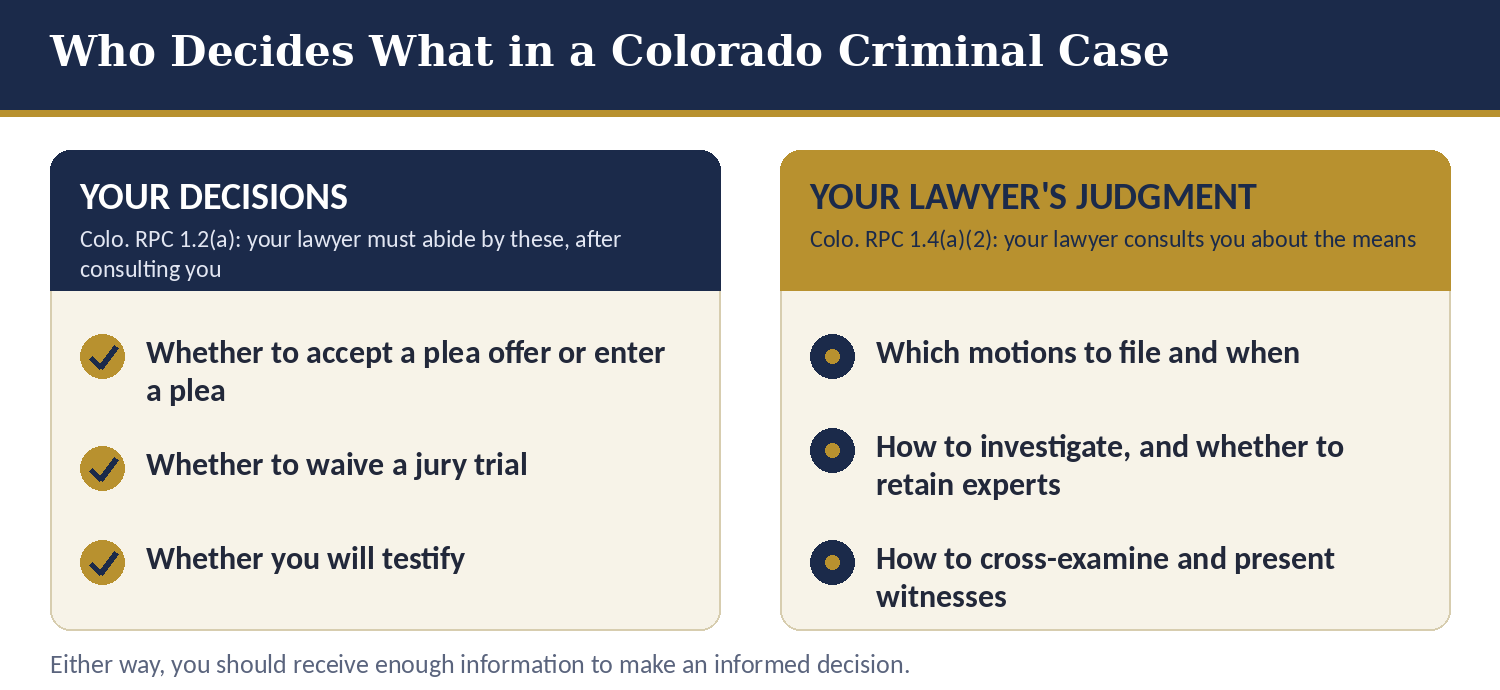
Colo. RPC 1.2(a) provides that in a criminal case the lawyer shall abide by the client’s decision, after consultation, as to the plea to be entered, whether to waive a jury trial, and whether the client will testify. Your lawyer can and should recommend a course of action, but the choice is yours.
Tactical matters, such as which motions to file and how to cross-examine a witness, are handled by your lawyer, who must still consult you about the means of pursuing your goals under Rule 1.4(a)(2). That is why a well-run defense includes real conversations, not just status emails.
Crim. P. 16 governs the exchange of information between the prosecution and the defense before trial. Your lawyer reviews police reports, recordings, lab results and witness statements, then tells you what matters and what it means for your options.
There are limits. The comments to Rule 1.4 recognize that rules or court orders governing litigation may provide that information supplied to a lawyer may not be disclosed to the client, and Rule 3.4(c) directs compliance with those rules and orders.
Crim. P. 16 also restricts to whom discovery materials may be provided. So your lawyer may sometimes review materials with you in a meeting instead of handing over copies. That is not a lack of transparency. It is compliance with the rules.
Under C.R.S. § 18-1-405(1), a defendant generally must be brought to trial within six months of the entry of a not guilty plea, subject to statutory exclusions. Subsection (3) provides that if a trial date has been set and the defendant requests and is granted a continuance, the period is extended an additional six months.
A request to continue the trial is therefore a strategic decision with consequences, and your lawyer should explain those consequences before making it. These rules have many exceptions, so your lawyer should calculate your deadlines and keep you updated as they change.
Updates can come by phone, in person, or by email or text where appropriate, and a good lawyer will meet with you before major hearings. The channel matters less than the substance: you should leave each conversation knowing where your case stands and what comes next.
Confidentiality protects these conversations. Colo. RPC 1.6 requires lawyers to make reasonable efforts to prevent inadvertent or unauthorized disclosure of information relating to a client’s representation. Colorado’s statutory attorney-client privilege, C.R.S. § 13-90-107(1)(b), provides that an attorney shall not be examined, without the client’s consent, about communications made by the client in the course of professional employment. The privilege belongs to the client, and only the client can waive it.
That puts part of the responsibility on you. Sharing your lawyer’s advice with friends, posting about your case online, or discussing it on a monitored phone line can put protection at risk. Likewise, our own website cautions that its contact form sends information by unencrypted email and that submitting it does not create an attorney-client relationship, so please do not put confidential details in a form, text message or voicemail.

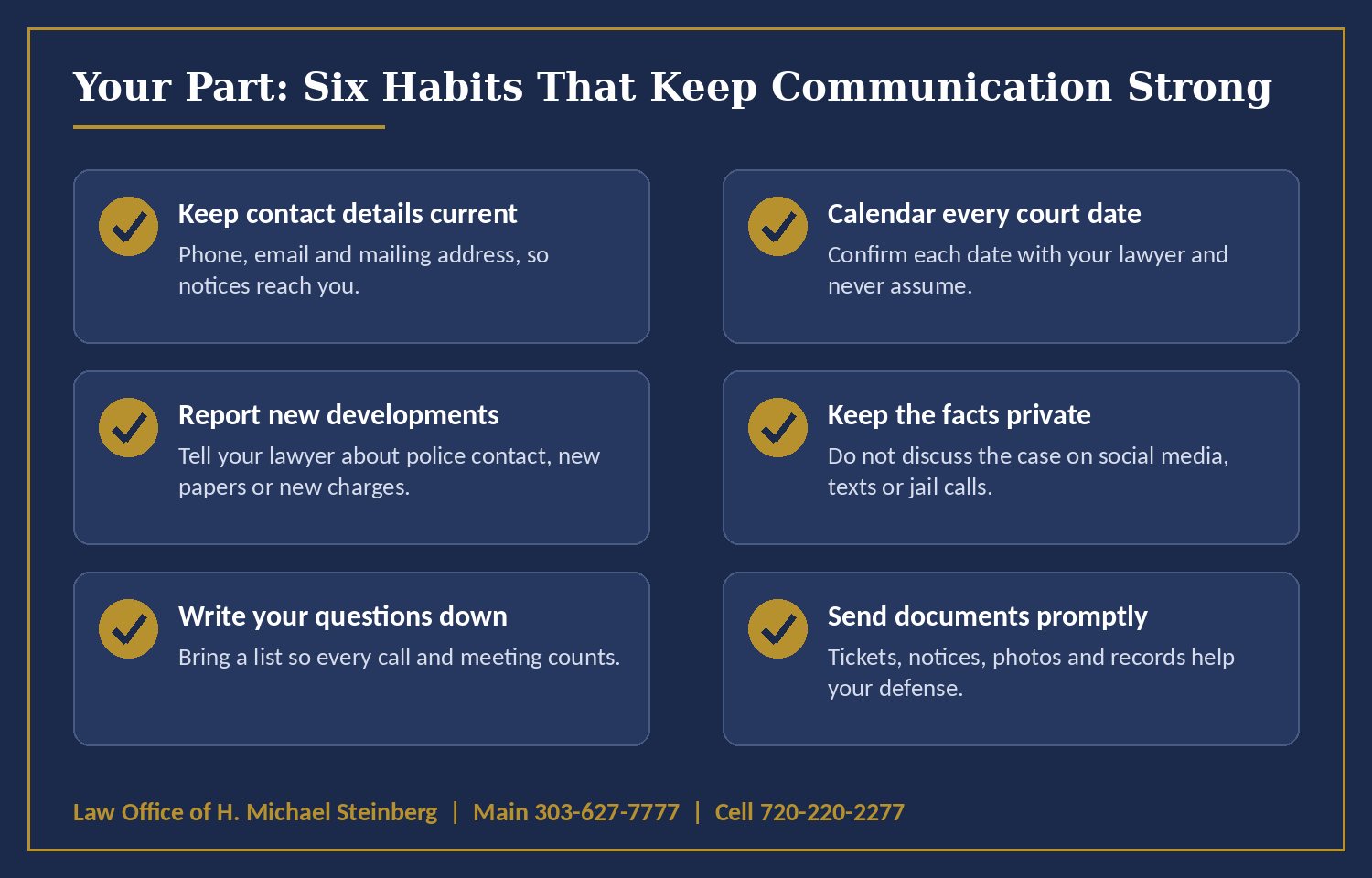
Strong communication is a partnership. You can also look up upcoming court dates yourself through the Colorado Judicial Branch docket search, which requires at least one search filter in addition to the date. Always confirm any date with your lawyer, because dockets can change.
H. Michael Steinberg has practiced Colorado criminal defense for over forty years, including thirteen years as a career prosecutor in Arapahoe and Douglas counties before founding his own firm in 1999. The firm’s approach is built on open and honest communication:
Mr. Steinberg maintains regular contact with clients so that each one stays updated on his or her case, and he encourages you to call him directly when you need to talk quickly about a fast-moving investigation or charge.
The firm defends the full range of state criminal charges, including domestic violence, DUI and DWAI, sex crimes, drug crimes, theft and assault cases.
Colorado’s rules do not set a fixed number. Colo. RPC 1.4 requires that you be kept reasonably informed and that your reasonable requests for information be answered promptly. Expect to hear about significant developments such as new filings, hearings, discovery and plea offers, and expect answers when you ask.
As a general rule, yes, for formal offers. In Missouri v. Frye, the U.S. Supreme Court held that defense counsel generally has a duty to communicate formal plea offers. Whether to accept one is your decision under Colo. RPC 1.2(a).
Often your lawyer will review it with you, but court rules or orders may limit whether you may keep copies. Ask your lawyer how discovery will be shared in your case.
Sometimes a case is waiting on the court calendar, a lab, or the prosecutor. Even then, your lawyer should be able to tell you what is pending and when to expect movement.
Generally, yes. Colo. RPC 1.6 and the privilege in C.R.S. § 13-90-107(1)(b) protect those communications, subject to limited exceptions. Keep the details of your case private from others so you do not put that protection at risk.
You can use the Colorado Judicial Branch docket search, then confirm the date with your lawyer, since schedules can change.
Free consultation. Call the main office or reach Mr. Steinberg directly.
Main: 303-627-7777 | Cell: 720-220-2277
Request Your Free Consultation
The Edwards Building, 8400 E Prentice Ave Penthouse 1500
Greenwood Village, CO 80111
Please do not send confidential details through the contact form, text or voicemail.
This article is general information about Colorado law, not legal advice, and reading it does not create an attorney-client relationship. Laws and court rules change, and every case is different. Consult a licensed Colorado attorney about your situation. See the firm’s full disclaimer. Visit the Colorado Criminal Lawyer Blog for more articles or return to hmichaelsteinberg.com.