
A Lawyer With a 42+ Year Proven Track Record
Exclusively Practicing Only Colorado Criminal
Law - Defending Your Future
Exclusively Practicing Only Colorado Criminal
Law - Defending Your Future







If you have been charged with a crime in Colorado, you will probably hear the words “plea bargain” or “plea deal” long before anyone mentions a trial. That is no accident. Plea agreements are how the overwhelming majority of criminal cases end, and for many defendants a well-negotiated agreement is the best realistic outcome. But a plea bargain is also a guilty plea (or a no-contest plea), and its consequences can follow you for the rest of your life.
This guide explains how plea bargains work in Colorado courts, the kinds of deals you may be offered, what happens at each step, and the questions you should answer before you decide. It reflects more than 42 years of Colorado criminal defense experience, including 13 years as a career prosecutor in Arapahoe and Douglas Counties, so it looks at plea negotiations from both sides of the table.
THE SHORT ANSWER
A plea bargain is a negotiated agreement in which you plead guilty (or no contest) and the district attorney gives something in return: reduced charges, dismissed counts, a sentencing recommendation, or a deferred judgment. Whether you should consider one depends on the strength of the evidence, your sentencing exposure, and consequences that go well beyond the sentence itself.
No one should accept or reject an offer before an experienced Colorado criminal defense lawyer has evaluated the case.
In This Article
A plea bargain (also called a plea agreement or plea deal) is a negotiated resolution of a criminal case. The defendant agrees to plead guilty or no contest, giving up the right to a trial, and the prosecutor agrees to something in return. That “something” is the bargain.
Colorado law expressly allows this. Under C.R.S. § 16-7-301 and Colorado Rule of Criminal Procedure 11(f), the district attorney may engage in plea discussions when doing so serves the effective administration of criminal justice. Those discussions are supposed to take place through defense counsel unless the defendant is unrepresented. The statute and rule also provide that defendants in similar situations should receive similar opportunities for plea agreements. The Colorado Supreme Court has treated plea bargaining as an accepted and unavoidable part of the judicial process (see People v. Darlington).
Two points are worth understanding from the start:
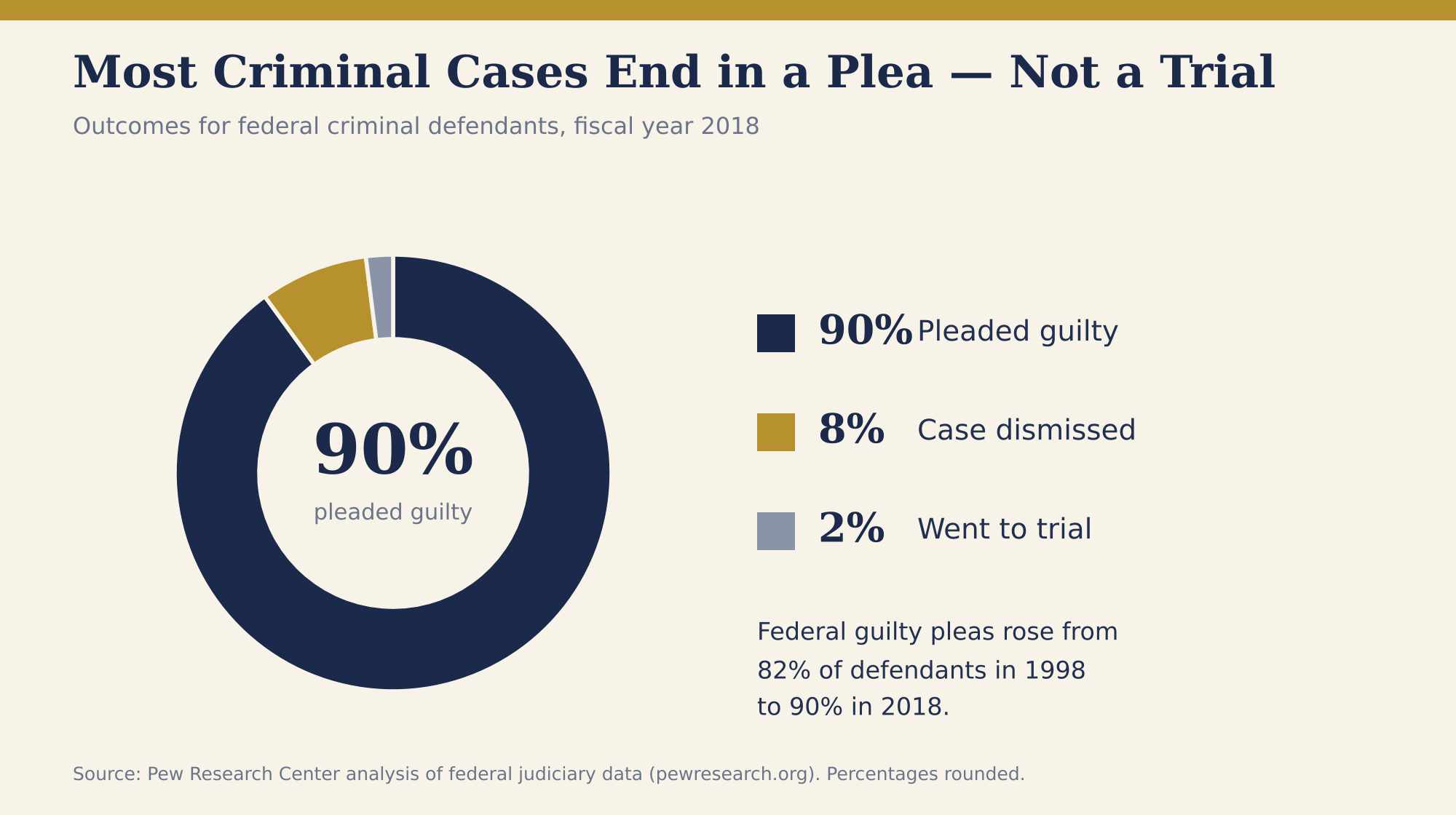
Trials are the exception. In federal court, a Pew Research Center analysis found that in fiscal year 2018 about 90% of defendants pleaded guilty, 8% had their cases dismissed, and only 2% went to trial. The Equal Justice Initiative, summarizing the U.S. Supreme Court’s reasoning in Missouri v. Frye and Lafler v. Cooper, reports that well over 90% of federal and state convictions result from guilty pleas.

Colorado follows the same pattern. State estimates reported in 2022 showed that from 2017 to 2021, 64,036 Colorado criminal cases ended in guilty pleas to class 1 or 2 misdemeanors alone.
Why? Prosecutors want certainty and manageable caseloads. Defendants want to limit risk, because a conviction after trial can mean a harsher sentence than the offer on the table. Critics, including the National Association of Criminal Defense Lawyers, call that gap the “trial penalty,” as Pew notes.
None of this means pleading guilty is usually the right call. It means that how a case is negotiated is often as important as how it would be tried. A plea should be the product of careful evaluation, not of fear or fatigue.
Depending on the facts, the district attorney may agree to several kinds of concessions. Most Colorado plea agreements fall into one or more of these categories:
| Type | How it works | Example |
|---|---|---|
| Charge bargaining | You plead to a lesser or different offense than the one originally charged. | An alleged felony theft is amended to a misdemeanor. |
| Count bargaining | You plead to some counts, and the DA dismisses others or agrees not to file additional charges. | Plead to one count; the remaining counts are dismissed. |
| Sentence bargaining | The DA agrees to recommend, or not oppose, a particular sentence or sentencing range. | An agreed probation sentence, or a cap on jail time. |
| Deferred judgment and sentence | You plead guilty, but judgment and sentence are deferred. If you comply with conditions, the plea is withdrawn and the charge is dismissed. | A first-offense case resolved with a deferred judgment. |
| Stipulated vs. open terms | Some agreements fix the sentence; others fix only the charge and leave sentencing to the judge. | Plea to a reduced charge with sentencing left to the court. |
Many agreements combine more than one of these. If you are charged with a drug offense, note that Colorado law bars a plea agreement from requiring you to give up the right to petition to seal your records after a plea to an offense under article 18 of title 18 (C.R.S. § 16-7-301). See our page on Colorado drug crime defense for more.

WATCH THE CALENDAR
Courts can set plea deadlines. In People v. Jasper, the Colorado Supreme Court held that a trial court may enforce a plea cutoff date when the parties had notice and showed no good cause for missing it. Some divisions refuse plea agreements on the morning of trial; the El Paso County division order linked above requires counsel to report an agreement by noon the day before trial. Ask your lawyer immediately what deadlines apply in your courtroom.
One of the most valuable agreements in Colorado is the deferred judgment and sentence under C.R.S. § 18-1.3-102. You plead guilty, but the court does not enter judgment or impose a sentence. Instead you agree to follow conditions for a set period. If you succeed, the plea is withdrawn and the charge is dismissed with prejudice.

Key points to understand:
After a successful deferred judgment, the case is dismissed. Under C.R.S. § 24-72-705, when a deferred judgment is completed and all counts are dismissed, the court is generally required to seal the records on its own motion. Not every case qualifies: certain offenses, including some involving unlawful sexual behavior, are excluded. The Colorado Judicial Branch’s guide to sealing non-conviction records explains the process, and its sealing overview notes that sealing a conviction does not vacate it.
Because a deferred judgment depends on strict compliance, one violation can turn a “no conviction” result into a conviction and sentence. If you are accused of violating terms, read about defending probation violations and speak with a lawyer right away.

If the prosecution’s case has real problems, such as an unlawful search, a shaky identification, unreliable testing, or credibility issues, your leverage grows, and the right move may be to litigate before deciding. When the evidence is strong, a favorable agreement can be wiser than the risk of trial.
Compare the realistic sentence after conviction at trial with the offer. Felony sentencing in Colorado is driven by offense class. For example, the presumptive range for a class 3 felony is 4 to 12 years in prison, according to a Colorado legislative overview of C.R.S. § 18-1.3-401, and special sentencing categories such as crimes of violence can raise that range. A plea that reduces a felony to a misdemeanor, or secures probation, can change your exposure dramatically.
Immigration status, firearm rights, professional licenses, employment, housing, and family-court matters can matter more than the sentence itself. We cover these in the next section.
A conviction, a deferred judgment that is later dismissed, and a dismissal outright are very different results. Ask whether the agreement preserves your ability to seal the record later.
Offers can expire, and courts can set cutoffs. Rushing is a mistake, but so is waiting until the last day.
Some clients value certainty and speed. Others will not accept any conviction and choose to fight. That choice is yours, and a good lawyer will respect it while making sure you understand the risks on each path.
A good plea agreement is not a surrender. It is usually the result of preparation: a case that has been investigated, tested, and made ready for trial.
A plea can affect your life in ways the judge never mentions. Depending on the offense, consider:
Rarely, and the window closes quickly.
The Sixth Amendment right to a lawyer does not stop at the courtroom door. In Missouri v. Frye and Lafler v. Cooper, the U.S. Supreme Court held that defendants are entitled to effective assistance during plea bargaining, including having formal offers communicated and receiving competent advice about whether to accept or reject them. The American Bar Association’s summary describes how those decisions treat remedies when counsel falls short. In short: you are entitled to a lawyer who evaluates the case, tells you about every offer, and explains your realistic options in plain language.
Not exactly. The plea bargain is the agreement with the prosecutor. The guilty or no-contest plea is what you then enter in court, and the judge must accept it.
No. The judge must exercise independent judgment, and the agreement is between the defendant and the prosecutor only. Courts should have good reason to reject an agreement, but they are allowed to do so.
In limited situations the law allows unrepresented defendants to talk with prosecutors. It is risky: you may miss defenses, immigration and licensing consequences, and better options.
It depends on the prosecutor and the court. Offers can expire, and some courts set plea cutoff dates before trial. Ask your lawyer on day one.
The court generally must enter judgment and impose sentence on your guilty plea, subject to limited exceptions for certain drug offenses. See C.R.S. § 18-1.3-102.
Generally, yes. A guilty plea waives many trial-related rights and narrows what can be challenged later, which is why the decision should be made with full information.
Whether you are weighing an offer today or have just been charged, the choices you make early can shape the outcome. H. Michael Steinberg has handled Colorado criminal cases for more than 42 years, including 13 years as a career prosecutor in Arapahoe and Douglas Counties, and offers a free consultation.
FREE CONSULTATION
Direct line: 720-220-2277Request a Free Consultation
The Edwards Building, 8400 E Prentice Ave, Penthouse 1500, Greenwood Village, CO 80111. Serving clients throughout Colorado, including Denver, Arapahoe, Adams, Jefferson, Douglas, El Paso, and Weld Counties.
Related: Criminal defense practice areas • About H. Michael Steinberg • Case results • Client reviews • Colorado Criminal Lawyer Blog
STATUTES AND RULES
COLORADO CASES
U.S. SUPREME COURT
DATA, FORMS, AND COMMENTARY
Disclaimer: This article is provided for general informational purposes only and is not legal advice. Reading it does not create an attorney-client relationship. Laws and court practices change, and every case is different. Consult a licensed Colorado criminal defense attorney about your specific situation. Please do not send confidential information through the website contact form, text message, or voicemail. Last reviewed October 14, 2026. Full site disclaimer.