
A Lawyer With a 42+ Year Proven Track Record
Exclusively Practicing Only Colorado Criminal
Law - Defending Your Future
Exclusively Practicing Only Colorado Criminal
Law - Defending Your Future












By H. Michael Steinberg | Denver Criminal Defense Attorney | Updated October 26, 2026
A fatal crash involving alcohol or drugs is the most serious traffic-related case a Colorado prosecutor can file. The charge is usually vehicular homicide, a class 3 felony that carries a presumptive prison range of 4 to 12 years, followed by a mandatory parole period.
But the real sentence depends on more than the statute: the charge selected, the number of victims, the driver’s history, and whether the case ends in a plea or a jury verdict can move the outcome from probation-eligible to decades in prison.
This article explains how Colorado courts actually sentence DUI drivers in fatal accidents, what changed in 2026, and what families and defendants should understand early.
It is written by a Denver criminal defense lawyer who spent 13 years as a career prosecutor in the Arapahoe and Douglas County District Attorney’s offices and has practiced Colorado criminal law for more than 42 years.
Vehicular homicide-DUI under C.R.S. 18-3-106 is a class 3 felony: 4–12 years in the Department of Corrections, a $3,000–$750,000 fine, and 3 years of mandatory parole for offenses on or after July 1, 2020 (see C.R.S. 18-1.3-401).
A judge who finds extraordinary aggravating circumstances may go up to 24 years. Separate victims can mean separate, consecutive sentences.In This Guide
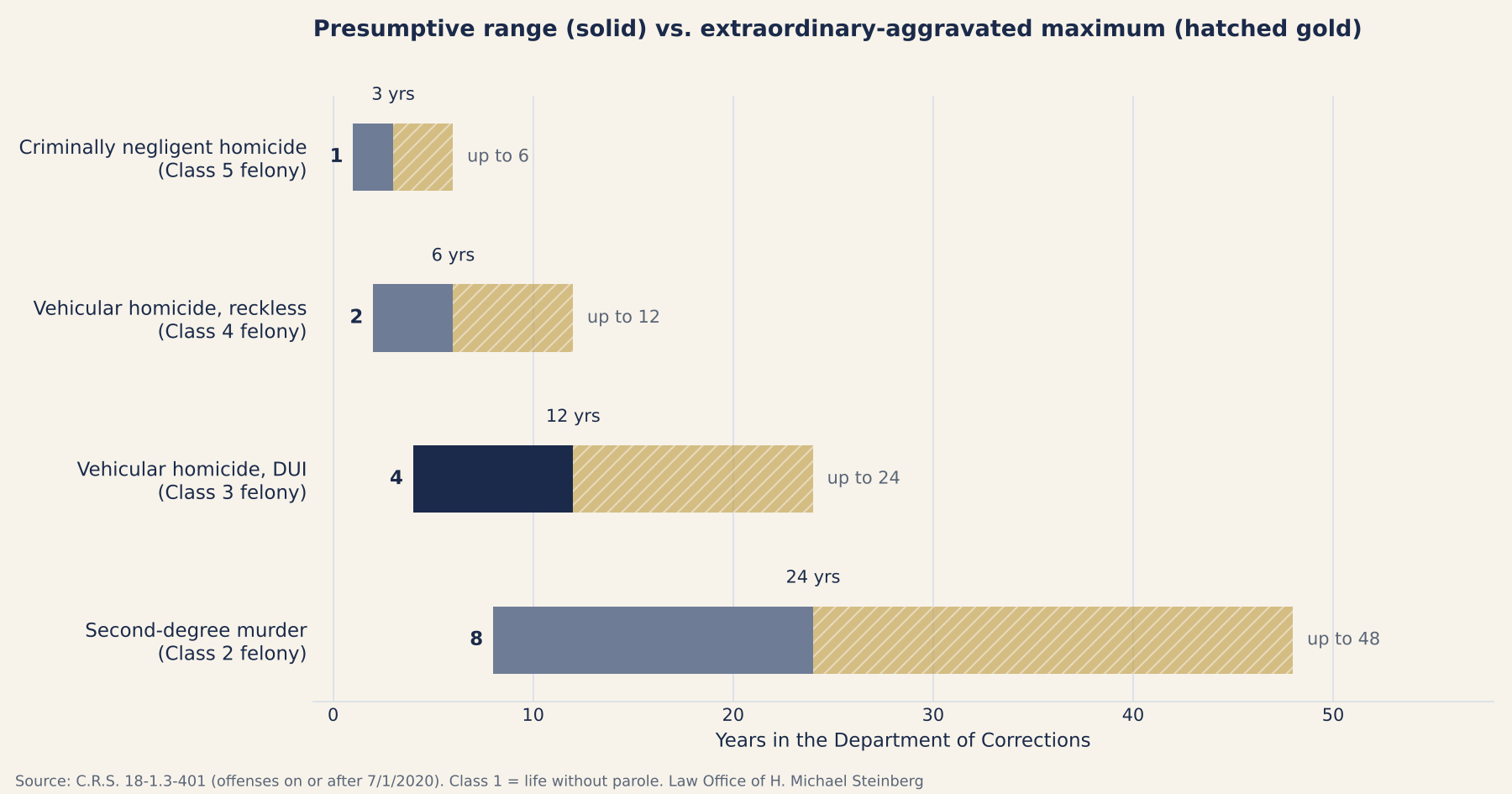
Colorado does not have a single “fatal DUI” offense. Prosecutors choose from a ladder of homicide charges, and the choice largely determines the sentencing range.
Charging escalation is rare but real. In 2025, a Douglas County judge sentenced a repeat DUI offender to life in prison plus 92 years after a fatal Castle Rock crash, according to The Gazette. Cases like that are the exception, but they show why the early charging decision matters so much.
For crimes committed on or after July 1, 2020, Colorado’s felony sentencing statute, C.R.S. 18-1.3-401, sets these presumptive ranges:

| Felony class | Prison range | Mandatory parole | Fine range | Typical fatal-crash charge |
|---|---|---|---|---|
| Class 5 | 1–3 years | 2 years | $1,000–$100,000 | Criminally negligent homicide |
| Class 4 | 2–6 years | 3 years | $2,000–$500,000 | Vehicular homicide (reckless) |
| Class 3 | 4–12 years | 3 years | $3,000–$750,000 | Vehicular homicide (DUI) |
| Class 2 | 8–24 years | 5 years | $5,000–$1,000,000 | Second-degree murder |
| Class 1 | Life without parole | None | n/a | Extreme-indifference murder |
A judge may sentence above the presumptive range if the court makes findings of extraordinary aggravating circumstances. Under the statute, the sentence can be no more than twice the maximum of the range, which is why a class 3 vehicular homicide can reach 24 years. Certain circumstances, such as flight from another felony or a pregnant victim, trigger mandatory aggravated sentencing under subsections (8)(g) and (13) of C.R.S. 18-1.3-401.
Long sentences can be challenged as grossly disproportionate under the Eighth Amendment and Colorado’s framework from Wells-Yates v. People. In People v. Kennedy, 2025 CO 63, the Colorado Supreme Court addressed vehicular homicide-DUI and concluded it is not per se a grave or serious offense for that analysis, which is relevant when a defendant challenges a long sentence as disproportionate.
Within the range, the judge has wide discretion. The pre-sentence investigation report, victim impact statements, and the lawyers’ arguments all shape the number.
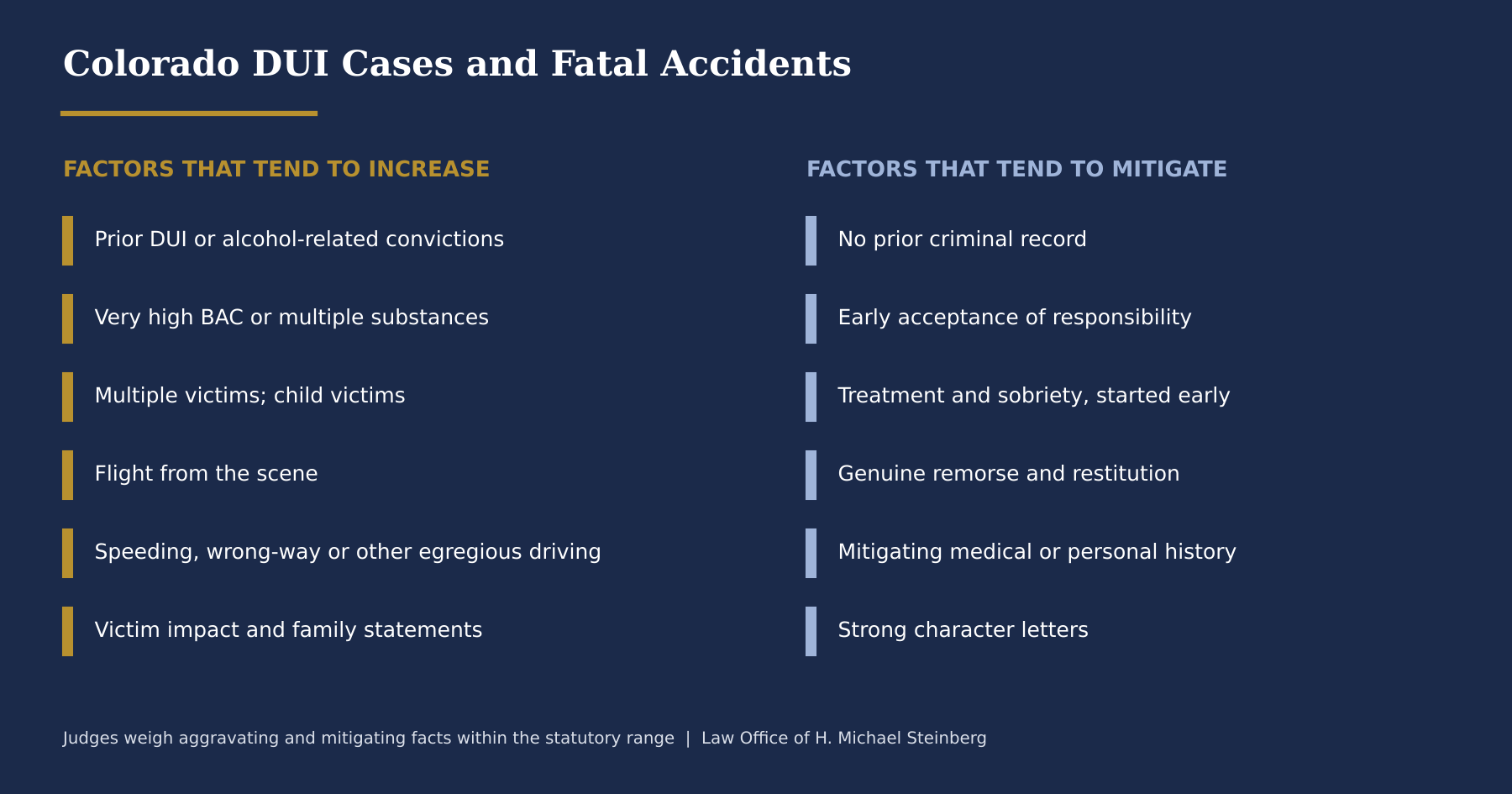
In a fatal DUI case, the sentence is often shaped long before the sentencing hearing.
Probation is a legal possibility in many vehicular homicide cases under C.R.S. 18-1.3-201, because vehicular homicide is not on the list of mandatory-prison crimes of violence in C.R.S. 18-1.3-406.
In practice, prison is the norm when someone dies. But probation or a community-corrections-plus-jail sentence does happen, usually through a negotiated plea. In one Douglas County case, a judge re-sentenced a driver convicted of vehicular homicide-DUI and leaving the scene to 180 days in jail and four years of probation after the initial six-year prison sentence, a result the prosecutor publicly opposed.
Some news and law-firm sites claim that SB26-072 made vehicular homicide a “crime of violence.” The enacted version of the bill does not do that. A Senate Judiciary amendment removed the language.
Read the bill and session law rather than relying on summaries.
The act clarifies the conduct by which a person can commit criminally negligent homicide to include proximately causing the death of another person while operating or driving a motor vehicle with criminal negligence. The act repeals the class 1 misdemeanor traffic offense of a person being the proximate cause of death to another person while driving a motor vehicle, while clarifying it can be charged as a class 5 felony elsewhere in statute.
When a crash kills or injures more than one person, each victim can support a separate count.
The judge then decides whether the sentences run concurrently (together) or consecutively (one after the other). This is how a class 3 felony with a 12-year maximum can become a much longer total sentence.
In April 2026, the Larimer County District Attorney announced that a defendant who pleaded guilty to vehicular homicide-DUI and two counts of vehicular assault-DUI was sentenced to 35 years in the Department of Corrections.
Plea structure matters. An open plea leaves the sentence to the judge. A stipulated cap or sentence agreement limits exposure, but can also limit the ability to argue for less. Choosing between them is a core strategic decision.
Because vehicular homicide is not a listed crime of violence, a defendant is generally parole-eligible after serving about 50% of the sentence under C.R.S. 17-22.5-403, subject to earned-time rules and Parole Board discretion. A 10-year sentence therefore often means about five years before a parole hearing, followed by the mandatory parole term. Parole is not automatic.
The following outcomes were publicly reported and illustrate the range of results. Every case turns on its own facts.
| Case (public reports) | Charges / result | Sentence |
|---|---|---|
| Paul Stephenson, Douglas County, 2025 | Sentenced after fatal Castle Rock crash; lengthy DUI history | Life plus 92 years |
| Shane Bradley Mills, Larimer County, 2026 | Guilty plea: vehicular homicide-DUI and two counts of vehicular assault-DUI | 35 years DOC |
| Swecker, Douglas County (crash 2012) | Jury verdict: vehicular homicide-DUI and leaving the scene | Originally 6 years; resentenced to 180 days jail and 4 years probation |
Sources for these cases: The Gazette, the Larimer County DA, and the 18th Judicial District DA.
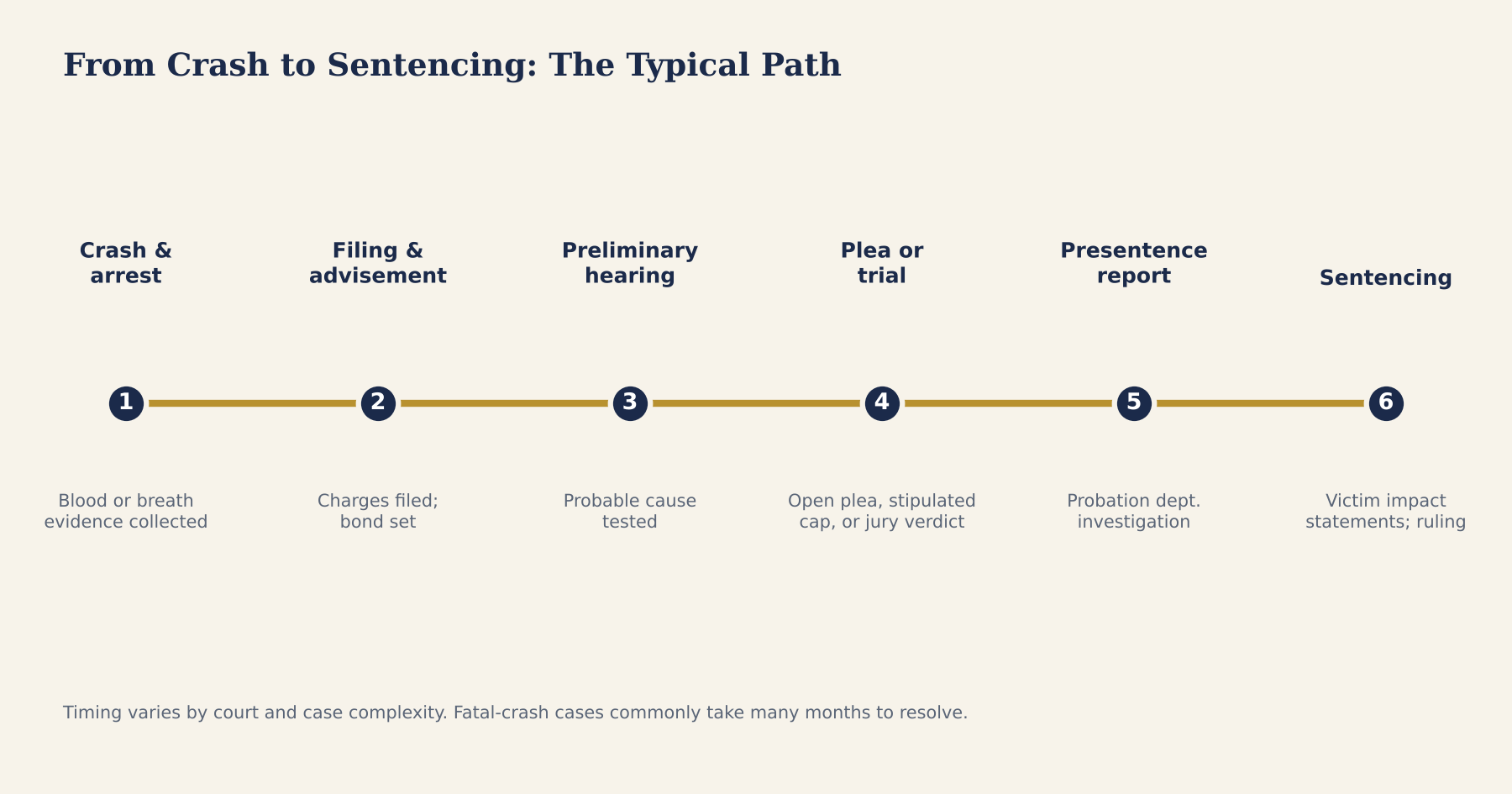

After arrest, the case moves through advisement and bond, a possible preliminary hearing, and then plea negotiations or trial. If there is a conviction, the probation department prepares a presentence report. The defense can and should submit its own mitigation package, including a sobriety and treatment record, evaluations, and letters. Sentencing follows, with victim statements.
Strong defenses in these cases often focus on causation (whether intoxication, as opposed to another factor, caused the death), the legality of the stop and blood draw, and the reliability of lab testing.
It is a class 3 felony with a presumptive range of 4 to 12 years in prison, up to 24 years with extraordinary aggravating circumstances, plus 3 years of mandatory parole. See C.R.S. 18-3-106 and 18-1.3-401.
No. It is not listed in C.R.S. 18-1.3-406, and the enacted SB26-072 did not add it.
Yes. With a long DUI history or extreme conduct, prosecutors can charge second-degree murder or first-degree extreme-indifference murder.
It is legally possible in many cases, but uncommon. It usually results from a negotiated plea and strong mitigation.
Typically parole eligibility arrives at about 50% of the sentence, though earned time and Parole Board discretion apply.
Yes. Each victim can support a separate count, and a judge may run the sentences consecutively.
No. Politely decline to answer questions and contact a criminal defense lawyer immediately.
Few cases carry more at stake. The decisions made in the first days, including what to say, what is said to investigators, preserving blood-test evidence, and how to begin building mitigation, can shape the final sentence. Attorney H. Michael Steinberg is a former Arapahoe and Douglas County prosecutor with more than 42 years of Colorado criminal law experience. Call 303-627-7777 (cell 720-220-2277) or visit hmichaelsteinberg.com for a confidential consultation.
Facing a Fatal DUI Investigation or Charge?
Free, confidential consultation with a former prosecutor and 42+ year defense lawyer.
Call 303-627-7777Cell 720-220-2277
The Edwards Building, 8400 E Prentice Ave, Penthouse 1500, Greenwood Village, CO 80111 | hmichaelsteinberg.com
This article is general information, not legal advice, and does not create an attorney-client relationship. Colorado law changes; statutes and case outcomes cited were current as of October 26, 2026. Case examples are drawn from public reports and each case depends on its own facts. Prior results do not guarantee a similar outcome. Attorney advertising.