
A Lawyer With a 42+ Year Proven Track Record
Exclusively Practicing Only Colorado Criminal
Law - Defending Your Future
Exclusively Practicing Only Colorado Criminal
Law - Defending Your Future










Colorado Criminal Defense • Know Your Rights
By H. Michael Steinberg • October 13, 2026 • Law Office of H. Michael Steinberg
It usually starts politely. A detective leaves a card on your door. An officer says, “You’re not in trouble, we just want to hear your side.” Or flashing lights fill your rearview mirror and the first question is, “Do you know why I pulled you over?” In each moment, the same question runs through your mind: Do I have to speak to the police?
The honest answer is more nuanced than “you have the right to remain silent.” Colorado law requires a few narrow things of you, protects you in many others, and — this is the part that surprises people — will not protect you at all unless you clearly say you are using your rights.
This guide explains exactly where those lines fall in Colorado, based on the statutes and court decisions that control, so you can protect yourself before a conversation turns into a criminal case.
No. In Colorado you generally do not have to answer police questions about a crime, whether you are a suspect, a witness, or under arrest. There are two narrow exceptions: when lawfully detained you must provide your name, address, and identification if you have it, and in a traffic stop you must hand over your license. Beyond that, your protection depends on clearly invoking your rights — silence alone may not be enough.

Three sources of law protect you, and a Colorado defense lawyer will rely on all of them:
Notice what these protections have in common: they exist to keep the government from using your own words to convict you. That is why the single most valuable thing you can do when police want to talk is often to say nothing about the facts and ask for a lawyer.
Many people talk because they assume police interviews are neutral. They are not. Investigators are trained to obtain statements, and courts have long allowed them to use some deception to do it. In Frazier v. Cupp, 394 U.S. 731 (1969), the U.S. Supreme Court upheld a confession even though the officer falsely claimed an accomplice had already confessed.
That means an officer can tell you that “your friend already talked,” that “this is your chance to tell your side,” or that “cooperating now will help you” — and none of it has to be true. You are never obligated to walk into that conversation without a lawyer.
“The only statement you can never take back is the one you made before you spoke to a lawyer.”
Your obligations depend on what kind of encounter you are in. Most people never stop to ask, but the answer changes everything.
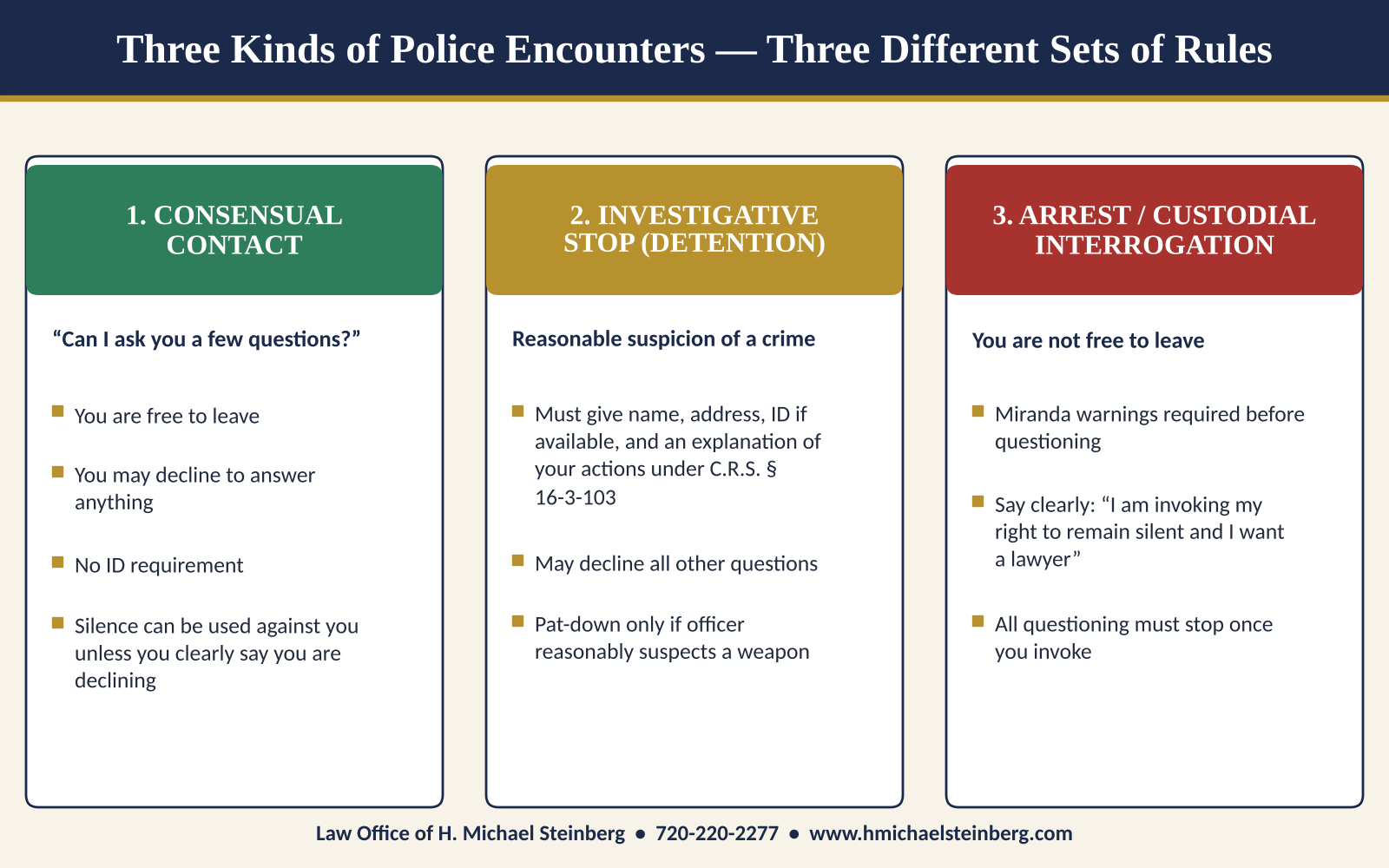
This is the “mind if I ask you a few questions?” conversation. You are not detained. You can decline to answer, and you can walk away. You are not required to show ID. The danger in this setting is that people stay and talk because they do not realize they are free to leave. Ask directly: “Am I free to go?”
Under Terry v. Ohio, 392 U.S. 1 (1968), an officer who reasonably suspects criminal activity can briefly detain you. Colorado codified this in C.R.S. § 16-3-103: an officer may stop a person reasonably suspected of committing, having committed, or being about to commit a crime, and may require the person to give a name and address, identification if available, and an explanation of his or her actions. The statute also bars officers from requiring you to produce or divulge your Social Security number, and it allows a pat-down for weapons only if the officer reasonably suspects the stop requires it for personal safety.
The U.S. Supreme Court upheld this kind of “stop and identify” law in Hiibel v. Sixth Judicial District Court of Nevada, 542 U.S. 177 (2004), holding that requiring a suspect to disclose his name during a lawful stop did not violate the Fourth or Fifth Amendment in that case. The decision was a narrow one, and it turned on a name-only requirement.
PRACTICAL TAKEAWAY
If you are lawfully detained in Colorado, calmly provide your true name, address, and ID. Then politely decline to discuss what happened. The statute’s reference to an “explanation of actions” is exactly the kind of demand where an experienced defense attorney can advise you about the Fifth Amendment — so the safest course is to state that you will not answer questions about the incident without a lawyer.
Once you are in custody and being interrogated, police must give Miranda warnings before questioning you, and anything you say without them is generally inadmissible in the prosecution’s case at trial. But Miranda is a rule about interrogation, not arrest.
Officers are not required to read you your rights the moment you are handcuffed. They only need to warn you before they question you. If they never question you, they never need to warn you.
Exercising your rights does not mean being uncooperative in every way. A few obligations are real, and violating them can create new charges on top of the original investigation.
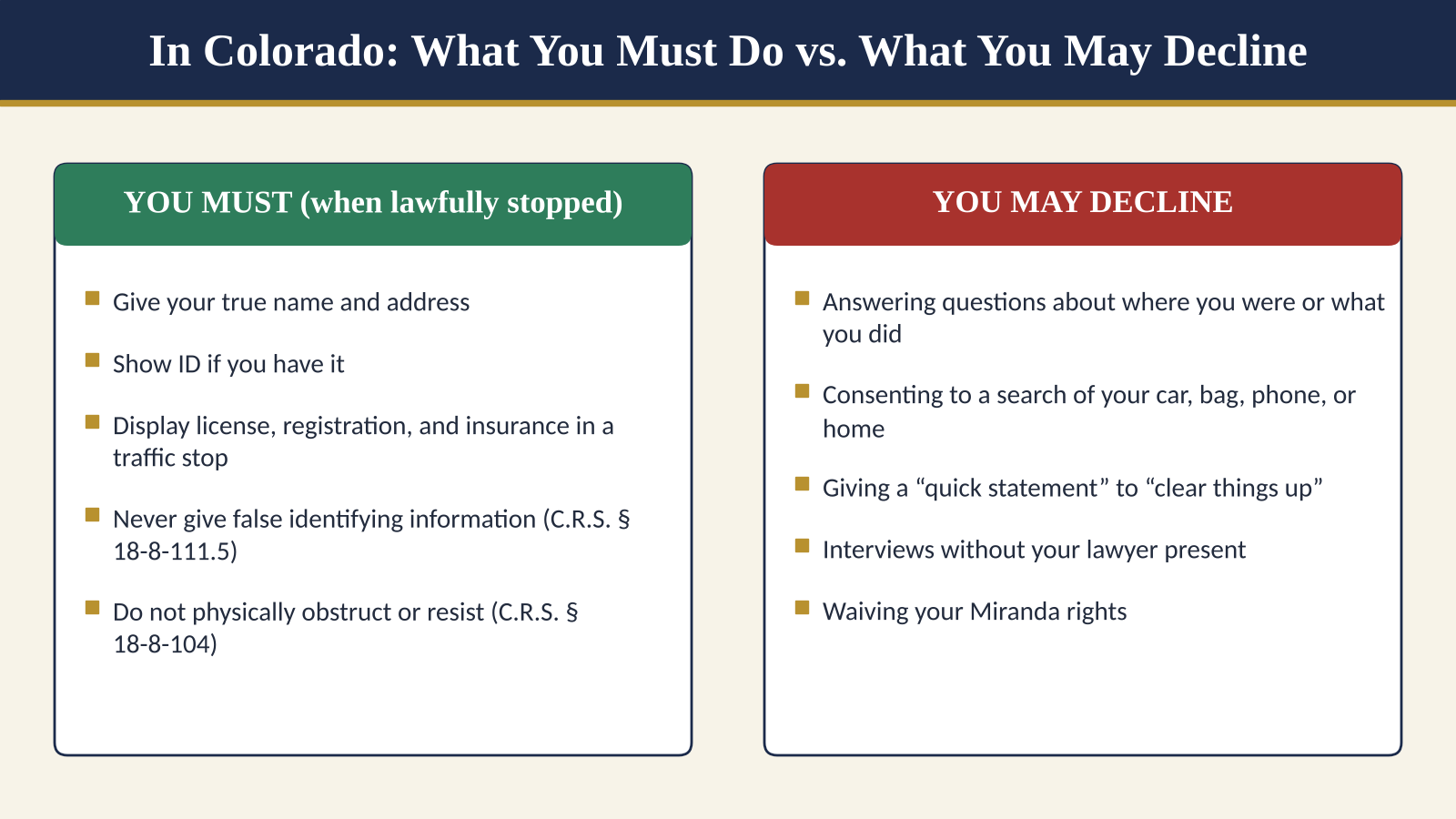
The safest approach is simple and polite: comply physically, decline verbally. Hand over what the law requires. Do not argue, run, or reach for your pockets.
Fight the case in court, not on the street.
This is the point most articles skip, and it is the one that costs people their cases. The “right to remain silent” is not self-executing. In practice, you generally have to say that you are invoking it.
“Silence is not an invocation. If you want your rights, you have to say the words.”
Clear, simple, and unmistakable. Then stop talking.
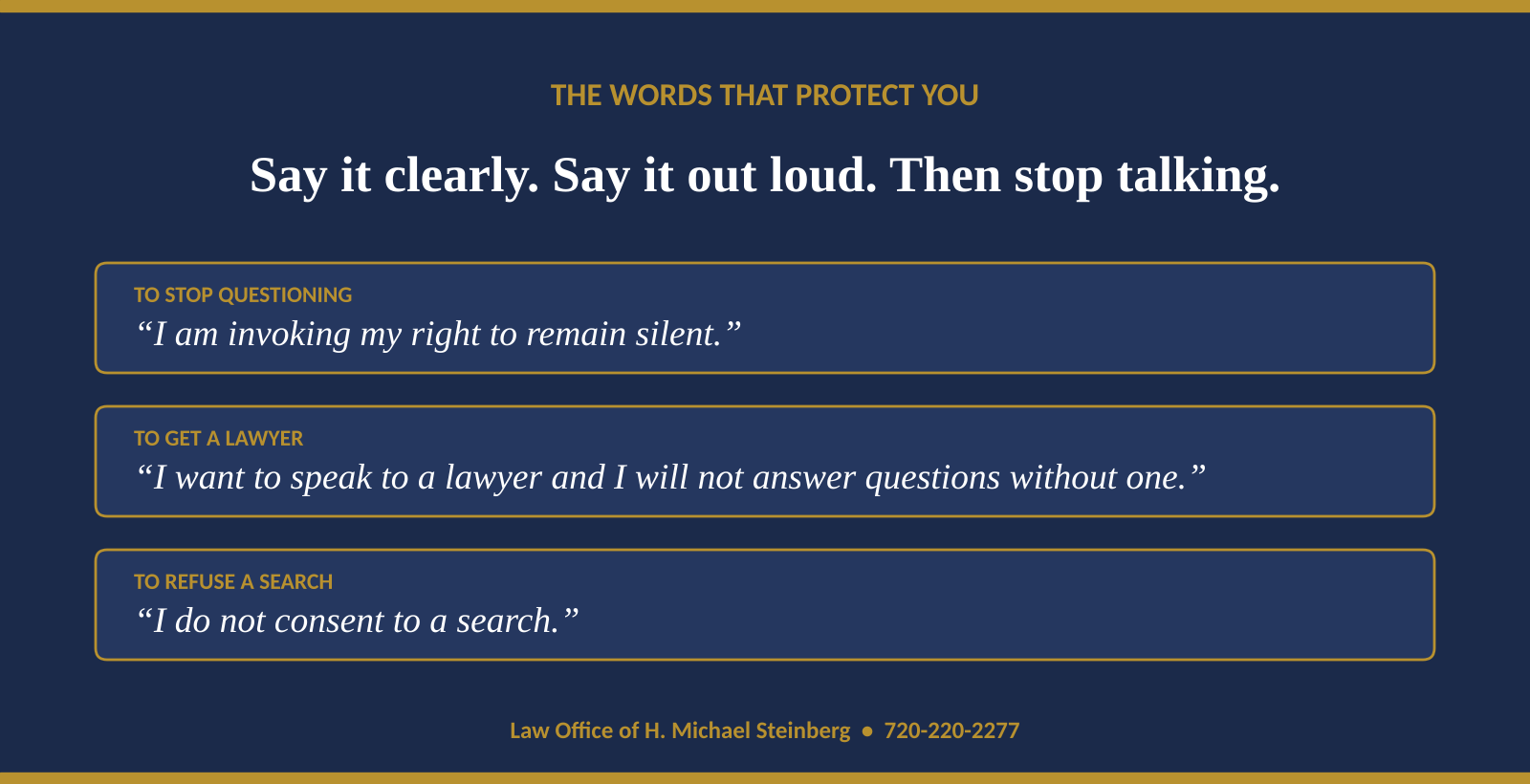
Once you have said these words, stop answering questions — including small talk, comments about the weather, or “off the record” remarks. Many suspects invoke correctly and then talk themselves out of it two minutes later.
Once you clearly invoke in custody, officers must stop. Colorado courts take violations seriously. In People v. Cerda, 2024 CO 49, the Colorado Supreme Court held that detectives violated Miranda when they kept interrogating a murder suspect after he clearly and unambiguously invoked his right to remain silent, and it affirmed suppression of the statements he made afterward from the prosecution’s case-in-chief.
But the rules have limits, and a 2026 decision shows how much timing and custody matter. In People v. Lulei, 2026 CO 17, a divided Colorado Supreme Court held that a man who asked for a lawyer while he was not in custody did not trigger the protections of Miranda and Edwards v. Arizona, even though a detective had begun to read him a Miranda advisement form.
The Court reasoned that Miranda applies only to custodial interrogation and that an advisement by itself does not create custody. Three justices dissented, including a strongly worded dissent criticizing how police treated the man’s request for counsel.
| WHY LULEI MATTERS TO YOU If you are asked to “come down to the station to give a statement,” you may not be “in custody” in the legal sense, which means the protections you assume you have may not apply yet. Do not rely on Miranda to rescue you. Speak to a Colorado criminal defense lawyer before you agree to any interview, and if you do go, state clearly that you will not answer questions without counsel. For more on the underlying rule, see Edwards v. Arizona, 451 U.S. 477 (1981). |
The lesson from Cerda and Lulei together is that police conduct and the legal status of the encounter both matter, and that the safest path is to avoid the interview and hand the conversation to a lawyer.
Talking is not the only way people hurt their cases. “Mind if I take a look in your car?” is a request for consent, and consent erases the need for a warrant or probable cause. Colorado law recognizes this risk: under C.R.S. § 16-3-310, before an officer asks to search a vehicle or a person during a police contact, the officer must advise you that you are being asked to voluntarily consent and that you have the right to refuse, and may search only if you voluntarily give verbal or written consent.
If you are asked, say: “I do not consent to a search.” Say it calmly, say it clearly, and do not physically interfere if the officer searches anyway. Whether the search was lawful is a question for your lawyer and the court, not for a roadside argument. An unlawful search can later lead to suppression of the evidence.
Many serious cases begin quietly: a voicemail from a detective, a business card in your door, a request to “clear up a few things,” or a call from someone claiming you are “just a witness.” You often have the most power at this stage because nothing has been filed yet. A defense attorney can contact investigators on your behalf, learn what the case is about, and decide whether and how any communication should happen.
These issues arise in nearly every area of criminal law we handle, including DUI and DWAI, domestic violence, drug crimes, sex crimes, and assault. In each, the statements made in the first few hours often decide how strong the prosecution’s case becomes.
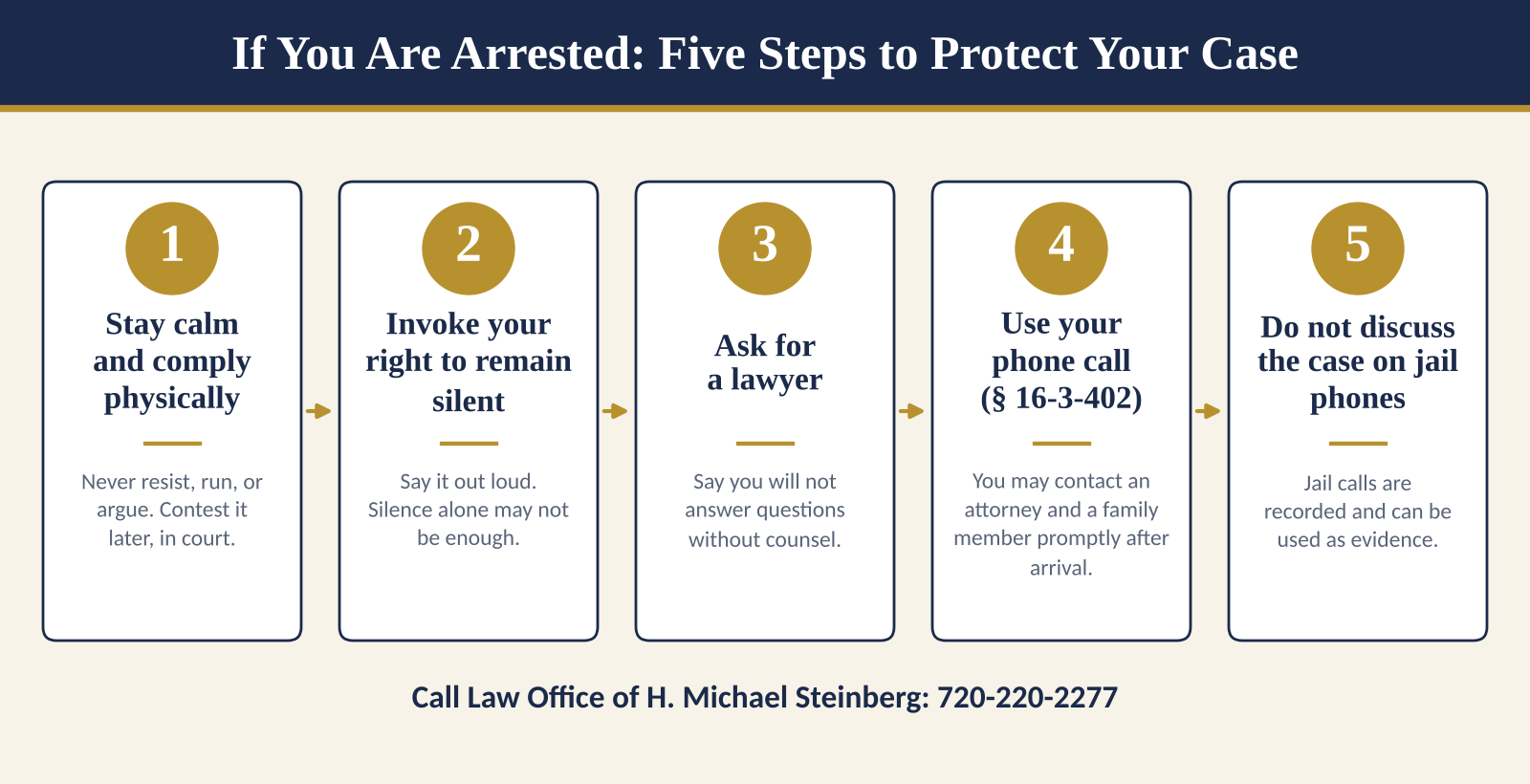
Colorado also requires police to electronically record certain custodial interrogations. Under C.R.S. § 16-3-601, an interrogation in a permanent detention facility must be audio-visually recorded when officers are investigating a class 1 or class 2 felony or a felony sexual assault, subject to listed exceptions. If an interrogation that should have been recorded was not, the court may still admit it but can give the jury a cautionary instruction.
| The Myth | The Reality |
|---|---|
| “If I’m innocent, I have nothing to hide.” | Innocent people give statements that are misremembered, misunderstood, or misquoted, and a small inconsistency can be portrayed as a lie. |
| “Police have to read me my rights when they arrest me.” | Miranda warnings are required before custodial interrogation, not at the moment of arrest. |
| “Staying silent will make me look guilty.” | If you invoke clearly after being warned, the prosecution generally cannot use your invocation as evidence of guilt. Before arrest, unexplained silence is riskier, which is why you should say you are declining. |
| “If I just explain, they will let me go.” | Officers are not obligated to release you because you gave an explanation, and your explanation may become the centerpiece of the case against you. |
| “I can talk to them first and hire a lawyer later.” | Statements you give cannot be taken back. The best time to hire a lawyer is before you talk. |
Generally no. Outside of the narrow duty to identify yourself when lawfully stopped and to show your license in a traffic stop, you are not required to answer questions about a possible crime. Be sure to state clearly that you are declining.
If an officer lawfully stops you based on reasonable suspicion, C.R.S. § 16-3-103 allows the officer to require your name and address and identification if available. If the encounter is consensual and you are free to leave, you are not required to provide identification. Never give a false name.
Declining to answer questions is not itself a crime in Colorado. The obstruction statute, C.R.S. § 18-8-104, is aimed at violence, force, physical interference, or an obstacle. Physical resistance, false information, or interfering with an investigation can lead to charges.
Say: “I am invoking my right to remain silent, and I want to speak to a lawyer. I will not answer questions without one.” Then stop talking.
Even innocent people should speak to a lawyer first. Statements can be taken out of context, and an attorney can decide whether any communication helps you.
No. You may refuse consent. In Colorado, officers must advise you of the right to refuse before asking for consent to search a vehicle or person during a police contact. Do not physically interfere if a search proceeds, and let your lawyer challenge it later.
You do not have to open it unless officers have a warrant or another lawful basis to enter. You can speak through the door, ask whether they have a warrant, state that you will not answer questions without a lawyer, and then call an attorney.
Every case is different, and the right move depends on the facts: whether you are a suspect or a witness, whether a warrant exists, and what the police already know. With more than forty years of Colorado criminal defense experience, the Law Office of H. Michael Steinberg has seen how early statements shape cases from the first interview through trial. We handle investigations, arrests, and charges across the Denver metro area.
If police have contacted you, or you believe you are under investigation, call before you answer a single question: 720-220-2277 (main office 303-627-7777). You can also contact us online, review our practice areas, read about attorney H. Michael Steinberg, or visit our Colorado Criminal Lawyer Blog.
ABOUT THE AUTHOR
H. Michael Steinberg is a Denver criminal defense attorney with more than forty years of Colorado practice experience. His firm defends clients accused of DUI, domestic violence, drug crimes, sex crimes, and a wide range of felony and misdemeanor offenses throughout the Denver metro area. Call 720-220-2277
This article is for general informational purposes only and is not legal advice. Reading it does not create an attorney-client relationship. Laws change and every case is different; consult a licensed Colorado criminal defense attorney about your specific situation. Past results do not guarantee a similar outcome.