
A Lawyer With a 42+ Year Proven Track Record
Exclusively Practicing Only Colorado Criminal
Law - Defending Your Future
Exclusively Practicing Only Colorado Criminal
Law - Defending Your Future











Published October 17, 2026 | Colorado Supreme Court case analysis
Yes—but not automatically. In People v. Vanpelt, 2026 CO 66, the Colorado Supreme Court held that officers did not violate the Fourth Amendment or the Colorado Constitution when they removed a holstered firearm from an unconscious man before arresting him.
The Court relied on two connected findings:
The People v. Vanpelt, 2026 CO 66, decision is narrower than the headline might suggest.
VanPelt does not hold that every welfare check authorizes police to disarm a person. It does not hold that lawful gun possession, standing alone, makes someone suspicious or dangerous.
And it expressly leaves unresolved whether an initially temporary safety seizure may lawfully become a permanent seizure after an arrest.
Police responded to a report of a man slumped over a motorcycle in a parking lot. An officer found Justin Winter Vanpelt unconscious, with his hands on the handlebars and his head hanging between his arms. The officer testified that the position did not look like intentional sleep because people who mean to sleep ordinarily seek a more comfortable position or get off the motorcycle.
As the officers approached, they saw a firearm holstered to Vanpelt’s leg. One officer removed the gun before waking him because the officers did not know what his state of mind would be—especially if alcohol or drugs explained his condition. Vanpelt awoke when the gun was removed. Only later, after he was transported to jail and identified, did police discover an active arrest warrant.
Vanpelt moved to suppress the firearm as the product of an illegal seizure. The trial judge agreed. Although the judge found that police could approach him to conduct a welfare check, the judge concluded that officers lacked reasonable suspicion of a crime and therefore lacked grounds to seize the gun.
The trial court emphasized that Vanpelt might simply have been asleep and that officers observed no drugs, alcohol, or other direct evidence of intoxication
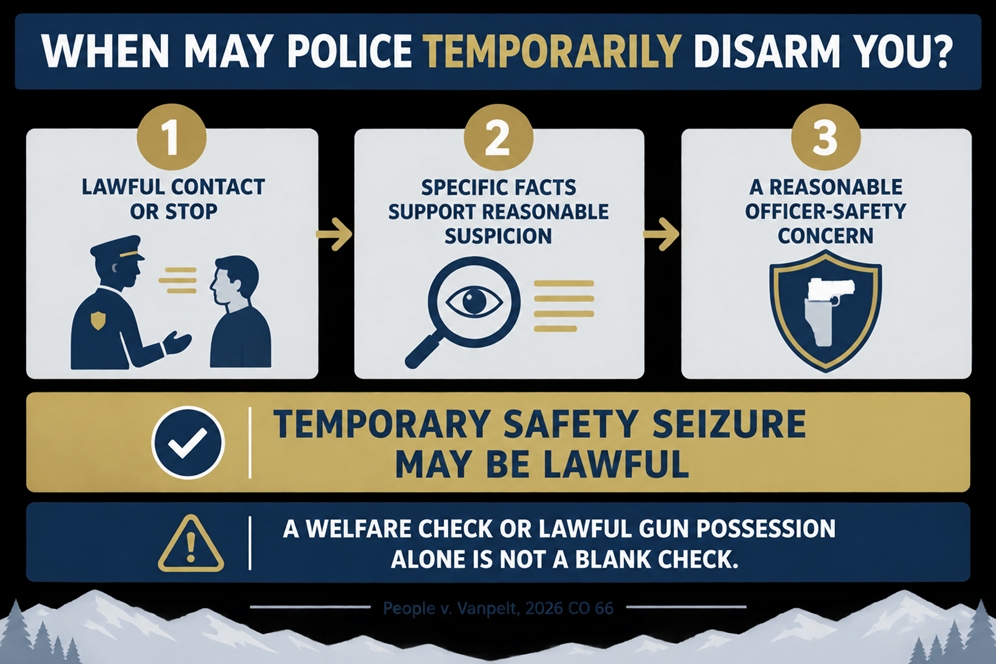
The Colorado Supreme Court unanimously reversed the suppression of the firearm. Justice Boatright wrote that the officers had reasonable suspicion of DUI based on the “specific and articulable facts” they observed: Vanpelt’s unusual, slumped-over and unconscious position on a motorcycle, together with the rational inference that he could be intoxicated while on a vehicle.
Reasonable suspicion is a lower threshold than probable cause. It requires more than a hunch, but it does not require officers to eliminate every innocent explanation. The Court therefore rejected the idea that the possibility of ordinary sleep or a medical episode defeated reasonable suspicion.
That approach follows People v. Reyes-Valenzuela, 2017 CO 31, which explains that reasonable suspicion may exist even when innocent explanations remain possible.
The Court then addressed officer safety.
During a lawful investigatory stop, officers may conduct a limited protective search and remove a weapon when they reasonably suspect that safety requires it.
Here, the officers faced a person who was armed, unconscious, and unpredictable. The Court held that it was reasonable for them to fear that he might awaken startled and use the gun.
“The officers faced an armed, unconscious, and thus unpredictable individual. It was reasonable for them to fear that he might wake and use his firearm in a startled state.”
People v. Vanpelt, 2026 CO 66, ¶ 23
The result was a narrow constitutional holding: the initial seizure of the firearm was reasonable under the Fourth Amendment and article II, section 7 of the Colorado Constitution. The Court did not rely on an unlimited welfare-check or “community caretaking” power.
This distinction is critical. A welfare check explains why officers approach. It does not, by itself, answer whether they may detain someone, search the person, or seize property. Each additional intrusion requires its own constitutional justification.
Colorado’s stop-and-frisk statute reflects the same two-step structure. Section 16-3-103, C.R.S., authorizes an officer to stop a person based on reasonable suspicion and permits a weapons pat-down when the officer reasonably suspects that personal safety requires it. For a broader explanation, see Detained vs. Arrested in Colorado: What Is the Difference?
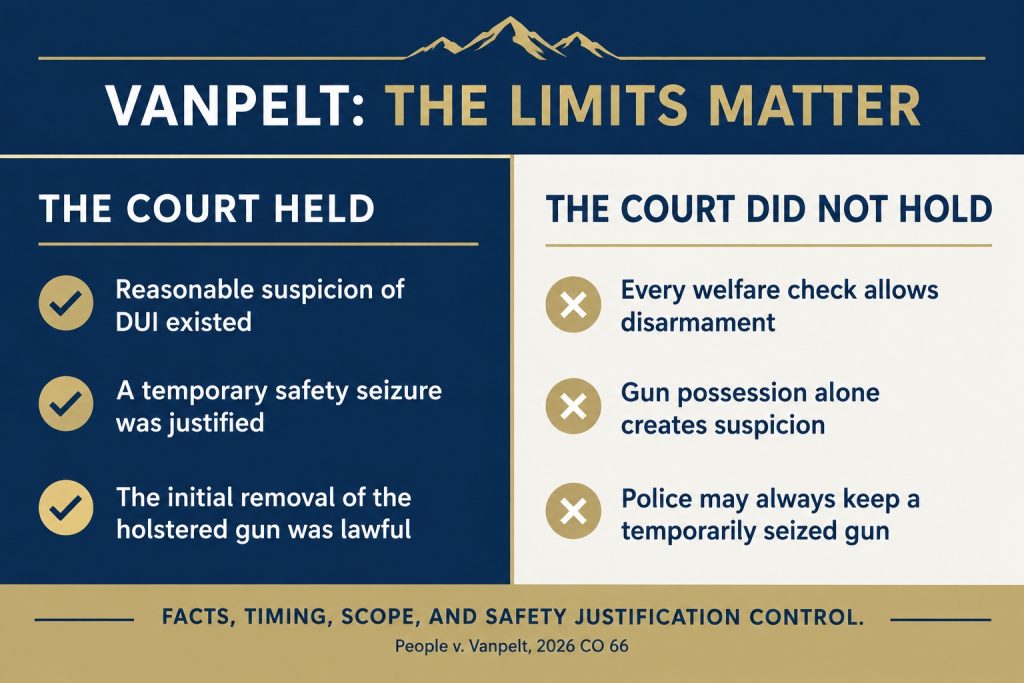
The opinion should not be read as creating a firearm exception to the Fourth Amendment. Several limits remain important.
Yes, in a properly limited situation. The constitutional question is not simply whether the person is under arrest. A brief investigatory stop is a seizure, but it requires reasonable suspicion rather than arrest-level probable cause. If that stop is lawful and specific circumstances support a reasonable safety concern, police may temporarily control a weapon even though no arrest has occurred.
That is precisely what happened in Vanpelt. When the officers took the gun, they had not yet identified Vanpelt and did not yet know about the warrant. The Supreme Court upheld the seizure based on what officers could observe at the scene: an unconscious person in an unusual position on a motorcycle, an inference of possible intoxication, an accessible holstered firearm, and uncertainty about how the person would react on waking.
A welfare check can change quickly from a consensual encounter into a detention. The safest response is calm, visible, and verbal—not physical. The goal is to avoid escalating a safety concern while preserving the ability to challenge police conduct later.
Never use a script mechanically if emergency medical care is needed. If you are injured, ill, disoriented, or experiencing a medication or mental-health crisis, tell the officers and request medical assistance. A welfare check may be genuinely intended to protect life, and accurate health information can be essential.
Vanpelt does not answer when a temporary officer-safety seizure must end. The Court expressly confined its holding to the gun’s initial removal. Whether police may continue holding it depends on additional facts—such as an arrest, a warrant, probable cause that the firearm is evidence or contraband, a court order, or another lawful basis.
If officers keep the gun, do not attempt to recover it informally or send another person to retrieve it without knowing the legal status of the property and the possessor. Obtain the agency name, report number, property receipt, and stated legal basis for retention. A lawyer can determine whether to seek return of property, challenge the seizure in a criminal case, or address any separate firearm-possession restriction.
A suppression court will examine the encounter step by step rather than treating it as a single event. Important questions include:
If the facts do not support reasonable suspicion or a genuine safety rationale, a defense lawyer may seek suppression under Colorado Rule of Criminal Procedure 41. For additional background, see Motions to Suppress in Colorado: A Guide and When a Police Investigatory Stop Crosses the Line.
No. Vanpelt relied on reasonable suspicion of DUI plus a particular officer-safety concern involving an unconscious and armed person who might awaken startled. The decision does not establish automatic firearm removal in every welfare check.
No. A limited protective seizure can occur during a lawful investigatory stop before arrest when officers reasonably believe safety requires control of the weapon.
Vanpelt does not say that it is. The Court considered the entire situation: unconsciousness, an unusual position on a motorcycle, suspected intoxication, immediate access to the gun, and uncertainty about the person’s reaction when awakened.
Do not physically resist or reach for the gun. State that you do not consent, comply with safety commands, and challenge the seizure through counsel and the courts.
Not necessarily, but continued retention requires a legal basis separate from the initial safety concern. Vanpelt did not decide when or whether the temporary seizure lawfully became permanent.
People v. Vanpelt confirms that police authority during a welfare check depends on what officers encounter. When objective facts support reasonable suspicion of a crime and a visible firearm creates a concrete safety concern, officers may temporarily disarm a person before arrest. But the opinion does not transform every welfare check into a detention, every gun owner into a danger, or every temporary seizure into permanent police custody.
For civilians, the safest approach is straightforward: keep your hands visible, disclose the firearm without reaching for it, comply without physically resisting, clearly withhold consent to any broader search, ask whether you are free to leave, invoke silence and counsel, and preserve the facts for later review.
If police seized a firearm, detained you during a welfare check, arrested you, or obtained statements during the encounter, prompt legal review can matter. The body-camera video, dispatch call, property record, and exact sequence of events may determine whether a motion to suppress or a request for return of property is appropriate.
Legal disclaimer: This article provides general educational information about Colorado law and the Colorado Supreme Court’s October 12, 2026 decision in People v. Vanpelt. It is not legal advice and does not create an attorney-client relationship. Search-and-seizure issues are intensely fact-specific. Consult a qualified lawyer about your circumstances.