











Is It Important to Hire a Criminal Defense Lawyer Early in the Process?


By H. Michael Steinberg | Colorado Criminal Defense Attorney, Denver | October 15, 2026
Is It Important to Hire a Criminal Defense Lawyer Early in the Process?
Yes. In Colorado, the decisions that shape a criminal case often happen in the first hours and days: whether you talk to police, how bond is argued, whether a DUI license deadline is met, and what prosecutors decide to file. A lawyer hired early can protect you at each of those points. A lawyer hired late inherits whatever has already happened.
In This Article
- The Short Answer: Yes, and the Reason Is Timing
- Your Right to a Lawyer Starts Earlier Than Many People Realize
- Hour One: Police Questions Can Define the Case
- The First Appearance: Bond and Release Conditions
- DUI Cases: A Seven-Day Deadline Can Put Your License at Risk
- Before Charges Are Filed: The Window Most People Miss
- Evidence Does Not Wait for You
- Colorado’s Speedy Trial Clock and Other Timing Decisions
- Plea Negotiations Begin Earlier Than You Think
- Which Cases Make Early Representation Especially Important?
- Common Myths About Hiring a Lawyer Early
- What to Look for in a Colorado Criminal Defense Lawyer
- Frequently Asked Questions
A criminal investigation or arrest tends to feel like the start of a long wait. In reality, the opposite is true. The earliest stretch of a Colorado criminal case is the busiest, and it is where the most consequential choices get made, often before anyone has explained them to you.
I have practiced criminal defense in Colorado for more than forty years. Before opening my own firm in 1999, I spent thirteen years as a career prosecutor in Arapahoe and Douglas counties, so I have seen these early moments from both sides of the courtroom.
This guide explains why timing matters, which deadlines and decision points come first, and what an early hire can realistically change.

The Short Answer: Yes, and the Reason Is Timing
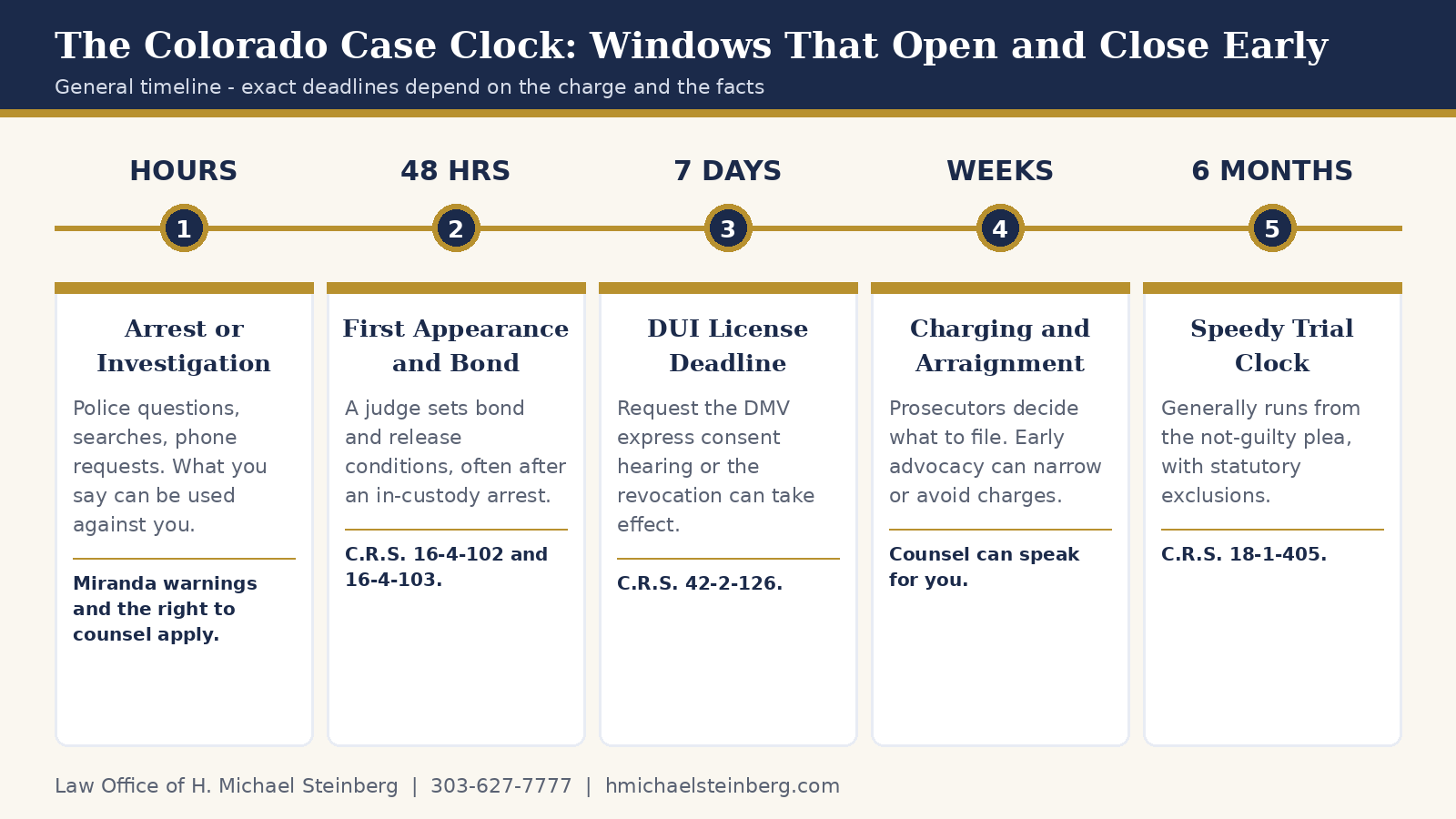
Criminal cases do not move at an even pace. A handful of moments carry most of the weight: the first police contact, the first court appearance and bond decision, the prosecutor’s charging decision, and the opening plea discussions.
Each arrives quickly, and each is difficult to redo once it has passed.
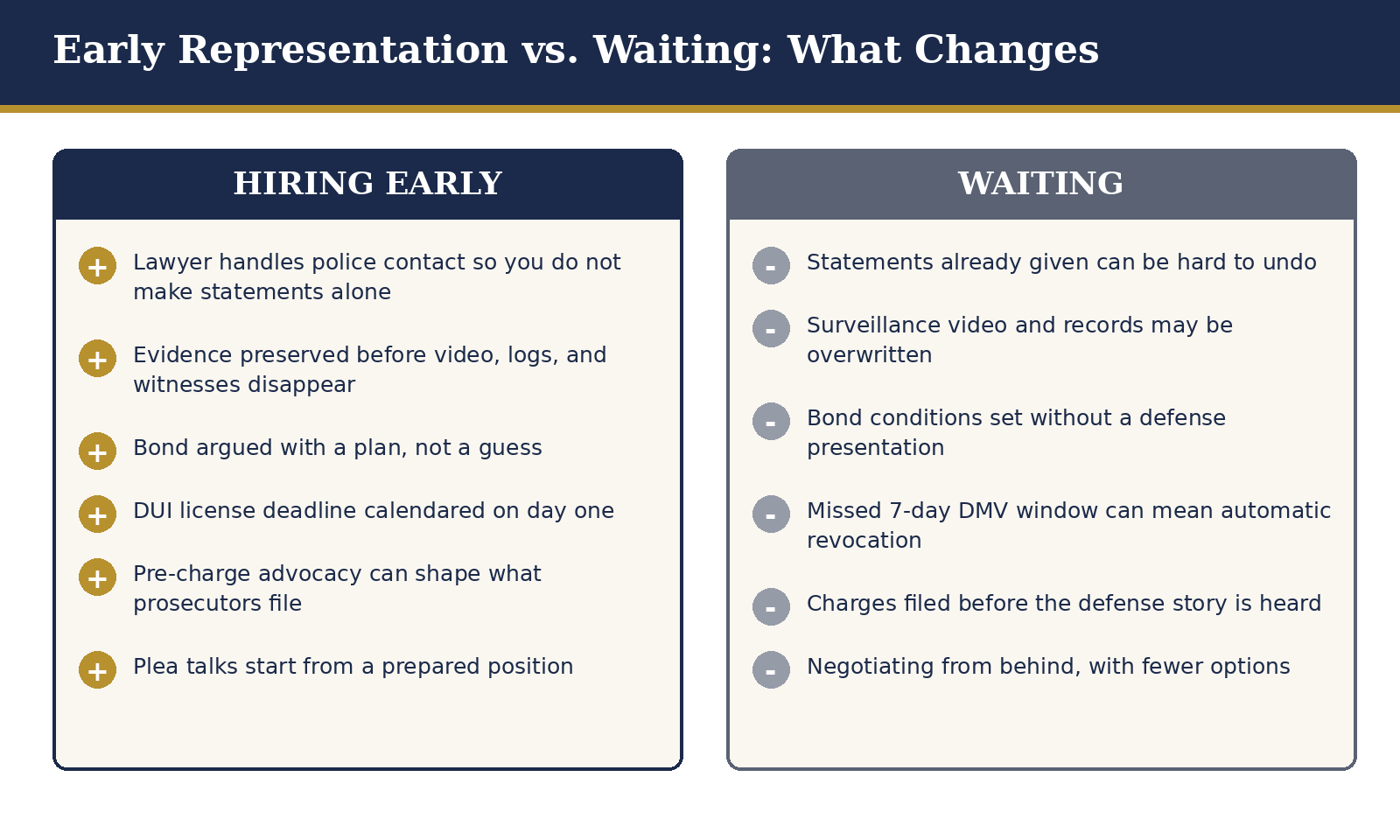
That is the core reason to hire a criminal defense lawyer early. It is not that a lawyer can do something magical on day one. It is that a lawyer can prevent avoidable damage and preserve options that disappear with time.
For a full walk-through of the stages, see our guide to the Colorado criminal case from investigation through trial.
Your Right to a Lawyer Starts Earlier Than Many People Realize
The Sixth Amendment guarantees the assistance of counsel in criminal prosecutions. In Rothgery v. Gillespie County, 554 U.S. 191 (2008), the U.S. Supreme Court held that the right to counsel attaches at a defendant’s initial appearance before a judicial officer, where the accused learns the charge and has his or her liberty restricted. And under Gideon v. Wainwright, 372 U.S. 335 (1963), a state must provide a lawyer to a person who cannot afford one in a felony prosecution.
Separately, Miranda v. Arizona, 384 U.S. 436 (1966) requires officers to warn a person in custody, before interrogation, of the right to remain silent and the right to a lawyer.
Here is the practical gap. Having a right to counsel is not the same as having a lawyer who has already started working. Before charges are filed, you may be asked by a detective to “come in and clear this up,” or asked to hand over your phone. At that stage, the first court appearance has not happened, and no one is appointed for you. If you want someone on your side during that period, you have to hire that person yourself.
AUTHORITY AT A GLANCE
- Rothgery v. Gillespie County, 554 U.S. 191 (2008) – the right to counsel attaches at the initial appearance before a judicial officer.
- Gideon v. Wainwright, 372 U.S. 335 (1963) – appointed counsel for people who cannot afford a lawyer in felony cases.
- Miranda v. Arizona, 384 U.S. 436 (1966) – warnings required before custodial interrogation.
Hour One: Police Questions Can Define the Case
Most people assume that if they are honest and cooperative, the problem will sort itself out. Officers and detectives are trained interviewers, and a casual, friendly conversation can still become the centerpiece of the prosecution’s case. A small inconsistency, an offhand comment, or a mistaken memory can be recast as a lie or an admission.
This is especially true for people who are innocent and want to help. I explain the problem in more detail in Why Innocent People Sometimes Hurt Their Cases by Talking to Colorado Police. A lawyer can tell you whether to answer questions at all, communicate with the investigators for you, and make it clear that you are represented.
In the first hour, one of the most valuable things a defense lawyer can do is make sure nothing is said that cannot later be unsaid.
The First Appearance: Bond and Release Conditions
If you are arrested and held, Colorado law requires a prompt bond hearing. Under C.R.S. 16-4-102, a judge, magistrate, or bond hearing officer must hold an individualized bond hearing as soon as practicable, and no later than 48 hours after an arrestee arrives at the jail or holding facility.
Under C.R.S. 16-4-103, the court must presume that people in custody are eligible for release with the appropriate and least restrictive conditions, unless the person is otherwise ineligible for release under Colorado law, including Article II, Section 19 of the Colorado Constitution.
That presumption does not argue itself. A defense lawyer can present your ties to the community, your employment, your family responsibilities, and a concrete plan for complying with conditions.
The conditions set at this stage can also last for months: no-contact orders, alcohol monitoring, travel limits, or restrictions on living in your own home. In domestic violence cases, those conditions can arrive within hours. See How Colorado Police Decide Who to Arrest in a Domestic Violence Case for how those early decisions are made.
DUI Cases: A Seven-Day Deadline Can Put Your License at Risk
A DUI arrest in Douglas County Colorado starts two cases at once: the criminal case in court and a separate administrative case through the Division of Motor Vehicles.
The Colorado Department of Revenue explains that after a breath test or a refusal you are generally given an Express Consent Affidavit and Notice of Revocation, and you have up to seven days to request a hearing. In blood test cases, the notice arrives by mail from the DMV. The details are on the department’s express consent cases page, which cites C.R.S. 42-2-126.
If you do not request a hearing in time, the revocation takes effect when the time frame expires. Late requests are possible in limited circumstances, but you should not plan around that. Winning or losing the DMV hearing does not decide the criminal case, and the reverse is also true. A lawyer hired in the first days can calendar the deadline, request the hearing, and use it to question the arresting officer. Learn more about DUI and DWAI defense in Colorado.
DEADLINE ALERT
- DMV hearing request: generally up to 7 days after you receive the notice of revocation. Source: Colorado Department of Revenue, Express Consent Cases.
- More on hearings: Colorado DMV alcohol and drug related offenses hearings.
Before Charges Are Filed: The Window Most People Miss
An arrest feels like the beginning of a criminal case, but police can arrest on probable cause while only a prosecutor decides what, if anything, to file. That gap is an opportunity. I explain how prosecutors approach that decision in What Does a Prosecutor Look For Before Filing Criminal Charges?.
A lawyer involved before filing may be able to give the prosecutor information that changes the picture: problems with identification, a lawful explanation for the conduct, issues with how evidence was obtained, or reasons the allegation is unreliable.
It does not always work, and no honest lawyer can promise a result. But it is nearly impossible once the complaint has been filed and the prosecutor has committed to a position.
Early advocacy can also matter when the original filing is broader than the evidence supports. For more on how stacked counts create plea pressure, read DA Overcharging in Colorado: How Prosecutors “Stack” Charges.
Evidence Does Not Wait for You
Evidence that helps the defense is often the most fragile. Surveillance video may be recorded over on a schedule. Recordings, logs, and messages can be lost. Witnesses move, forget details, or become harder to find. Your own phone and online accounts can become evidence as well. See How Social Media Posts Become Evidence in Colorado Criminal Cases.
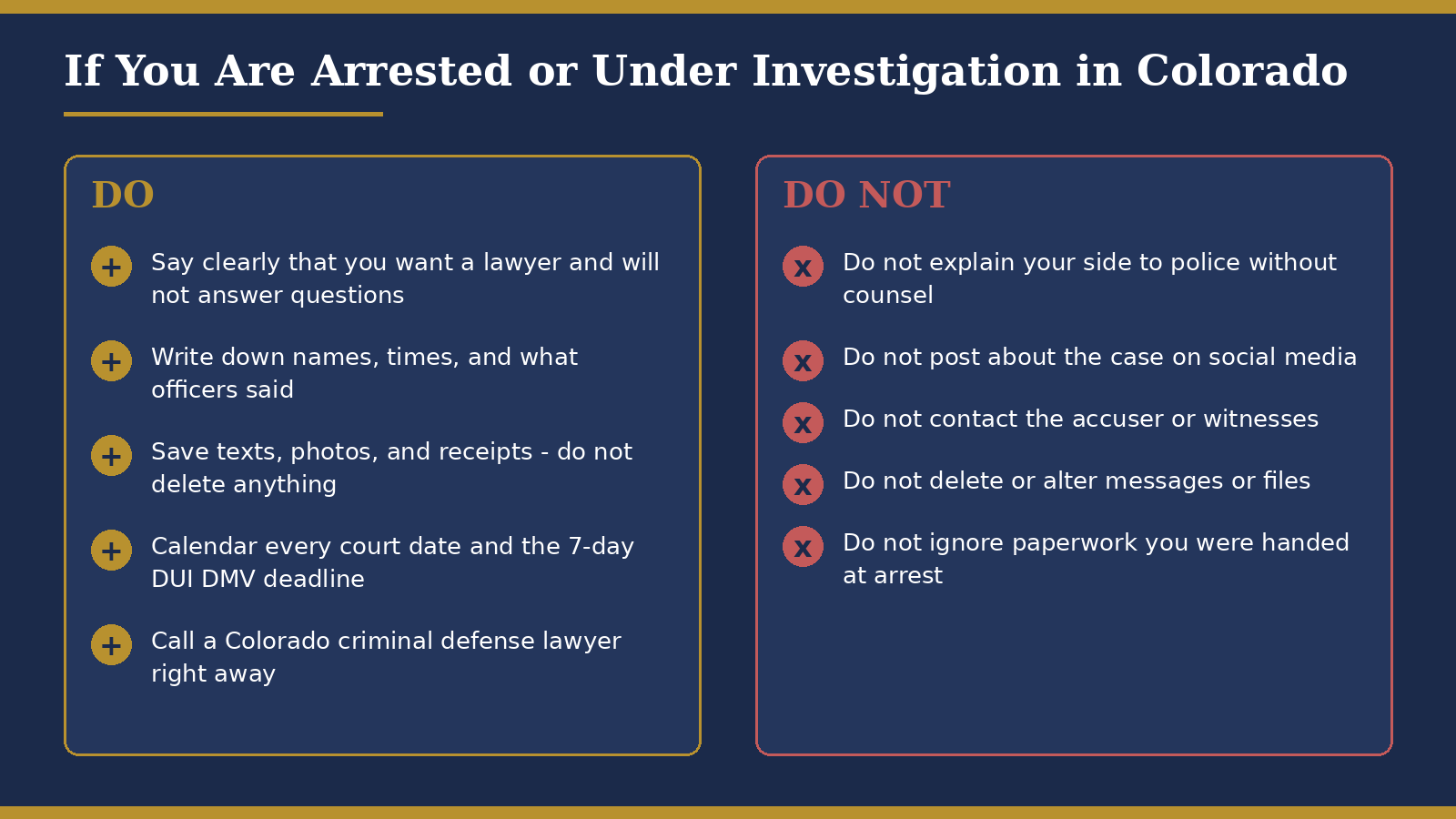
A lawyer who is engaged early can send preservation requests, retain an investigator, interview witnesses while memories are fresh, and tell you what not to delete, post, or send. Retention periods differ by agency and business, which is why waiting to find out is risky.
Colorado’s Speedy Trial Clock and Other Timing Decisions
Colorado’s speedy trial statute, C.R.S. 18-1-405, generally requires that a case be brought to trial within six months of the entry of a not-guilty plea, subject to statutory exclusions. If a defendant asks for and receives a continuance after a trial date has been set, the period can be extended by an additional six months.
That creates a real strategic choice. More time can help the defense investigate and prepare. It can also cost you a protection the statute gives you. Deciding when to ask for time, and when to hold the prosecution to its deadline, is a judgment call a lawyer makes with you based on the evidence. It is much harder to make well when a lawyer joins the case after key dates have passed.
Plea Negotiations Begin Earlier Than You Think
Most criminal cases are resolved by negotiation rather than trial. The first conversations with the prosecutor tend to set the baseline for everything that follows. A lawyer who has already reviewed the discovery, spoken with witnesses, and identified weaknesses in the State’s case negotiates from facts rather than hope.
Those talks also have rules about what can and cannot be used later. Read Colorado Rule 410 and Plea Negotiations: What You Say in Plea Talks before you say anything to a prosecutor on your own, and browse our plea bargaining articles for more.
Which Cases Make Early Representation Especially Important?
Every criminal charge is serious, but some situations move particularly fast or carry consequences beyond the sentence:
- Domestic violence: mandatory-arrest rules, protection orders, and immediate bond conditions. See our domestic violence defense page and defending false or mistaken allegations.
- DUI and DWAI: the seven-day DMV deadline and evidence that must be reviewed early. See DUI defense.
- Drug crimes: cases often turn on how a stop or search was conducted. See drug crimes defense and what a recent Tenth Circuit drug-dog ruling means.
- Sex crimes: investigations frequently begin before any arrest, and early statements can be damaging. See sex crimes defense.
- Assault and theft: charges that can carry lasting consequences for work and reputation. See assault and theft defense.
Common Myths About Hiring a Lawyer Early
“I’m innocent, so I don’t need a lawyer yet.”
Innocence is not a shield against a mistaken investigation. Innocent people give statements that are misunderstood, and a prosecutor does not need certainty to file a case. Early advice helps you avoid handing the State something that makes a weak case stronger.
“Hiring a lawyer will make me look guilty.”
Everyone has the right to counsel, and prosecutors and police deal with represented people every day. Asking for a lawyer is a lawful exercise of a constitutional right, not an admission.
“I’ll wait and see if charges are filed.”
Waiting can mean missing the DMV deadline, giving up the chance to speak to the prosecutor before filing, and losing evidence. A short consultation costs little compared with a decision you cannot take back.
What to Look for in a Colorado Criminal Defense Lawyer
- A practice focused on criminal defense. Colorado courts and prosecutors have their own rules, habits, and personalities. Local, focused experience matters.
- Experience on both sides of the courtroom. A lawyer who has worked as a prosecutor understands how charging and plea decisions are made. H. Michael Steinberg spent thirteen years as a career prosecutor in Arapahoe and Douglas counties before founding his defense firm in 1999.
- Availability and clear communication. Early in a case, you need someone who answers questions quickly and explains what comes next.
Frequently Asked Questions
When should I hire a criminal defense lawyer?
As early as possible: ideally as soon as you learn you are under investigation, are contacted by police, or are arrested. Many of the most important decisions in a case are made in the first hours and days.
Can a lawyer help me before I am charged?
Yes. A lawyer can communicate with investigators for you, advise you about questions and requests, and in some cases present information to a prosecutor before a charging decision. There are no guarantees, but this is a stage at which a lawyer can sometimes affect what is filed.
Should I talk to the police if I am innocent?
Speak with a lawyer first. Innocent people sometimes harm their own cases by trying to explain. You can politely state that you want a lawyer and will not answer questions without one.
Is it too late to hire a lawyer after an arrest or first court date?
No. A lawyer can still help with bond modification, evidence, negotiations, motions, and trial. But some opportunities, like pre-charge advocacy and early evidence preservation, are easier to use when a lawyer is hired sooner.
How quickly must I act after a Colorado DUI arrest?
The Colorado Department of Revenue states that you generally have up to seven days to request the DMV express consent hearing. Missing that window can allow the revocation to take effect. Speak with a lawyer immediately and keep the paperwork you were given.
What should I bring to a first consultation?
Bring any paperwork from the arrest or investigation, bond papers, court dates, a DMV notice if you have one, and a list of questions. Please do not send confidential details through a website contact form or text message; call the office instead.
Facing an Investigation or Criminal Charge in Colorado?
H. Michael Steinberg has more than 42 years of Colorado criminal defense experience, including 13 years as a career prosecutor. Call for a free consultation about your situation.
Main: 303-627-7777 | Urgent: 720-220-2277 Request a Free Consultation
Related Reading
- The Colorado Criminal Case: From Investigation Through Trial
- Why Innocent People Sometimes Hurt Their Cases by Talking to Colorado Police
- What Does a Prosecutor Look For Before Filing Criminal Charges?
- Colorado Rule 410 and Plea Negotiations: What You Say in Plea Talks
- More from the Colorado Criminal Lawyer Blog
Sources and Authority
- Rothgery v. Gillespie County, 554 U.S. 191 (2008)
- Gideon v. Wainwright, 372 U.S. 335 (1963)
- Miranda v. Arizona, 384 U.S. 436 (1966)
- C.R.S. 16-4-102 (Right to bail)
- C.R.S. 16-4-103 (Setting and selection of type of bond)
- Colo. Const. art. II, sec. 19 (Right to bail)
- C.R.S. 18-1-405 (Speedy trial)
- Colorado Department of Revenue: Express Consent Cases Procedures (C.R.S. 42-2-126)
- Colorado Department of Revenue: Alcohol and Drug Related Offenses Hearings
About the Author
H. Michael Steinberg is a Denver criminal defense attorney with more than 42 years of Colorado experience. He served as a career prosecutor in Arapahoe and Douglas counties for 13 years before founding the Law Office of H. Michael Steinberg in 1999. He is a member of the National Association of Criminal Defense Lawyers, the Colorado Bar Association, and other professional organizations. Explore more on the Colorado Criminal Lawyer Blog or review his practice areas.
This article is for general informational purposes only. It is not legal advice and does not create an attorney-client relationship. Laws and deadlines change and every case is different. Please do not include confidential or sensitive information in a contact form, text message, or voicemail. Past results do not guarantee a similar outcome.