
A Lawyer With a 42+ Year Proven Track Record
Exclusively Practicing Only Colorado Criminal
Law - Defending Your Future
Exclusively Practicing Only Colorado Criminal
Law - Defending Your Future








By H. Michael Steinberg, Colorado Criminal Defense Attorney, Denver · October 13, 2026
If you or someone you love has been charged with a crime in Colorado, one of the first questions is whether the charge is a misdemeanor or a felony. The answer shapes nearly everything that follows: how much time is at stake, which court hears the case, how many jurors decide it, what a conviction costs you years from now, and whether the record can ever be sealed.
This guide explains, in plain English, how Colorado separates the two, what each one carries, and why the line is not always where people expect it to be. It is written from the defense side of the courtroom by a Denver criminal defense lawyer with more than 42 years of Colorado experience, including 13 years as a career prosecutor in Arapahoe and Douglas Counties.
Quick Answer
A felony is Colorado’s most serious category of crime. It is punishable by state prison, with sentences ranging from one year (class 6) up to life (class 1), followed by a mandatory period of parole.
A misdemeanor is less serious: a class 1 misdemeanor carries up to 364 days in county jail and a class 2 misdemeanor up to 120 days, and misdemeanor time is served in county jail rather than state prison. Below both sit petty offenses and civil infractions.
Beyond the sentence, the label changes the court, the jury, the filing deadline, firearm rights, and how long you must wait to ask a court to seal the record.
In This Article
Colorado does not leave the label to a judge’s mood on the day of sentencing. The legislature assigns every offense a category. Under C.R.S. § 18-1-104, there are six classes of felonies, four levels of drug felonies, two classes of misdemeanors, two levels of drug misdemeanors, petty offenses, and civil infractions. Some offenses are “unclassified” and carry whatever penalty is written into their own statute.
One recent change matters if your case involves an older date. For offenses committed before March 1, 2022, Colorado had three misdemeanor classes with longer maximums, including up to 18 months for a class 1. For offenses on or after that date, there are two classes and the shorter maximums described below.
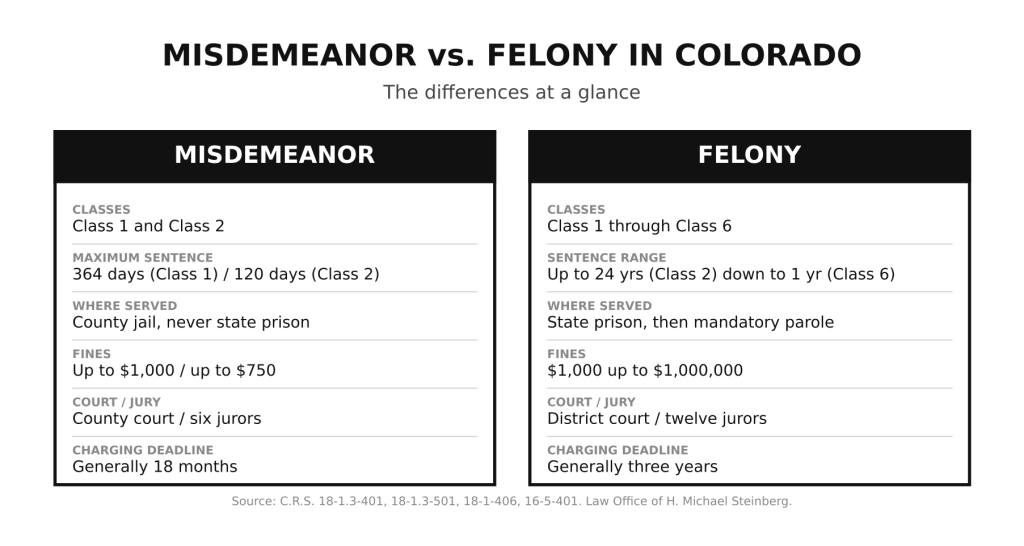
A felony is a crime for which Colorado authorizes a prison sentence in the Department of Corrections, followed by mandatory parole. The presumptive ranges in C.R.S. § 18-1.3-401, as summarized by the Colorado Legislative Council Staff in January 2026, are:
| Felony class | Prison range | Mandatory parole | Fine range |
|---|---|---|---|
| Class 1 | Life imprisonment | N/A | N/A |
| Class 2 | 8 to 24 years | 3 or 5 years | $5,000 to $1,000,000 |
| Class 3 | 4 to 12 years | 3 years | $3,000 to $750,000 |
| Class 4 | 2 to 6 years | 3 years | $2,000 to $500,000 |
| Class 5 | 1 to 3 years | 2 years | $1,000 to $100,000 |
| Class 6 | 1 to 18 months | 1 year | $1,000 to $100,000 |
Colorado repealed the death penalty in 2020, so life imprisonment is now the maximum for a class 1 felony. A class 2 felony carries three years of parole if the crime was nonviolent and five if it was violent.
Drug felonies have their own scale under C.R.S. § 18-1.3-401.5: a level 1 drug felony carries 8 to 32 years, level 2 carries 4 to 8 years, level 3 carries 2 to 4 years, and level 4 carries 6 months to 1 year, each followed by parole.
Colorado law allows alternatives to prison, including deferred judgment, probation, and community corrections. A court may also impose up to 90 days in county jail as a condition of probation under C.R.S. § 18-1.3-202. Prison is more likely for class 1 through 4 felonies, while alternatives are more common for class 5 and 6 felonies, but every case depends on the facts and the defendant’s history.
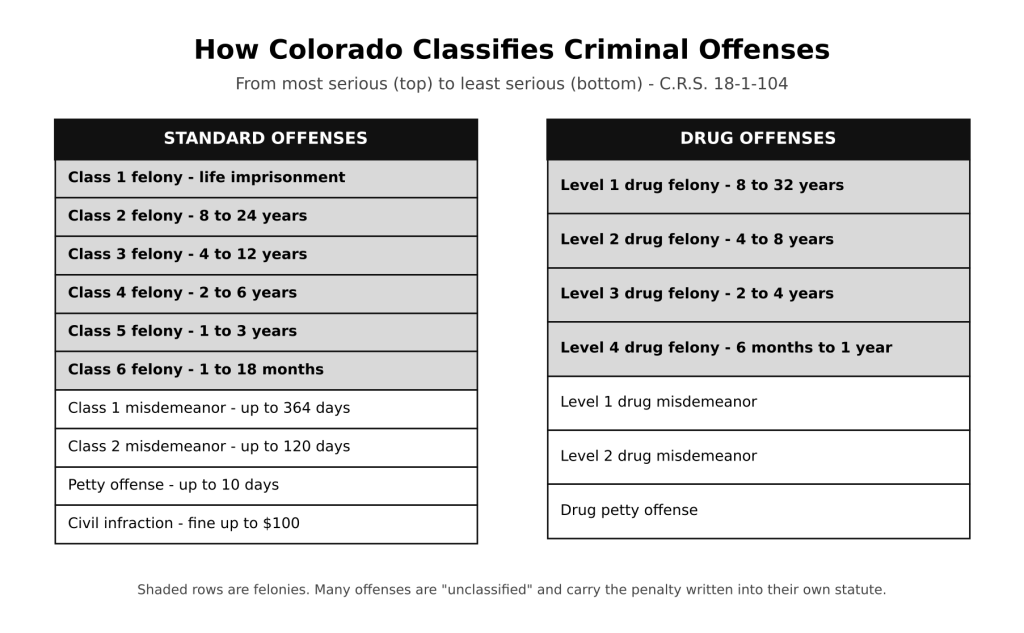
For offenses committed on or after March 1, 2022, C.R.S. § 18-1.3-501 sets two misdemeanor classes:
| Misdemeanor class | Maximum jail | Maximum fine |
|---|---|---|
| Class 1 | 364 days | $1,000 |
| Class 2 | 120 days | $750 |
A judge may impose jail, a fine, or both, and may sentence a defendant to community service. Probation is far more common for misdemeanors than a jail term. Four rules are worth knowing:
Most simple drug possession is now a misdemeanor, and the legislature has said it should be treated primarily as a health concern. For a level 1 drug misdemeanor possession offense, a court may impose up to two years of probation with up to 180 days in jail (up to 364 days for a third or subsequent offense) and a fine of up to $1,000. For a level 2 drug misdemeanor, the limit is one year of probation with up to 120 days in jail (180 days for a third or subsequent offense) and a fine of up to $500. See C.R.S. § 18-1.3-501(1)(d.5).
Below misdemeanors, C.R.S. § 18-1.3-503 provides for petty offenses, punishable by up to 10 days in county jail, a fine of up to $300, or both, and civil infractions, which are civil matters with a fine of up to $100. A petty offense is still a criminal charge. It can still lead to a conviction and a record, so it deserves a real answer rather than a quick plea at the counter.
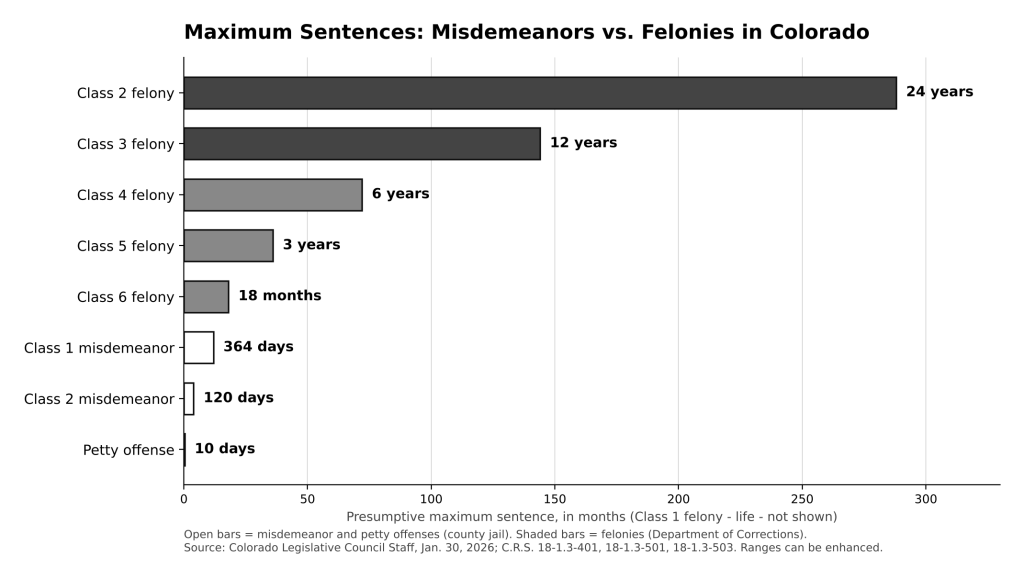
| Misdemeanor | Felony | |
|---|---|---|
| Possible sentence | Up to 364 days (class 1) or 120 days (class 2) | 1 year (class 6) up to life (class 1), with enhancements possible |
| Where served | County jail | Department of Corrections (state prison) |
| Mandatory parole | No | Yes, 1 to 5 years depending on the class |
| Fines | Up to $1,000 (class 1) or $750 (class 2) | $1,000 up to $1,000,000 |
| Usual court | County court (Denver County Court in Denver) | District court |
| Jury | Six jurors | Twelve jurors, unanimous verdict |
| Usual deadline to file charges | 18 months | 3 years |
| Federal firearm ban | Generally no, with an exception for misdemeanor domestic violence | Yes, for crimes punishable by more than one year |
| Petition to seal (waiting period) | 2 to 3 years | 3 to 5 years, with some offenses excluded |
Felony cases are heard in district court and misdemeanor cases in county court, although a district attorney may file a misdemeanor in district court because the two courts share jurisdiction over misdemeanors (C.R.S. § 13-6-106). In Denver, misdemeanors go to Denver County Court.
Under C.R.S. § 18-1-406, a person accused of a felony is entitled to a jury of twelve with a unanimous verdict, and a person accused of a misdemeanor is entitled to a jury of six. Petty offense jury trials are governed by C.R.S. § 16-10-109: the defendant must request a jury in writing within 21 days of the plea, and the jury is three jurors unless the defendant asks for up to six.
The Constitution guarantees counsel in serious cases. Gideon v. Wainwright, 372 U.S. 335 (1963), requires appointed counsel for people who cannot afford a lawyer in felony cases, and Argersinger v. Hamlin, 407 U.S. 25 (1972), extends that right to misdemeanors where a jail sentence is imposed. Whatever the charge, the time to involve a lawyer is before you make statements or decisions that cannot be undone.
Colorado fixes the class of each offense by statute, but the facts of your case often decide which version of the offense applies. Four things commonly move a charge across the line.
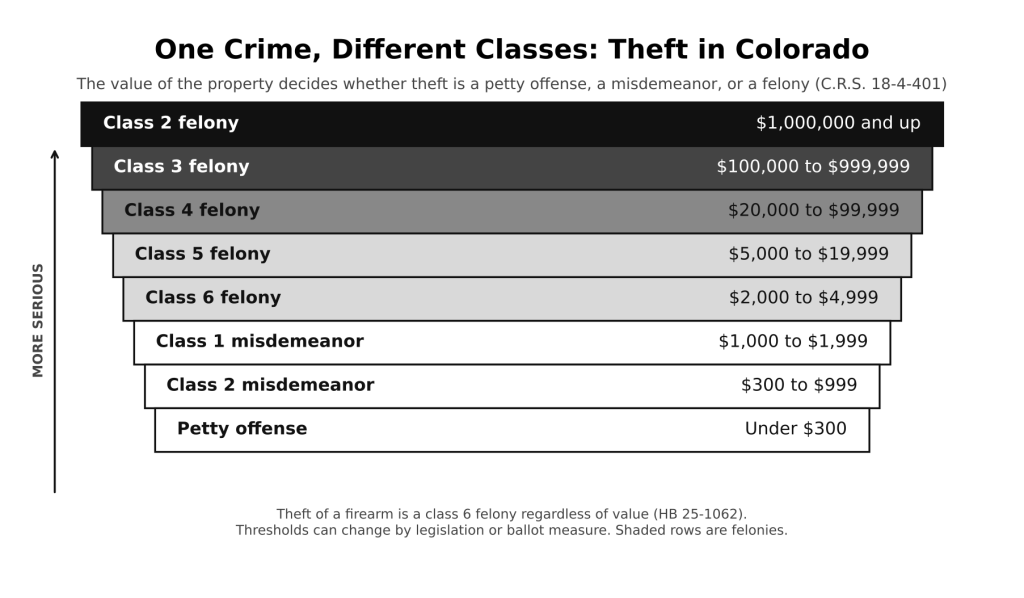
Theft is the clearest example. Under C.R.S. § 18-4-401, theft of less than $300 is a petty offense, $300 to under $1,000 is a class 2 misdemeanor, and $1,000 to under $2,000 is a class 1 misdemeanor. At $2,000 it becomes a class 6 felony, and the class rises with the value up to a class 2 felony at $1,000,000. Thefts committed within six months can be added together and charged in one count, so repeated shoplifting can become a felony. Theft of a firearm is a class 6 felony regardless of its value under HB 25-1062, signed in 2025. Learn more about theft crimes.
A first, second, or third DUI is generally a misdemeanor, but a fourth is a class 4 felony under C.R.S. § 42-4-1301. Possessing one gram or less of a substance containing fentanyl is a level 1 drug misdemeanor, but a fourth or subsequent offense is a level 4 drug felony. See our page on DUI defense.
Assault shows the ladder clearly. Third degree assault (C.R.S. § 18-3-204) is a class 1 misdemeanor. Second degree assault (C.R.S. § 18-3-203) is a class 4 felony, and first degree assault (C.R.S. § 18-3-202) is a class 3 felony. A DUI that causes serious bodily injury is vehicular assault, a class 4 felony (C.R.S. § 18-3-205), and a DUI that causes a death is vehicular homicide, a class 3 felony (C.R.S. § 18-3-106). See our pages on assault and domestic violence charges.
Under C.R.S. § 18-18-403.5, possession of more than four grams of a Schedule I or II controlled substance is a level 4 drug felony, as is possession of any quantity of certain substances such as ketamine or GHB. For fentanyl compounds the felony line is lower: more than one gram, up to four grams, is a level 4 drug felony. Smaller amounts are generally misdemeanors. See our page on drug crimes.
The prosecutor decides what to file, and a charge can be filed higher than the evidence supports. Our articles on what a prosecutor looks for before filing charges and how prosecutors “stack” charges explain how this works. Many felony cases are resolved by negotiation, and a plea to a misdemeanor can change the outcome. Statements made in plea talks are protected only within limits, which we discuss in Colorado Rule 410 and plea negotiations. For eligible drug possession cases, Colorado law also requires a court to vacate a felony drug conviction and enter a level 1 drug misdemeanor after the defendant successfully completes a probation or community corrections sentence, unless exclusions such as a prior violent conviction or two or more prior felony drug convictions apply (C.R.S. § 18-1.3-103.5).
A felony carries heavier long-term consequences, but a misdemeanor is never “nothing.” Both leave a public record unless sealed, and both can affect work, housing, licensing, and family cases.
Under C.R.S. § 16-5-401, prosecutors generally have three years to file felony charges, 18 months for most misdemeanors, and six months for petty offenses. Many exceptions apply, including longer periods for some sex offenses and no deadline for the most serious crimes.
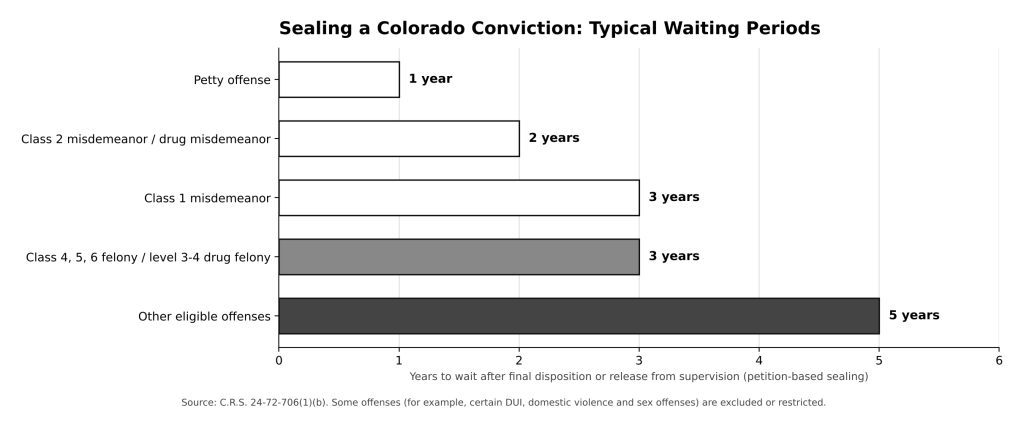
Colorado’s main remedy is record sealing rather than expungement. Under C.R.S. § 24-72-706, you can generally petition to seal a conviction after waiting from the later of final disposition or release from supervision: one year for a petty offense, two years for a class 2 misdemeanor or drug misdemeanor, three years for a class 1 misdemeanor, a class 4, 5, or 6 felony, or a level 3 or 4 drug felony, and five years for other eligible offenses. Colorado also has an automatic sealing process with longer waits, discussed in the Colorado Bar Association’s Colorado Lawyer article “Automatic Record Sealing in Colorado”.
Not every conviction qualifies. Some offenses, including certain DUI, domestic violence, and sex offenses, are excluded unless narrow exceptions apply. Sealing also has limits: it does not block access by courts, law enforcement, or others entitled by law to run a criminal history check (C.R.S. § 24-72-703). The Judicial Branch publishes forms and instructions at its Seal My Case page.
The Law Office of H. Michael Steinberg defends misdemeanor and felony cases throughout Colorado. Mr. Steinberg has more than 42 years of experience on both sides of the courtroom, and the firm practices exclusively Colorado criminal defense. To discuss your case, call 303-627-7777 or 720-220-2277, or use the free consultation form. Learn more about the attorney and the firm’s practice areas.
A felony is more serious. It can mean state prison, mandatory parole, and heavier lasting consequences. A misdemeanor still carries up to 364 days in county jail for a class 1, a permanent record unless sealed, and potential loss of gun rights, work, and immigration status.
For offenses committed on or after March 1, 2022, a class 1 misdemeanor carries up to 364 days in county jail and a class 2 up to 120 days. A petty offense carries up to 10 days. Total consecutive jail time for misdemeanors charged in one case is capped at 24 months.
Yes. It often happens through plea negotiation, when the prosecutor agrees to a lesser charge. In eligible drug possession cases, a court must also vacate a felony drug conviction and enter a misdemeanor after the defendant successfully completes a probation or community corrections sentence. Whether it is possible depends on the facts, the evidence, and the offense.
Most DUIs are misdemeanors. A fourth DUI is a class 4 felony, DUI causing serious bodily injury is a class 4 felony, and DUI causing death is a class 3 felony.
Theft of $2,000 or more is a felony, starting as a class 6 felony. Theft of $300 to under $2,000 is a misdemeanor, and theft of a firearm is a class 6 felony regardless of value.
Many can, after a waiting period and by court order, but some offenses are excluded. Waiting periods range from one year for petty offenses to five years for other eligible offenses.
This article is for general information only and is not legal advice. Laws change, and every case turns on its own facts. Reading it does not create an attorney-client relationship. See the firm’s [disclaimer](https://www.hmichaelsteinberg.com/disclaimer/). Please do not send confidential information through the website or by text message.