
A Lawyer With a 42+ Year Proven Track Record
Exclusively Practicing Only Colorado Criminal
Law - Defending Your Future
Exclusively Practicing Only Colorado Criminal
Law - Defending Your Future










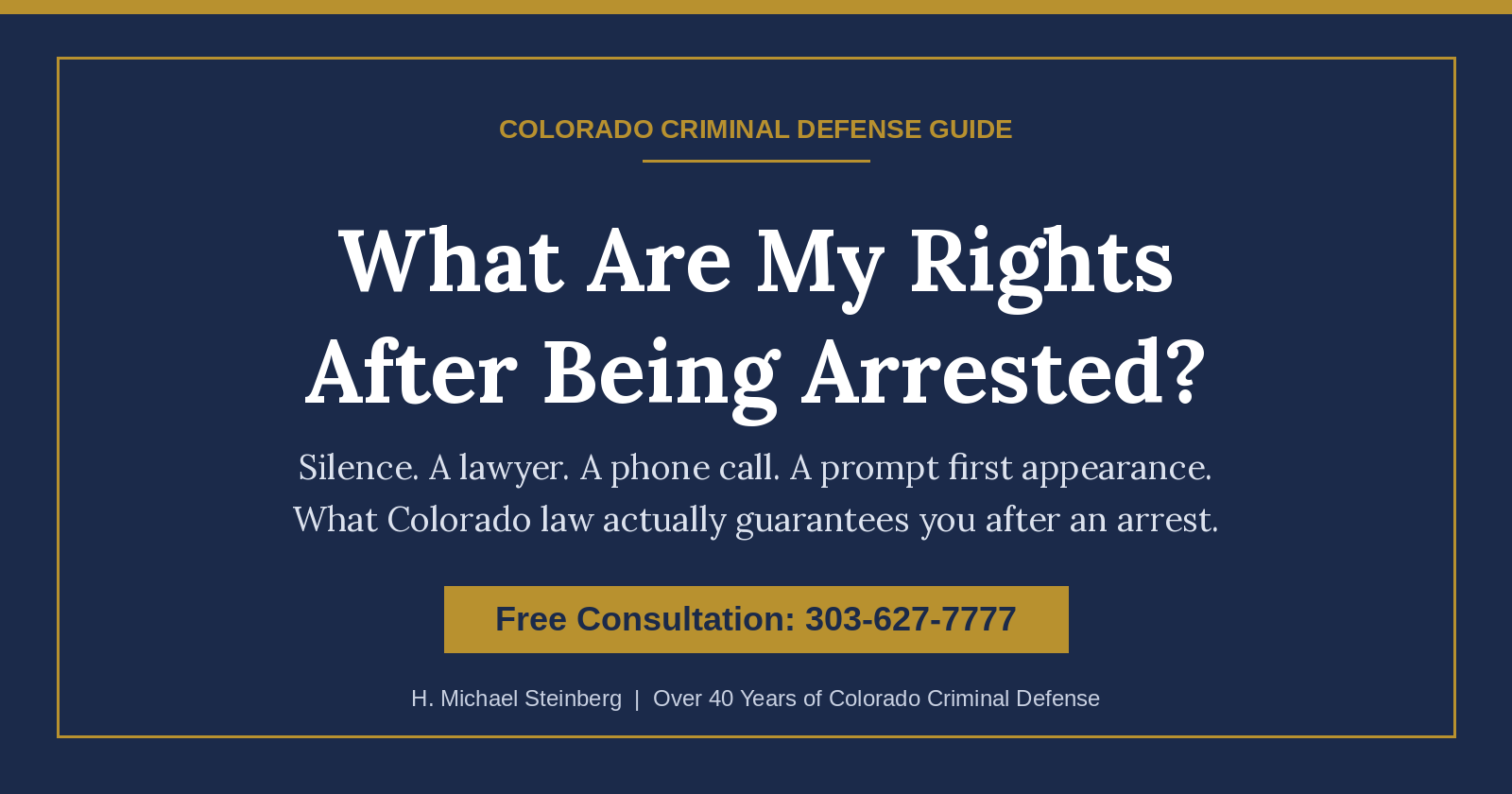
COLORADO CRIMINAL DEFENSE GUIDE
By H. Michael Steinberg | Colorado Criminal Defense Attorney, Denver | October 14, 2026
An arrest is one of the most frightening moments a person can face. The handcuffs go on, the questions start, and almost everything you say from that point forward can become evidence. What you do and say in the first hours often matters as much as anything that happens later in court.
I have spent my entire professional life practicing Colorado criminal law for more than forty years. Before opening my own firm in 1999, I spent thirteen years as a career prosecutor in Arapahoe and Douglas counties, so I have viewed this moment for people from both sides of the courtroom.
There is no question that there is often a devastating impact on the average person of an officer’s “checklist of questions” followed by the damage done to a criminal case when a frightened person tries to talk their way out of a difficult situation.
This guide explains what your rights actually are after an arrest in Colorado, how to invoke them, and what happens next.
QUICK ANSWER
After a Colorado arrest you have the right to remain silent, the right to a lawyer, the right to call an attorney and a family member, the right to refuse to consent to a search, the right to see a judge promptly, and the right to seek bond.
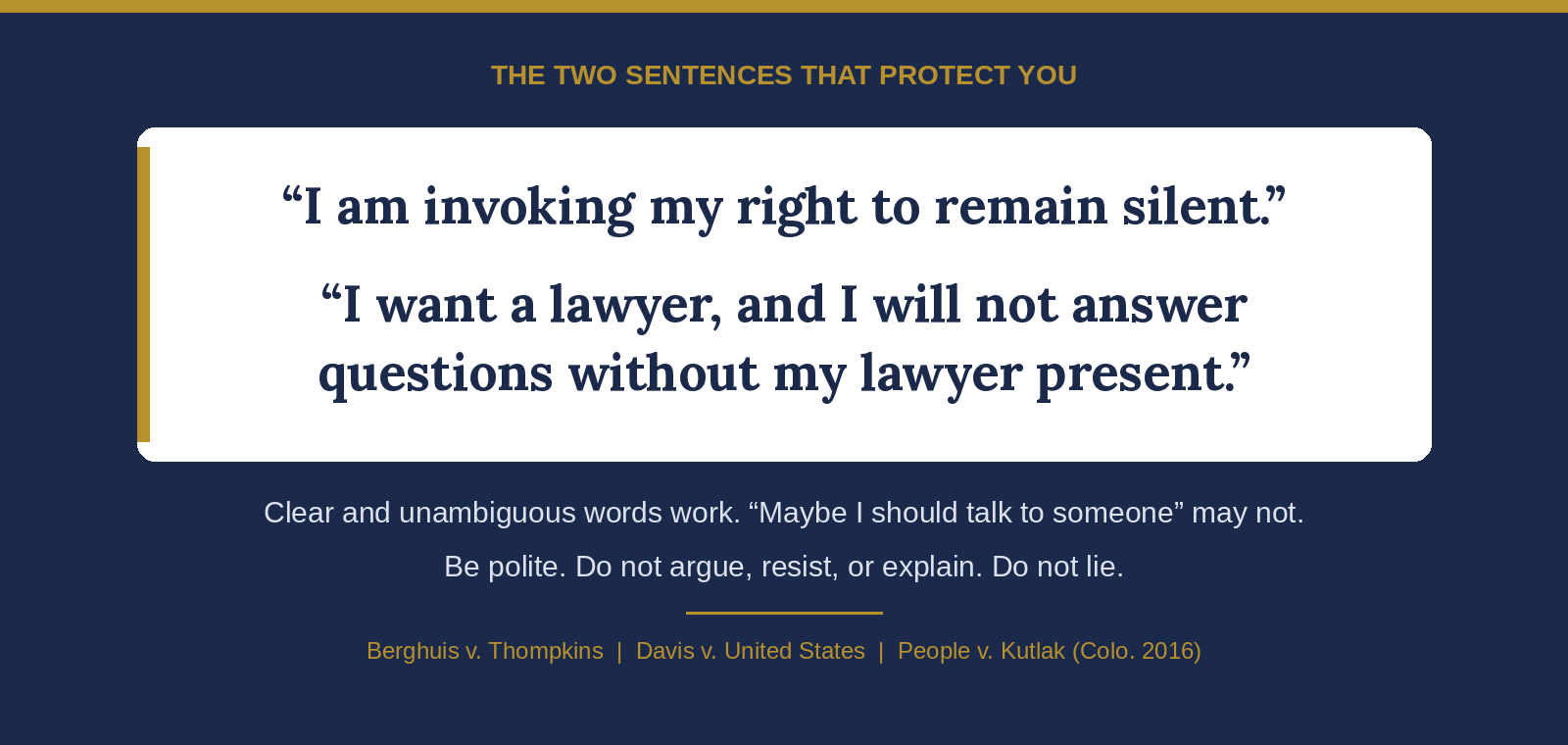
Silence and a lawyer only protect you if you clearly assert these rights. Just say this clearly: “I am invoking my right to remain silent, and I want a lawyer.” Then stop talking and call a defense attorney.
In This Article
Not every police encounter is an arrest. In Colorado, an officer who reasonably suspects you are involved in a crime may briefly stop you, and during that stop may require your name, address, identification if you have it, and an explanation of your actions. C.R.S. § 16-3-103 makes such a stop lawful.
An arrest requires probable cause, and a judge-issued arrest warrant requires a sworn affidavit establishing probable cause that a crime occurred and that you committed it (C.R.S. § 16-3-108).
This matters because several of your most important rights are triggered by custodial interrogation, meaning questioning by police while you are in custody. If officers arrest you and never question you, they are not required to read you any warnings.
The consequence of skipping warnings is limited to the statements that follow: a court generally will not admit those statements in the prosecution’s case at trial. It does not dismiss the case.
The right comes from the Fifth Amendment and from Article II, Section 18 of the Colorado Constitution, which protects a person from being compelled to testify against himself in a criminal case. The warnings most people know as Miranda come from Miranda v. Arizona (1966).
Colorado has since written its own version into statute. Under C.R.S. § 16-3-406, a court may not admit a statement from a custodial interrogation unless you were first told, in a manner that reasonably conveyed it, that:
Colorado Authority: Custodial Interrogation
C.R.S. § 16-3-406 codifies Miranda warnings in Colorado, places the burden on the prosecution to prove a knowing, intelligent, and voluntary waiver, and preserves the use of voluntary statements to impeach a defendant and certain recognized exceptions, including public safety and booking questions. C.R.S. § 16-3-601 defines “interrogation” as words or conduct an officer should know are reasonably likely to elicit an incriminating response.
Here is the part that surprises people. In Berghuis v. Thompkins (2010), the U.S. Supreme Court held that a suspect who sits silent during questioning has not invoked the right to remain silent. A suspect who later answers a question can be found to have waived it. The invocation has to be unambiguous.
And in Salinas v. Texas (2013), the Court held that when a person is not in custody and chooses to answer some questions voluntarily, staying quiet on others without saying why can be used against them unless they expressly invoke the privilege.
In the eyes of the law, you have to say it out loud. Staying quiet is not the same as invoking your rights.
Salinas v. Texas (2013)
Be polite and direct. Do not argue, do not explain, and do not lie. If you are being questioned, the safest sentence is short: “I am invoking my right to remain silent, and I want a lawyer.” Then say nothing else, no matter how friendly or urgent the questioning becomes. I explain why even innocent people get hurt by “just clearing things up” in Why Innocent People Sometimes Hurt Their Cases by Talking to Colorado Police.
You have the right to counsel under the Sixth Amendment, Article II, Section 16 of the Colorado Constitution, and as part of the Miranda protections during questioning. Once you clearly ask for a lawyer, police must stop interrogating you until one is present, unless you start the conversation again yourself. That rule comes from Edwards v. Arizona (1981).
The word that matters is clearly.
In Davis v. United States (1994), the Supreme Court held that officers need not stop questioning when a suspect makes an ambiguous reference to counsel. Colorado courts apply that standard. In People v. Kutlak, 2016 CO 1, the Colorado Supreme Court explained that the question is whether a reasonable officer in the circumstances would understand the statement to be a request for counsel.
And in People v. Trujillo-Tucson, 2022 CO 31, a 5-2 court held that a suspect’s question about getting a phone call to his lawyer, asked in casual conversation with an officer who was not the interrogator, was a logistical question and not a request for counsel. The practical lesson is to avoid questions and hints. Say “I want a lawyer,” and say it to the officer who is questioning you.
Colorado Authority: Access to Your Attorney
A person who is arrested may consult an attorney alone and in private at the place of custody, as many times and for as long as is reasonable (C.R.S. § 16-3-403). Officers must promptly admit an attorney who asks to see you, if you consent (C.R.S. § 16-3-404). Under HB25-1049, signed May 31, 2025, jails must give attorneys a way to initiate private, unrecorded, no-cost calls with a person in custody, subject to reasonable administrative procedures.
If you cannot afford a lawyer, you can ask the court to appoint one. The judge must tell you at your first appearance that you may request appointed counsel or consult the public defender (Crim. P. 5(a)(2)), and the Colorado State Public Defender explains that people held in jail will have a public defender at that first hearing. Asking for a lawyer is not an admission of anything. It is exactly what an innocent person should do.
C.R.S. § 16-3-402 gives a person who is arrested the right to communicate with an attorney of their choice and a member of their family, through a reasonable number of telephone calls or another reasonable means, at the earliest possible time after arriving at the station or jail.
If you were arrested for violating an order not to contact certain family members, the jail may block calls to the protected people but must still place your other calls.
Use that call wisely. Assume that every non-legal call from a jail phone is recorded and that prosecutors can listen to it. Do not discuss what happened, who was there, or what you are worried about.
Call a defense lawyer first, and keep any family call to logistics.
The same caution applies once you are out: posts and messages are routinely turned into evidence, as I describe in How Social Media Posts Become Evidence in Colorado Criminal Cases.
The Fourth Amendment and Article II, Section 7 of the Colorado Constitution protect you from unreasonable searches and seizures, and Colorado courts have in some areas read the state provision more protectively than its federal counterpart (University of Colorado Law Review analysis).
Officers may search you incident to a lawful arrest. Searching your home, your car, or your phone generally requires a warrant, a recognized exception, or your voluntary consent. On phones specifically, the Supreme Court held in Riley v. California (2014) that police generally need a warrant to search a cell phone seized during an arrest.
Before a consensual search of a person who is not under arrest, their belongings, or their vehicle, C.R.S. § 16-3-310 requires an officer to tell you that you are being asked to consent voluntarily and that you have the right to refuse.
If the officer skips that advisement, a court must treat the failure as a factor in deciding whether your consent was voluntary. The statute does not apply to searches incident to a lawful arrest or searches justified on some other legal basis.
You do not have to help build the case against yourself. Say, calmly, “I do not consent to any searches.” Do not physically resist, even if the officers search anyway. Your lawyer can challenge the search later, and a motion to suppress is often the strongest tool in a defense file. For more, see our search and seizure articles and the discussion of drug-dog sniffs after U.S. v. Ostertag.
C.R.S. § 16-3-401 forbids officers from using unlawful means to obtain a statement, admission, or confession from a person in custody. It also requires that people who are arrested be treated humanely and given adequate food, shelter, and necessary medical treatment.
In the most serious cases, Colorado also requires recording. When an officer reasonably believes they are investigating a class 1 or class 2 felony or a felony sexual assault, C.R.S. § 16-3-601 requires the officer to electronically record a custodial interrogation that takes place in a permanent detention facility.
There are exceptions, including a request from the suspect that the interview not be recorded and equipment failure. When the police fail to record without a valid exception, the court may instruct the jury that the failure violated state law and may be weighed in judging the statement.
Colorado gives young people an added layer of protection. Under C.R.S. § 19-2.5-203, a statement a juvenile makes as a result of custodial interrogation is not admissible against the juvenile unless a parent, guardian, or legal or physical custodian was present and both the juvenile and that adult were advised of the juvenile’s rights.
There are exceptions, including when a public defender or the juvenile’s own counsel is present or when the juvenile and the adult expressly waive the requirement.
In a 2025 case, the Colorado Court of Appeals rejected a juvenile’s argument that his mother’s attention was divided during the interview and concluded that the statute was satisfied and the statements were admissible (2025 COA 16).
If your child has been taken into custody, do not let them be questioned without a lawyer, and do not assume that a parent’s presence in the room is enough protection.
After an arrest, Colorado Crim. P. 5 requires that you be taken without unnecessary delay before the nearest available county or district court for a felony, or the nearest county court for a misdemeanor (Colo. R. Crim. P. 5). At that first appearance the court must make sure you understand that:
Since HB 21-1280, Colorado judicial districts have set procedures to bring bail-eligible arrestees who have not had a bond set before a judge within 48 hours of arrival at the jail. Chief judges in different districts have read the scope of that requirement differently, particularly for people arrested on warrants that already set a bond, so ask your lawyer exactly how it applies in the county that is holding you.
Article II, Section 19 of the Colorado Constitution recognizes a right to bail, with narrow exceptions. Under C.R.S. § 16-4-103, a court sets the type and conditions of bond at the first appearance and must presume that all people in custody are eligible for release on bond with the least restrictive appropriate conditions, unless they are otherwise ineligible under C.R.S. § 16-4-101 and the constitution.
Bond can be monetary, through cash or a surety, or a personal recognizance bond that releases you on your promise to appear. A lawyer at that hearing can argue for the least restrictive terms.
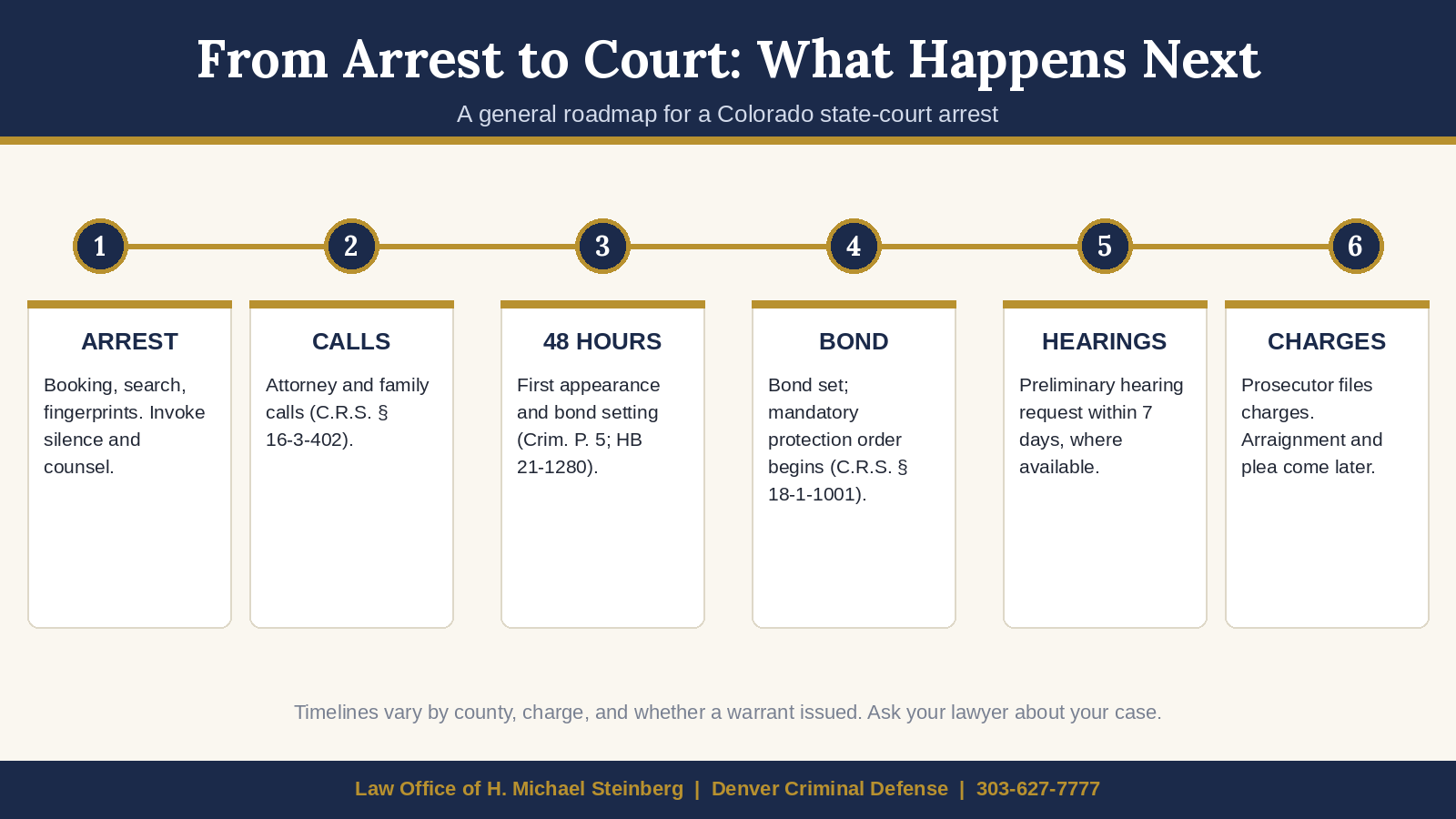
For many felonies, you or the prosecutor can request a preliminary hearing within seven days after you first come before the county court, and the hearing is generally held within 35 days of setting. At that hearing the prosecutor must establish probable cause, and your lawyer can cross-examine witnesses.
Which felonies qualify, and what happens if you are in custody, is spelled out in Crim. P. 5(a)(4). For a walk through every stage, read The Colorado Criminal Case: From Investigation Through Trial.
Domestic violence arrests come with extra consequences that start immediately. Under C.R.S. § 18-6-803.6, when an officer has probable cause to believe a domestic violence offense was committed, the officer must arrest the suspect without undue delay.
Where both people claim to be the victim, the officer evaluates each complaint separately and considers factors such as prior complaints, the relative severity of injuries, the likelihood of future injury, and self-defense. I walk through that decision in How Colorado Police Decide Who to Arrest in a Domestic Violence Case.
Colorado Authority: Mandatory Protection Orders
C.R.S. § 18-1-1001 creates a mandatory protection order against any person charged with a crime under title 18. It takes effect when you are advised of it at arraignment or first appearance and lasts until the case ends. It bars you from harassing, molesting, intimidating, retaliating against, or tampering with a witness or victim, and violating it is a separate crime.
In domestic violence cases, a court may add orders to stay away from the home, avoid all contact, and give up firearms and weapons. You may ask the court to modify or dismiss the order, and you are entitled to request a hearing on its terms.
Do not contact the person who accused you, even if they contact you first and even if they say they want to drop the case. In Colorado, the decision to prosecute belongs to the district attorney, not the complaining witness, and a protection order violation can add a new charge to the one you already face. If you believe the accusation is false or exaggerated, see False, Exaggerated, or Mistaken Domestic Violence Allegations: How Are They Defended? and our domestic violence defense page.
A DUI arrest layers a second set of rules over everything above. Under Colorado’s expressed consent statute, C.R.S. § 42-4-1301.1, a driver who is lawfully arrested for DUI is required to take a chemical test of blood or breath. You choose which test, but once you make the election you generally cannot change it, and failing to complete or cooperate with the test you chose is treated as a refusal. A roadside preliminary screening test is not a substitute for the statutory test.
The decisions in a DUI stop move fast, and mistakes made at the roadside or the station are hard to undo. See our Colorado DUI and DWAI defense page for how we approach these cases.

The first 72 hours after an arrest are not the whole case, but they shape it. A lawyer who knows the Colorado courts can:
My practice focuses on DUI, domestic violence, drug crimes, sex crimes, assault, theft, and a broad range of other felony and misdemeanor defense across the Denver metro area and the Front Range. You can read about my background on my attorney profile.
Arrested or Under Investigation in Colorado?
Do not talk to investigators until you have spoken with a lawyer. H. Michael Steinberg offers a free consultation and is available to talk about fast-moving cases.
Call 303-627-7777 Free Consultation Form
Urgent? 720-220-2277 | The Edwards Building, 8400 E Prentice Ave Penthouse 1500, Greenwood Village, CO 80111
No. Warnings are required before a custodial interrogation, not at the moment of arrest. If officers arrest you and do not question you, no warning is required. If they do question you without the warnings required by C.R.S. § 16-3-406, the usual remedy is that the statement cannot be used against you in the prosecution’s case at trial. The case itself is not dismissed.
A defense lawyer can ask the court to suppress statements you made during a custodial interrogation without proper warnings or after you invoked your rights. The statement may still be used in limited ways, such as to impeach your testimony if you take the stand, and certain exceptions, like public safety and booking questions, may apply.
You must be taken before a court without unnecessary delay. For bail-eligible arrestees who have not had a bond set, Colorado courts have procedures to provide a bond hearing within 48 hours of arrival at the jail. The details depend on the county and the type of arrest, so ask a lawyer how it applies to you.
Generally not without a warrant. The U.S. Supreme Court held in Riley v. California that police must usually obtain a warrant before searching the digital contents of a cell phone, even when they seize it during an arrest. Do not give consent to a search of your phone.
During a lawful stop based on reasonable suspicion, Colorado law lets an officer require your name, address, identification if you have it, and an explanation of your actions (C.R.S. § 16-3-103). You do not have to give your Social Security number, and you are not required to answer questions about the facts of the case.
Yes, if you cannot afford a lawyer. The judge must tell you at your first appearance that you may request appointed counsel or consult the public defender. If you are released, you will need to apply to the public defender’s office to determine eligibility.
Most people are. Colorado law presumes that people in custody are eligible for release on bond with the least restrictive appropriate conditions, subject to narrow constitutional and statutory exceptions for the most serious offenses. A lawyer can present information to the judge about your ties to the community, your record, and conditions that would address any concern.
As soon as possible, ideally before you speak with investigators. Early decisions about statements, searches, bond, and protection orders can affect the entire case. H. Michael Steinberg offers a free consultation at 303-627-7777.
Disclaimer. This article is general information about Colorado criminal law and is not legal advice. Laws, court rules, and local court practices change, and every case turns on its own facts. Reading this article does not create an attorney-client relationship. Please do not send confidential information through a contact form, text message, or voicemail. If you have been arrested or are under investigation, contact an attorney immediately.
Law Office of H. Michael Steinberg | The Edwards Building, 8400 E Prentice Ave Penthouse 1500, Greenwood Village, CO 80111 | 303-627-7777 | 720-220-2277