A Juror Admitted She Could Not Be Fair—Why Was She Allowed to Decide the Case?
COLORADO JURY SELECTION · PEOPLE v. RITCHIE (COLO. APP. OCT. 22, 2026)
How a Boulder County first-degree murder conviction was reversed because one biased juror stayed on the panel, and what every person facing a Colorado jury trial should know about challenges for cause, juror rehabilitation, and the record.
By H. Michael Steinberg, Colorado Criminal Defense Lawyer · Updated November 2026
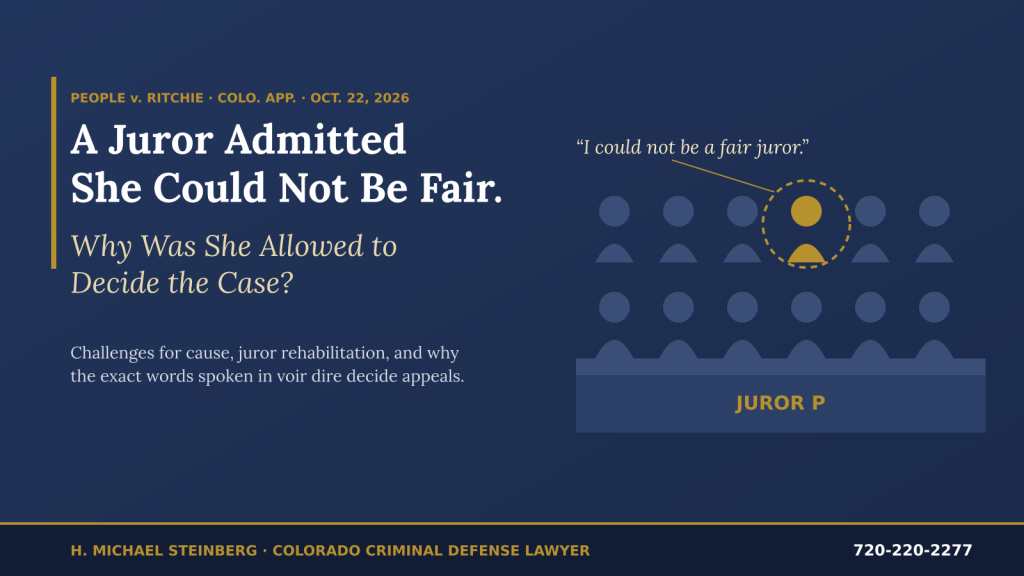
People v. Ritchie: one juror said she could not be fair, and a first-degree murder conviction fell.
★ KEY TAKEAWAYS
In People v. Ritchie, No. 23CA1960 (Colo. App. Oct. 22, 2026) (unpublished), the Colorado Court of Appeals reversed a first-degree murder conviction because the trial judge refused to excuse a juror who said she could not be fair.
The juror described serious PTSD from a past death threat, called jury selection re-traumatizing, admitted she was not listening, and told the court she admired one of the prosecutors.
No one rehabilitated her. The judge’s only follow-up addressed her feelings about the prosecutor, not her trauma, and the judge later misremembered what she had said.
Because the biased juror actually deliberated, the error was structural. Under People v. Abu-Nantambu-El, 2019 CO 106, that means automatic reversal and a new trial.
Jury selection is not a formality. The precise words a juror speaks during voir dire, and how defense counsel preserves them, can decide the case years later on appeal.
Most people charged with a serious crime in Colorado focus on the evidence: the police reports, the forensic results, the witness statements, the video. That is understandable. But in four decades of defending clients in Colorado courtrooms, I have learned that a trial can be won or lost before a single witness takes the stand. It happens in jury selection, the stage lawyers callvoir dire.
A recent Colorado Court of Appeals decision shows why. In People v. Ritchie, decided October 22, 2026, a three-judge division reversed a first-degree murder conviction out of Boulder County. The reason had nothing to do with the strength of the prosecution’s evidence. It had everything to do with one juror who told the court, in plain words, that she could not be fair, and who was allowed to sit on the jury anyway.
This article explains what happened in Ritchie, why the appellate court ordered a new trial, and what the case teaches about challenges for cause, peremptory challenges, juror rehabilitation, prior victimization and emotional triggers, jurors who favor a lawyer, and why preserving the exact words spoken during voir dire matters so much on appeal.
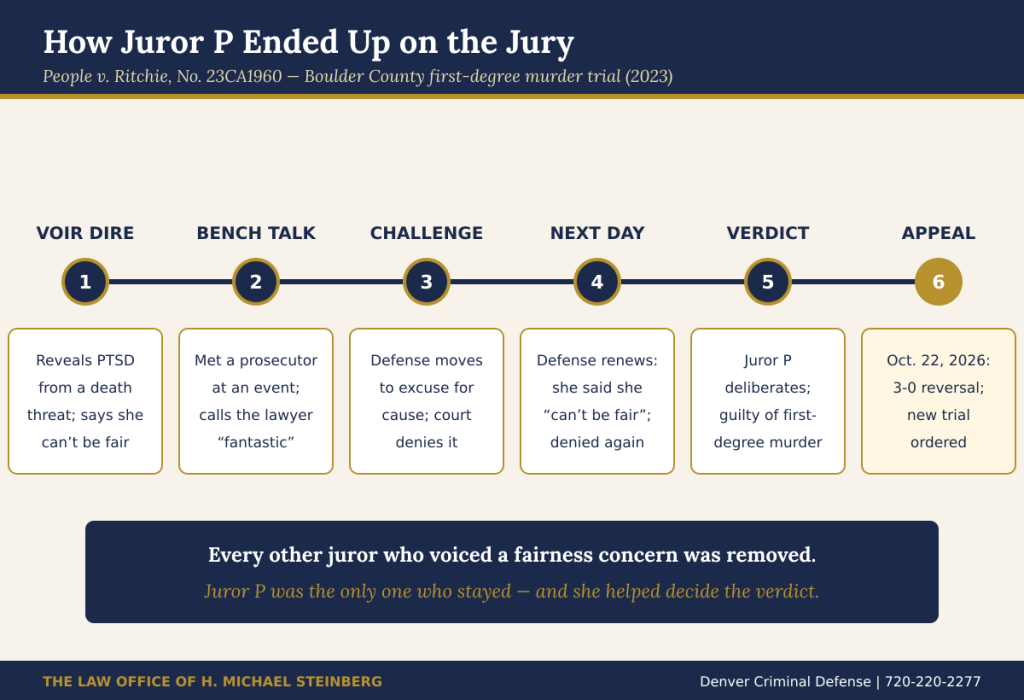
Andrew Ritchie was tried in Boulder County District Court in 2023 and convicted of first-degree murder as a complicitor. According to the opinion, the prosecution’s theory was that a woman with whom he was romantically involved killed her husband. Colorado Politics reported that the shooting happened in Longmont in 2021.
During jury selection, defense counsel asked the panel whether anyone had concerns about sitting on a first-degree murder trial. A prospective juror, identified in the opinion as Juror P, spoke up. Her answers, as recounted by the Court of Appeals, were remarkable for how direct they were:
About twenty years earlier, someone had threatened to kill her and her family.
She suffered from what she called serious post-traumatic stress disorder (PTSD), and she was already stressed about the case.
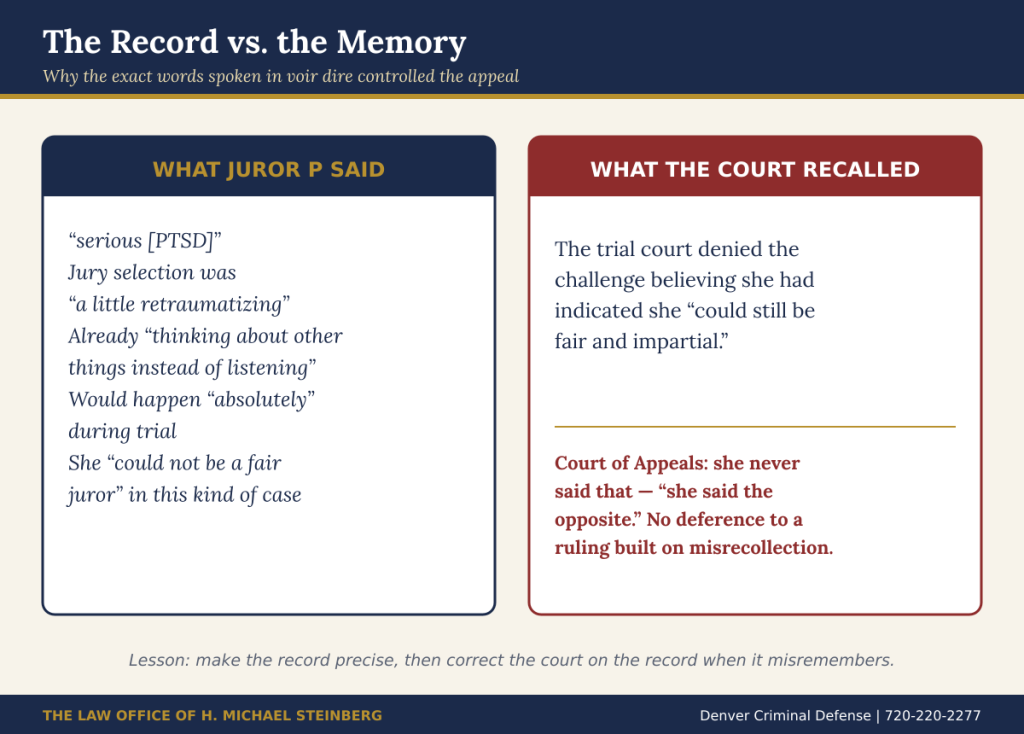
Jury selection itself was, in her words, “a little retraumatizing.”
She was already thinking about other things instead of listening, and she “absolutely” expected that to continue during trial.
She said she could not be a fair juror in this kind of case.
Juror P then asked to speak privately at the bench. There she disclosed that she had met one of the prosecutors at an event, thought the prosecutor was “fantastic,” and felt that connection “pulling” her strongly as she heard about the case. The judge responded that lawyers often draw mixed reactions and asked whether she could decide the case on the evidence rather than on whether she liked a particular attorney. She said she believed she could.
The Challenge for Cause, the Denial, and the Renewed Objection
Defense counsel challenged Juror P for cause, pointing to her traumatic experiences and serious doubt about her ability to be fair. The prosecutor objected, saying she did not recall Juror P expressing doubt about her fairness. The judge denied the challenge, explaining that Juror P had indicated she “could still be fair and impartial” despite her emotional experience.
The next day, defense counsel went back to the court and corrected the record: Juror P had not merely expressed doubt. She had said she can’t be fair. The judge kept the ruling in place, stating that she had indicated an ability to be fair to both sides.
The Court of Appeals noted a striking fact. Every other prospective juror who voiced a concern about being fair in this case was excused, either for cause or by a peremptory strike. Juror P was the only one who stayed. She deliberated, and the jury convicted.
Why the Court of Appeals Reversed
Judge Elizabeth L. Harris wrote for a unanimous division that also included Judges Lino S. Lipinsky de Orlov and Christina F. Gomez. The panel applied the familiar abuse of discretion standard that governs rulings on challenges for cause, citing Vigil v. People, 2019 CO 105 and Carrillo v. People, 974 P.2d 478 (Colo. 1999). Even under that deferential standard, the court concluded the trial judge got it wrong. Four points carried the analysis.
1. A Juror Who Cannot Listen Cannot Be Fair
On appeal, the prosecution argued that Juror P’s trauma and her difficulty paying attention were not bias against the defendant. Worry about her own mental health, the argument went, is not the same as favoring one side. The Court of Appeals rejected that narrow view. Relying on People v. Clemens, 2017 CO 89, and People v. Blassingame, 2021 COA 11, the panel reasoned that a juror must be able to render a fair verdict based on the evidence and the court’s instructions, and a juror who cannot listen to or focus on the evidence cannot do that.
2. Her Trauma Was Connected to the Charged Crime
The court also found actual bias. Juror P’s PTSD came from being threatened with death, which closely resembled the violent crime on trial. In the court’s view, her inability to be fairreflected a bias against the person accused of that kind of crime. That is exactly the state of mind that C.R.S. § 16-10-103(1)(j) addresses when it requires a court to sustain a challenge to a juror whose state of mind shows “enmity or bias toward the defendant or the state.”
3. Asking About the Prosecutor Did Not Rehabilitate Her
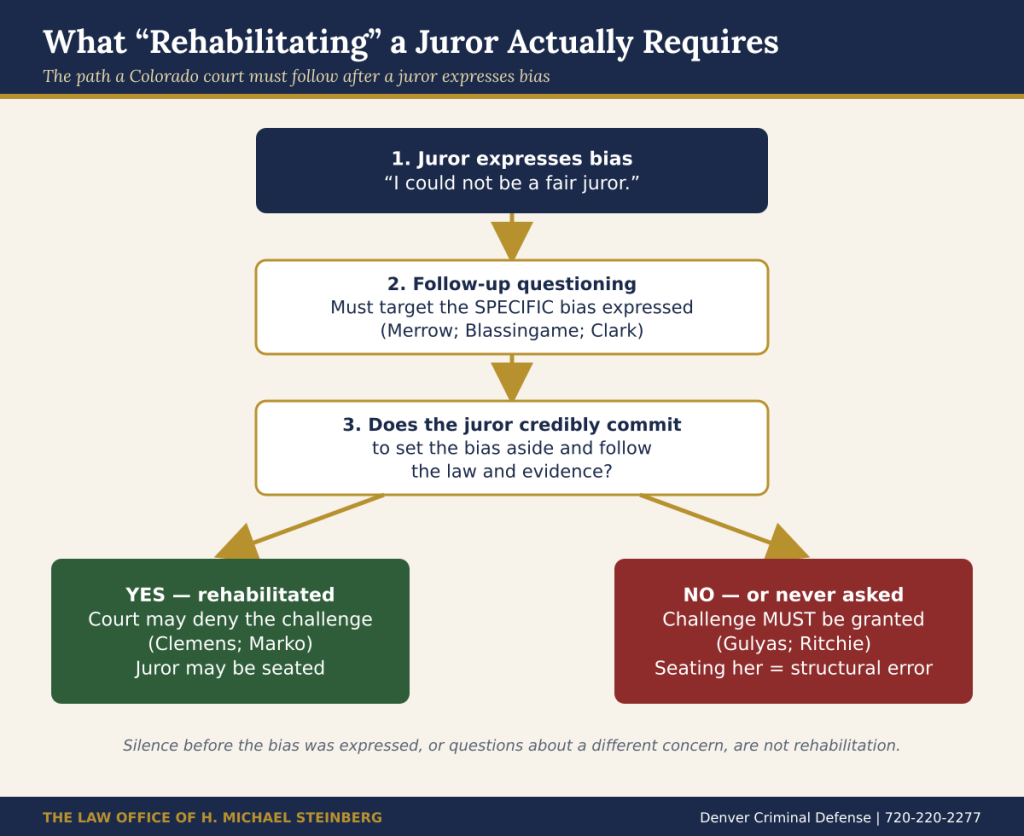
The trial judge did ask one follow-up question: whether Juror P could decide the case on the evidence rather than on her liking for a lawyer. But that question addressed a different concern. It said nothing about the trauma-based inability to be fair she had already announced. Citing People v. Merrow, 181 P.3d 319 (Colo. App. 2007), People v. Clark, 2022 COA 33, and Blassingame, the division held that rehabilitation has to be directed at the bias the juror actually expressed.
The court likewise rejected the idea that the judge’s general introductory remarks to the whole panel, followed by the venire’s silence, could serve as “anticipatory” rehabilitation. Juror P’s statements came after those remarks, and Clemens does not treat silence that comes before a juror announces a bias as a cure for it.
4. The Ruling Rested on a Misrecollection
Finally, the appellate court observed that the trial judge believed Juror P had promised to be fair despite her emotional experience. She never said that. As Judge Harris put it, she said the opposite. Appellate deference exists because trial judges can see and hear jurors, but that deference does not extend to a ruling built on a misremembered record, a point the division drew from People v. Gulyas, 2022 COA 34.
The exact words in the transcript, not the court’s memory of them, decided the appeal.
“When a prospective juror’s statements compel the inference that she cannot decide the issues fairly, and no rehabilitation occurs, the challenge for cause must be granted.”
— Principle applied in People v. Ritchie, drawing on People v. Gulyas, 2022 COA 34, ¶ 19
Why a New Trial Was Automatic: Structural Error
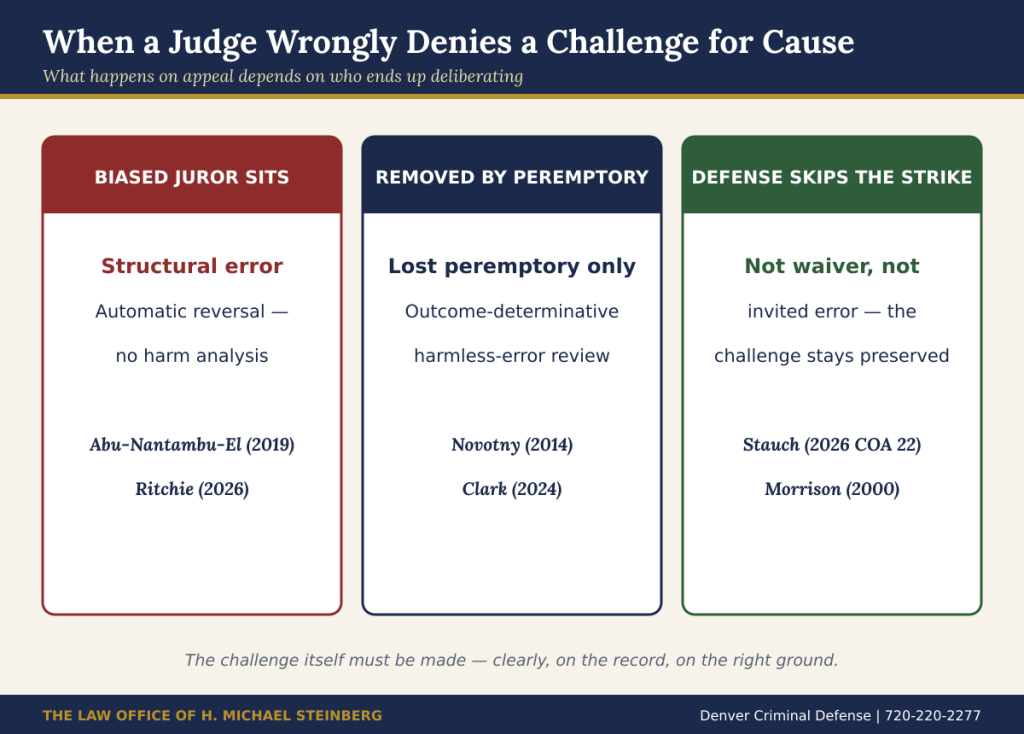
Many trial errors are reviewed for harmlessness: an appellate court asks whether the mistake likely affected the verdict, and if not, the conviction stands. Seating a biased juror is different. The Sixth Amendment and the Colorado Constitution guarantee the accused a trial by an impartial jury. When a court wrongly denies a challenge for cause and the biased juror actually deliberates, that guarantee is broken at its foundation.
In People v. Abu-Nantambu-El, 2019 CO 106, the Colorado Supreme Court held that this kind of error is structural and requires automatic reversal, and it extended that rule to jurors who are impliedly biased by statute, not only those who are actually biased. The Supreme Court reaffirmed the principle in Clark v. People, 2024 CO 55, explaining that when an erroneous ruling results in seating a juror biased against the defendant, the conviction must be reversed. Ritchie applied that rule directly: because Juror P sat, no showing of prejudice was required. The court reversed and remanded for a new trial.
§ COLORADO AUTHORITY: THE STATUTE BEHIND CHALLENGES FOR CAUSE
C.R.S. § 16-10-103(1) lists the grounds on which a Colorado trial court shall sustain a challenge for cause. They include, among others, a juror’s relationship to the defendant, a victim, or an attorney of record (implied bias), employment by a public law enforcement agency or public defender’s office, and, under subsection (1)(j), a state of mind evincing enmity or bias toward the defendant or the state.
Under subsection (1)(j), a court may deny the challenge only if it is satisfied, from the juror’s examination or other evidence, that the juror will render an impartial verdict according to the law and the evidence. Crim. P. 24(b) contains a parallel rule. The Colorado Supreme Court described these challenges as mandatory in People v. Rhodus, 870 P.2d 470 (Colo. 1994).
Challenges for Cause vs. Peremptory Challenges
Clients are often surprised to learn that there are two very different ways to remove a juror, and they work on completely different rules.
Challenges for Cause
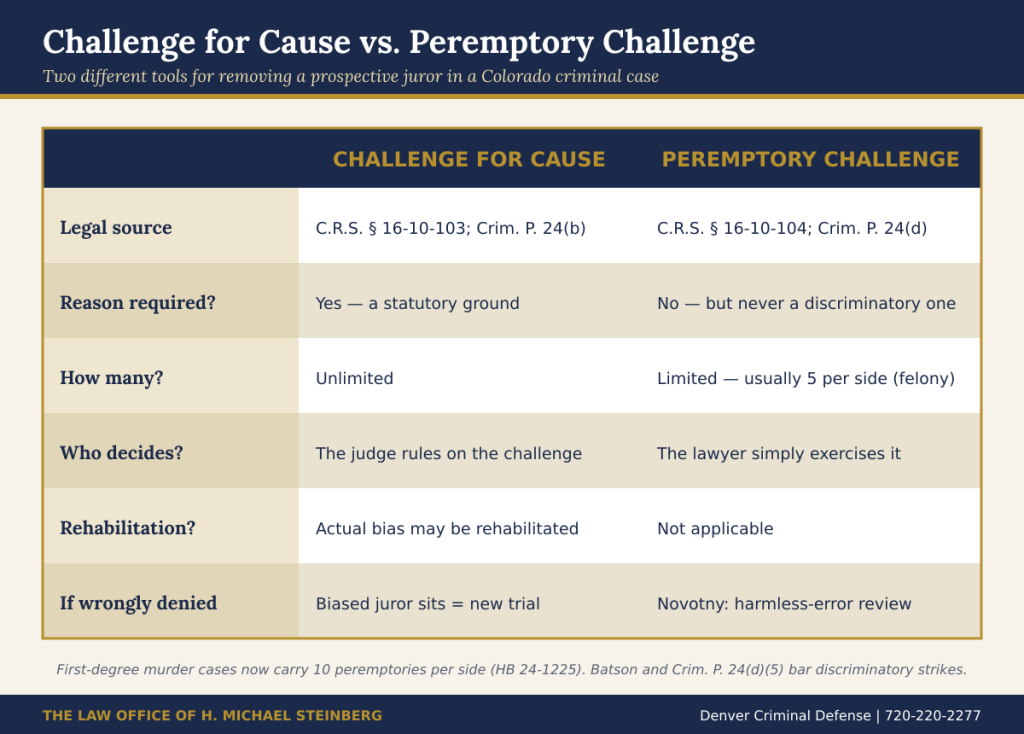
A challenge for cause asks the judge to remove a juror because there is a legal reason the person should not serve. The grounds come from C.R.S. § 16-10-103 and Crim. P. 24(b). There is no limit on how many for-cause challenges a party may make, but each one must be justified, and the judge decides whether it is granted. Some grounds create implied bias: the law presumes the juror cannot be impartial, and no promise to be fair can fix it. Other grounds, like the actual bias in Ritchie, can sometimes be cured through rehabilitation.
Peremptory Challenges
A peremptory challenge lets each side remove a limited number of jurors without stating a reason. Under C.R.S. § 16-10-104 and Crim. P. 24(d), each side generally receives five peremptory challenges in felony cases and three in other cases. Since a 2024 amendment (HB 24-1225), each side receives ten in first-degree murder cases. Peremptory strikes may never be used to exclude jurors on the basis of race or sex, a rule rooted in Batson v. Kentucky, 476 U.S. 79 (1986) and strengthened in Colorado by Crim. P. 24(d)(5), which targets improper bias, including unconscious or implicit bias, in the use of peremptory strikes.
Two different tools: challenges for cause require a legal ground; peremptory challenges are limited in number.
The two tools interact. When a judge wrongly refuses to strike a biased juror for cause, the defense is often forced to spend a precious peremptory strike to remove that person. For years, Colorado treated that loss of a peremptory as grounds for automatic reversal under People v. Macrander, 828 P.2d 234 (Colo. 1992). In People v. Novotny, 2014 CO 18, the Colorado Supreme Court overruled that rule. Now, if the biased juror is removed by peremptory and never deliberates, the error is reviewed under an outcome-determinative harmless-error test. That is why it matters so much who ends up in the jury room.
Importantly, the defense is not required to use a peremptory strike on a juror it unsuccessfully challenged for cause in order to preserve the issue. The Colorado Supreme Court made that clear in People v. Morrison, 19 P.3d 668 (Colo. 2000), and in April 2026 a division of the Court of Appeals held in People v. Stauch, 2026 COA 22, that declining to spend a peremptory on the biased juror was neither waiver nor invited error.
The remedy on appeal turns on whether the biased juror actually deliberated.
What Does It Mean to “Rehabilitate” a Juror?
Rehabilitation is the process by which a judge or lawyer asks follow-up questions to a prospective juror who has expressed a bias or a preconceived view, in order to find out whether the juror can set that view aside and decide the case fairly. Colorado law recognizes that jurors are human. Many arrive with opinions, experiences, and assumptions. As the Supreme Court explained in Marko v. People, 2018 CO 97, and Clemens, a juror who expresses a preconceived belief is not automatically disqualified if, after further questioning, the court is convinced the juror can impartially evaluate the evidence and follow the court’s instructions.
But rehabilitation has limits, and Ritchie illustrates several of them:
It must address the actual bias expressed. A question about whether the juror likes a lawyer does not rehabilitate a juror who said trauma prevents her from being fair. See Merrow and Blassingame.
It requires a genuine assurance, not silence or vague nods. In Clemens, the Supreme Court allowed courts to consider a juror’s silence in context, but Ritchie clarifies that silence before a juror announces her bias cannot erase it.
Leading questions that extract a reluctant “I guess so” deserve skepticism. A juror who says she will “try” to be fair has not necessarily committed to being fair.
Doubts should be resolved by excusing the juror. Colorado courts have long said that when there is real doubt about a juror’s impartiality, the safer course is to excuse the juror, as the Court of Appeals noted in People v. Chavez, No. 08CA2144 (Colo. App. 2011).
Implied bias cannot be rehabilitated at all. If a juror falls within a statutory category such as a close family relationship with the prosecutor’s office or employment by a law enforcement agency, no promise to be fair saves her. See Abu-Nantambu-El, 2019 CO 106, and Mulberger v. People, 2016 CO 10 (construing the law-enforcement-employee ground).
Rehabilitation must target the specific bias and produce a credible commitment to fairness.
In Gulyas, a sexual assault on a child case, the Court of Appeals found error where a juror expressed a strong bias in favor of child witnesses and never gave any assurance he could set it aside. Ritchie follows the same logic: no specific assurance, no rehabilitation, and the challenge should have been granted.
Prior Victimization and Emotional Triggers
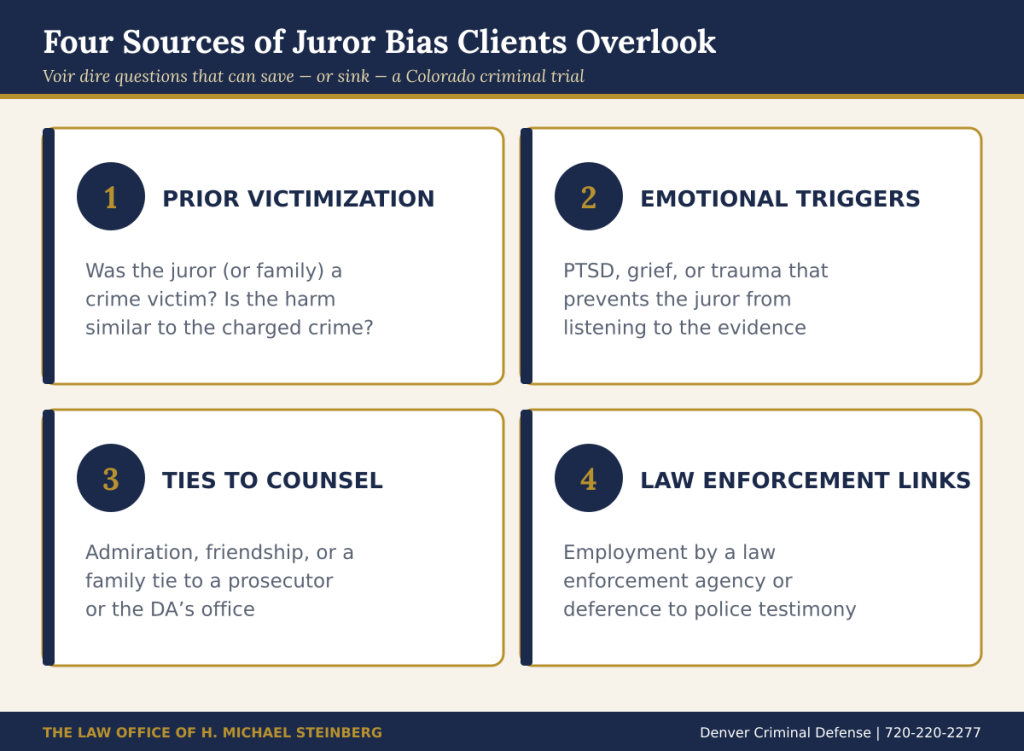
Many good, honest people who report for jury duty have been victims of crime. Prior victimization does not automatically disqualify a juror. The question is always whether the experience prevents that person from deciding this case fairly. Several factors matter:
Similarity. Is the juror’s experience similar to the crime charged? A juror who was threatened with death sitting on a homicide case, as in Ritchie, or a juror who survived an assault sitting on an assault case, may struggle to separate past and present.
Ongoing effects. Is the trauma still active? PTSD, ongoing counseling, or present-day distress are very different from a long-resolved event the juror rarely thinks about.
Ability to listen.Ritchie makes clear that a juror who cannot focus on the evidence because of emotional distress cannot render a fair verdict, whether or not the distress is framed as “bias.”
Candor. The juror’s own description of her state of mind is powerful evidence. When a juror says she cannot be fair, the court must take that seriously.
These issues come up constantly in cases involving sex crimes and domestic violence, where many prospective jurors have personal or family experience with similar allegations. A careful defense lawyer asks about those experiences respectfully, often in a private setting at the bench, and listens closely to the answers. Our article on mental health issues in Colorado criminal cases discusses how trauma and mental health affect the courtroom from the defendant’s side; Ritchie shows that they matter on the jury’s side as well.
Four categories of juror bias that clients often overlook.
When a Juror Favors a Lawyer: Relationships and Favorable Impressions
Juror P’s second problem was her admiration for one of the prosecutors. Colorado law treats some lawyer connections as automatically disqualifying. Under C.R.S. § 16-10-103(1)(b), a juror related within the third degree to the defendant, a victim, or an attorney of record, and in some circumstances to a deputy district attorney in the office prosecuting the case, must be excused. In Macrander, the juror’s son worked as a deputy district attorney in the prosecuting office. In Stauch, the juror was related to a deputy district attorney in the elected district attorney’s office, and the Court of Appeals reversed a first-degree murder conviction when he deliberated.
A favorable impression that falls short of a statutory relationship is evaluated under the general actual-bias standard. Meeting a prosecutor at a community or political event, admiring a lawyer’s reputation, or knowing someone who works in the district attorney’s office will not always disqualify a juror. But it must be explored. In Ritchie, the juror herself described the pull she felt toward the prosecution because of that impression. Combined with her trauma-based statements, it painted a picture of a juror who was not starting from a neutral position.
The same concern applies in reverse. Jurors who know defense counsel, or who have strong positive or negative views about defense lawyers generally, should also be questioned. Fairness runs both ways.
Why the Precise Words Spoken in Voir Dire Matter on Appeal
Perhaps the most practical lesson of Ritchie is this: appellate courts decide jury-selection issues from the transcript. The appellate judges never saw Juror P. They could not observe her tone, her demeanor, or her body language. What they had was a written record of what she said, what the lawyers said, and what the judge said. That record decided the case.
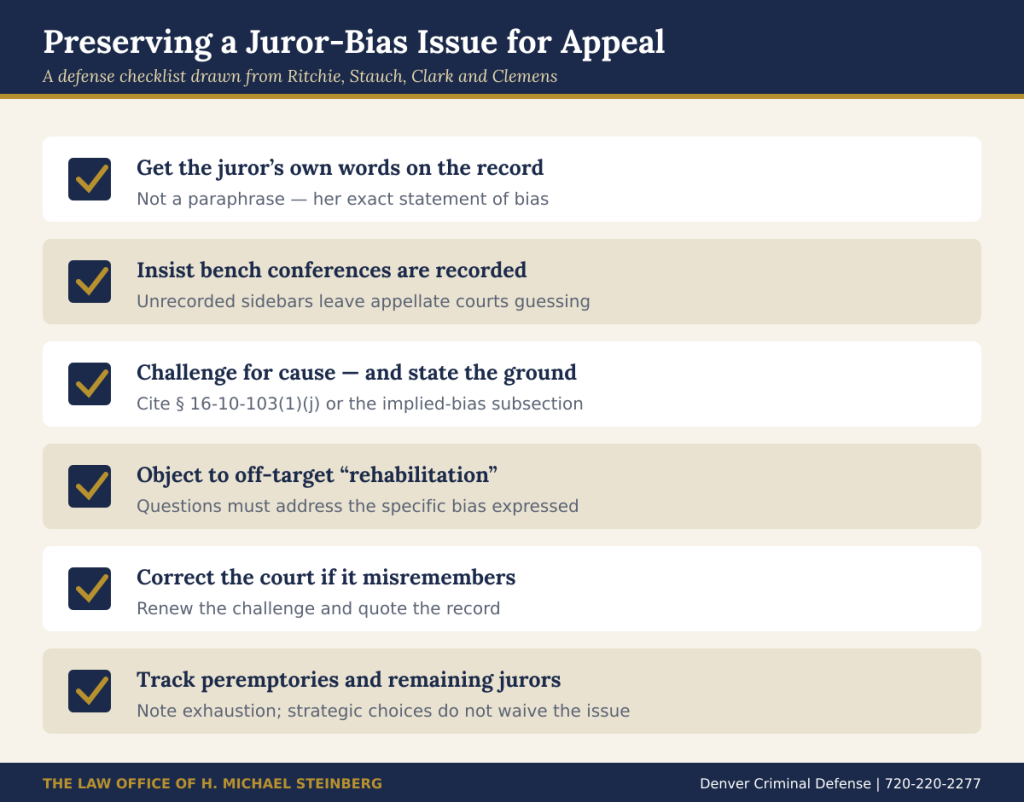
In Ritchie, the defense did three things right:
It drew out the juror’s own words. Juror P did not merely hint at a problem. Defense questioning produced clear statements: serious PTSD, retraumatized, not listening, could not be fair.
It made a timely challenge for cause that identified the trauma and her doubts about fairness.
It corrected the court. When the judge and prosecutor misremembered her answer, defense counsel came back the next day and put the accurate words on the record. That renewed objection made it impossible for the appellate court to defer to the judge’s mistaken recollection.
Contrast that with cases where the critical exchange happens at an unrecorded bench conference. In Clark, for example, the trial court denied a challenge for cause after a bench conference that was not recorded, leaving the appellate courts with a less complete picture. A defense lawyer should insist that every sidebar involving a juror be on the record.
Preservation also means naming the right legal ground. In Stauch, the State argued on appeal that defense counsel had not specifically cited the implied-bias subsection of the statute. The challenge survived, but the argument itself shows how closely appellate courts scrutinize what was said. Precision in the moment protects the client later.
A defense checklist for preserving juror-bias issues for appeal.
§ A NOTE ON UNPUBLISHED OPINIONS
People v. Ritchie was not selected for official publication. Unpublished Colorado Court of Appeals opinions do not bind other divisions the way published opinions do. But Ritchie does not announce new law. It applies settled, published decisions, including Abu-Nantambu-El, Clark, Clemens, Gulyas, Merrow, and Blassingame, to a clear set of facts. That makes it a useful illustration of how those rules work in practice.
What This Means If You Are Facing a Colorado Jury Trial
If you have been charged with a felony in Colorado and your case may go to trial, Ritchie carries several practical lessons:
Ask your lawyer how they approach jury selection. Voir dire is not a formality to rush through. It is the only opportunity to learn who will decide your case.
Expect your lawyer to ask uncomfortable questions. Questions about prior victimization, trauma, law enforcement ties, and feelings about lawyers can feel intrusive, but they are essential.
Understand that silence is not safety. A juror who says nothing may still hold strong views. Good questioning invites honesty.
Know that the record matters. If a juror makes a damaging admission, your lawyer should make sure it is captured accurately and acted on.
Remember that jury selection connects to your defense theory. The jurors you keep should be people who can actually hear your theory of the case.
Jury selection is also one piece of a larger defense strategy that starts long before trial, from challenging weak charges at a preliminary hearing to suppressing statements obtained in violation of Miranda. Each stage builds the record that protects you if something goes wrong later.
Frequently Asked Questions About Juror Bias in Colorado
What is a challenge for cause in Colorado?
A challenge for cause is a request asking the judge to remove a prospective juror for a legal reason listed in C.R.S. § 16-10-103 or Crim. P. 24(b), such as bias toward one side, a close relationship with a party or lawyer, or employment by a law enforcement agency. There is no limit on the number of challenges for cause.
How many peremptory challenges does each side get in a Colorado criminal trial?
Under C.R.S. § 16-10-104, each side generally receives five peremptory challenges in a felony case and three in other cases. Each side receives ten in first-degree murder and capital cases, with additional strikes in multi-defendant cases and when alternates are seated.
Can a juror who says she cannot be fair still serve?
Only if she is genuinely rehabilitated: follow-up questioning must address her specific bias and produce a credible assurance that she can set it aside and decide the case on the evidence and the law. In People v. Ritchie, no such assurance was obtained, so the challenge should have been granted.
Is being a crime victim enough to disqualify a juror?
Not automatically. Courts look at whether the experience is similar to the charged crime, whether its effects are ongoing, and whether the juror can listen to the evidence and decide fairly. A juror who says her trauma prevents her from being fair should be excused.
What happens if a biased juror ends up on my jury?
If your lawyer properly challenged the juror for cause, the judge wrongly denied the challenge, and the juror deliberated, Colorado treats the error as structural. Under People v. Abu-Nantambu-El, the conviction must be reversed and a new trial ordered, without any need to prove the juror changed the outcome.
Does my lawyer have to use a peremptory strike to preserve a juror-bias issue?
Talk With an Experienced Colorado Criminal Trial Lawyer
Jury selection is where experience shows. H. Michael Steinberg has defended people accused of crimes in Colorado courtrooms for over forty years, from Denver’s Lindsey-Flanigan Courthouse to courts throughout the Denver metro area. He knows how to question jurors, how to recognize hidden bias, and how to build a trial record that protects his clients.
DISCLAIMER: This article is provided for general informational purposes only and does not constitute legal advice. Reading it does not create an attorney-client relationship. Every case depends on its own facts, and the law changes. People v. Ritchie is an unpublished decision and may be subject to further review. If you are facing criminal charges, consult a qualified Colorado criminal defense attorney about your specific situation.
"Mr. Steinberg provided my family with expert handling of my son's case. He took extra time understand the case, to consult with us during the pretrial proceedings, and to support him for a plea agreement. Mr. Steinberg is very...
Tanya Witt
"I found myself in criminal trouble, that I wasn't guilty of and thanks to Mr. Steinberg's dedication and hard work, right before we we're looking at having to continue on to trial level Mr. Steinberg was able to use his vast knowledge...
Josh
"Working with Michael Steinberg was a wonderful experience. Truly people need to know that he is a expert in what he does. His personality is compassionate, intellectual, and down to earth. I glean that Michael is fun to be around. In...
Renee Taylor
Mr. Steinberg, It has been an honor working with you. I very much appreciated your style, demeanor, patience, and determination. I was well instructed in every step of the court process, and I felt that I received excellent guidance...