A Lawyer With a 42+ Year Proven Track Record
Exclusively Practicing Only Colorado Criminal
Law - Defending Your Future
Exclusively Practicing Only Colorado Criminal
Law - Defending Your Future








THE LAW OFFICE OF H. MICHAEL STEINBERG
Colorado Criminal Defense | 720-220-2277 | www.hmichaelsteinberg.com
By H. Michael Steinberg, Colorado Criminal Defense Lawyer | Updated November 2026
One of the most important tactics in defending against criminal charges is developing a coherent theory of the case. This “defense theory” serves as the foundation for an organized, aggressive attack on the District Attorney’s case.
A criminal trial is a contest between two stories. The prosecutor arrives with one already written: the police reports, the charging document, and the witness list all point in a single direction.
A defense that only pokes holes in that story, without offering the jury a better way to understand the evidence, is never enough and therefore may lose at trial.
After more than forty years in Colorado courtrooms, first as a prosecutor and then as a Colorado criminal defense lawyer, I have seen the same thing occur in case after case. The side with the clearer, more believable explanation of what happened has the advantage from the first minute of jury selection.
This article explains what a defense theory of the case is, how it is designed, the Colorado rules that shape it, and why it matters throughout a case even if your case never reaches a jury.
A defense theory of the case is the defense’s account of what really happened and why, under Colorado law, that account means the accused is not guilty of the crime charged.
It is not a list of complaints about the police investigation. It is not the phrase “reasonable doubt.” It is a positive explanation that a juror can repeat to another juror in the deliberation room.
Every sound theory has three parts.
The first is factual: the story the evidence will actually support.
The second is legal: why those facts lead to acquittal, whether because the State cannot prove an element or because the legislature has written a defense into the criminal code.
The third is human: the reason an ordinary person, applying common sense, would want to reach that result.
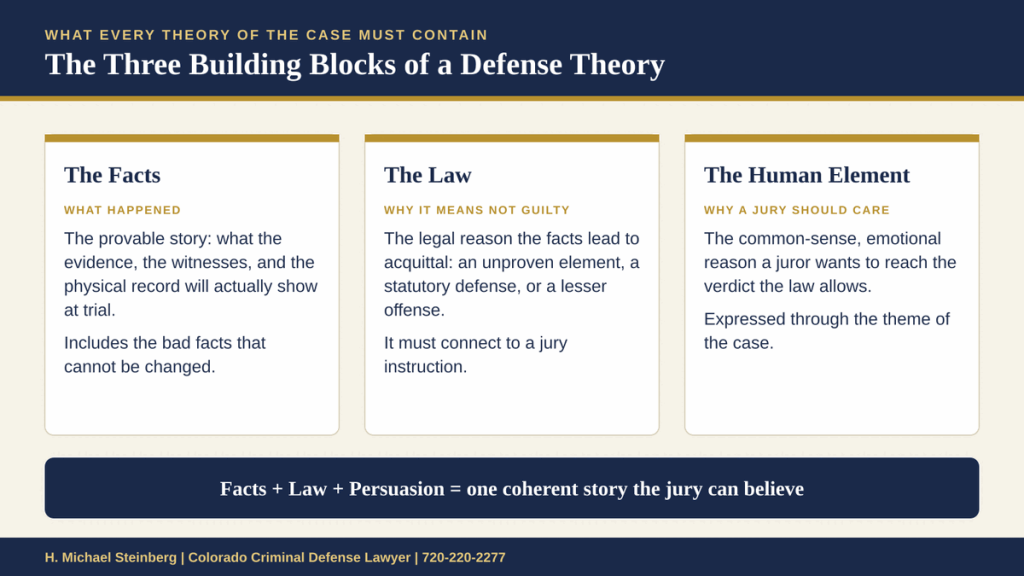
A theory of the case is not an attack on the prosecution’s story. It is a better story, and one the evidence can carry.
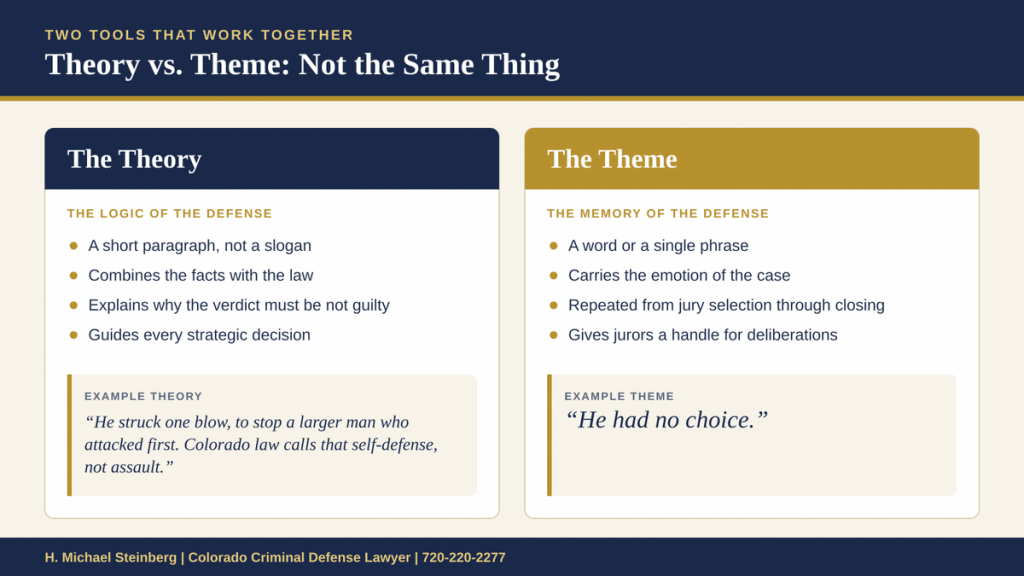
Lawyers often use “theory” and “theme” as if they were interchangeable. They are different tools. The theory is the logic of the defense, usually a few sentences long. The theme is the short phrase that makes the theory stick: a handful of words the jury hears in jury selection, again in opening statement, and again in closing argument.
In an assault case, the theory might be that the accused struck a single blow to stop a larger man who had attacked first, and that Colorado’s self-defense statute makes that conduct lawful. The theme might be three words: “He had no choice.” The theory persuades. The theme is what jurors remember.
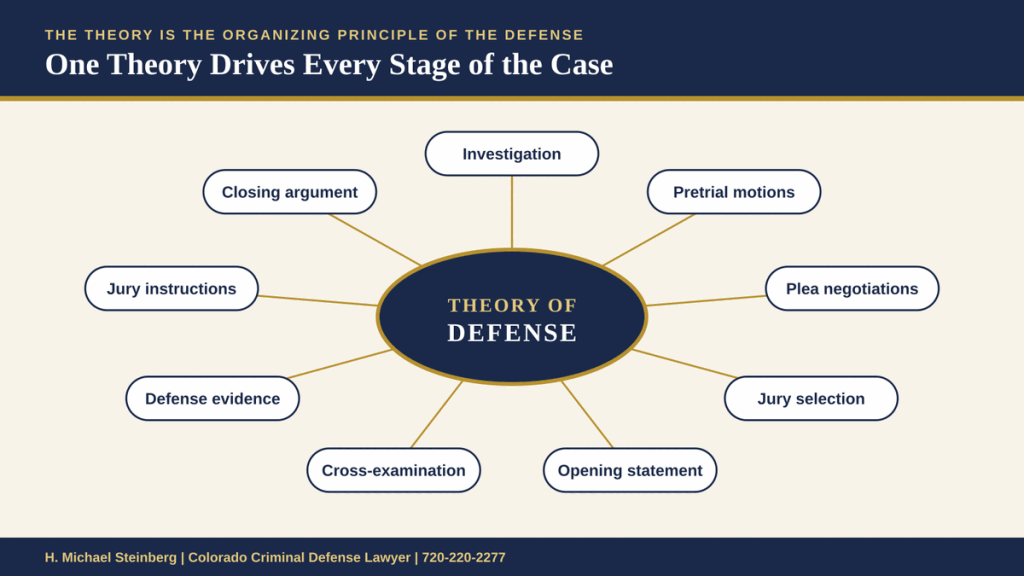
The theory of defense is the organizing principle of the entire case. Until it is chosen, a defense lawyer cannot know which witnesses matter, which motions to file, what to ask potential jurors, or which questions to leave unasked on cross-examination. A lawyer who cross-examines a police officer without a theory is only giving the officer a second chance to repeat the direct examination.
Once the theory is fixed, each stage of the case has a purpose. The investigation looks for the facts the theory needs. Pretrial motions try to exclude the evidence that contradicts it. Jury selection searches for jurors whose life experience makes the theory believable. Cross-examination draws out, one fact at a time, the pieces that will be assembled in closing.
This is also why early representation matters. The best time to begin shaping a theory is before charges are filed, when evidence can still be preserved and witnesses located. See our discussion of pre-charge investigation representation.
Every defense theory is built on two legal foundations. The first is the burden of proof. Under C.R.S. § 18-1-402, every person is presumed innocent, and no one may be convicted unless guilt is proved beyond a reasonable doubt. The United States Supreme Court made that standard a constitutional requirement in In re Winship, 397 U.S. 358 (1970), which requires proof beyond a reasonable doubt of every fact necessary to constitute the crime charged.
The second is the right to be heard. In Holmes v. South Carolina, 547 U.S. 319 (2006), the Court confirmed that the Constitution guarantees a criminal defendant a meaningful opportunity to present a complete defense. The rules of evidence still apply, but a court may not use an arbitrary rule to keep the defense’s side of the story from the jury.
C.R.S. § 18-1-402: presumption of innocence; guilt must be proved beyond a reasonable doubt.
C.R.S. § 18-1-407: once an affirmative defense is raised by some credible evidence, the prosecution must disprove it beyond a reasonable doubt.
People v. Nunez, 841 P.2d 261 (Colo. 1992): a theory of the case instruction must be given if any evidence in the record supports it.
People v. Dye, 2024 CO 2: the defense must disclose the nature of any defense before trial under Crim. P. 16(II)(c).
The facts of every case are different, but nearly every defense theory belongs to one of three families.
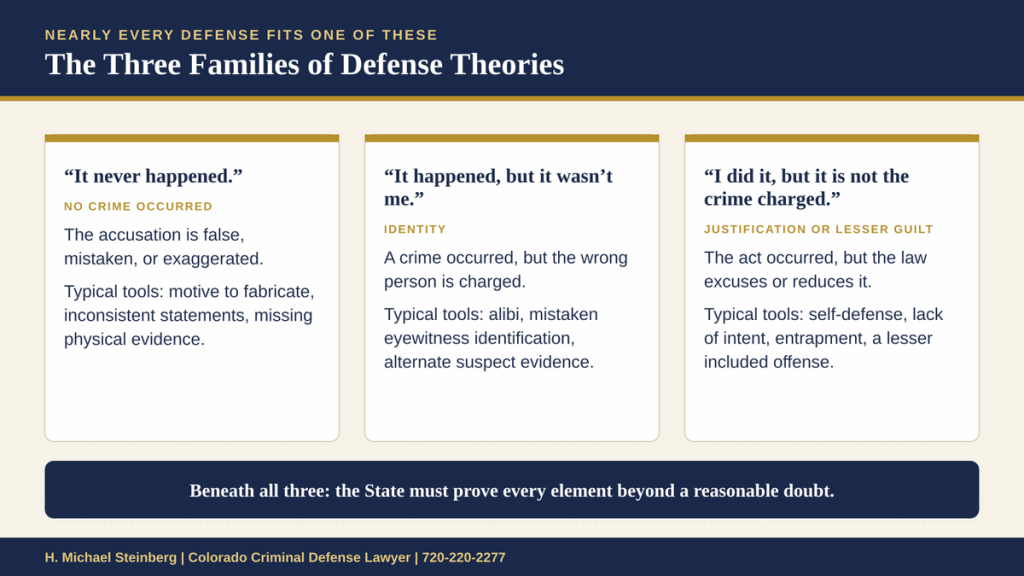
No crime occurred. The accusation is fabricated, mistaken, or exaggerated. These theories are common in domestic violence and sexual assault prosecutions, where the case often rests on the word of one person. The theory must answer the question every juror will ask: why would the accuser say it if it were not true? See what to do when falsely accused and the common legal defenses in Colorado sex crimes cases.
A crime was committed, but the State charged the wrong person. This family includes mistaken eyewitness identification, alibi, and alternate suspect defenses. Colorado courts will admit alternate suspect evidence only where there is a real, non-speculative connection between the other person and the crime. The Colorado Supreme Court set out that framework in People v. Elmarr, 2015 CO 53. A theory of this kind must be built on evidence, not suspicion.
The act occurred, but the law justifies it, excuses it, or treats it as a less serious offense. Self-defense under C.R.S. § 18-1-704 is the most familiar example. Others include entrapment under C.R.S. § 18-1-709, the absence of the required mental state, and the argument that the evidence proves only a lesser included offense.
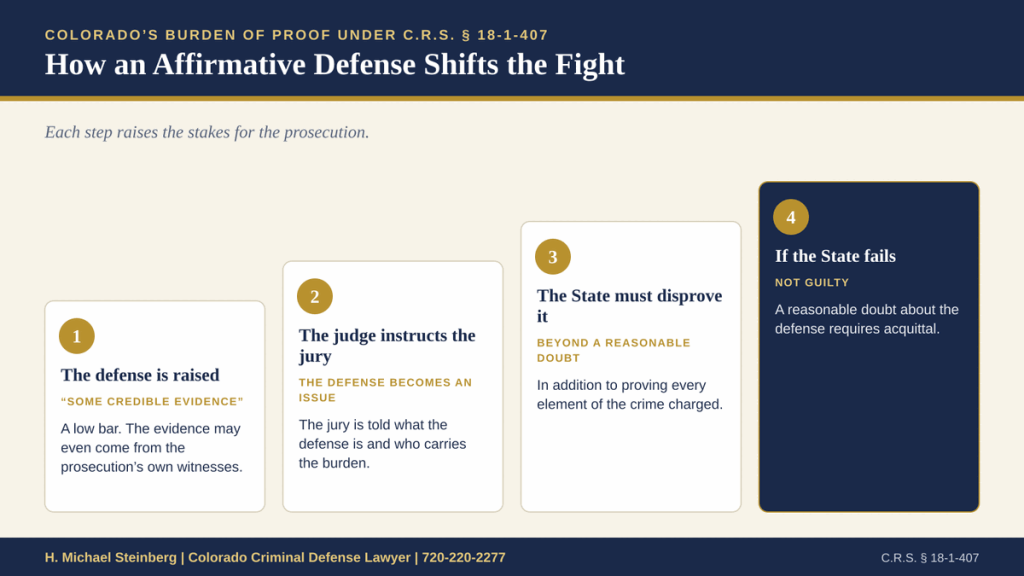
Many of these are affirmative defenses, and Colorado treats them generously. Under C.R.S. § 18-1-407, the defense need only point to “some credible evidence” on the issue. The Colorado Supreme Court has described that standard as a low bar, most recently in People v. Gallegos, 2025 CO 41. Once it is met, the burden falls on the prosecution to disprove the defense beyond a reasonable doubt, as the court explained in People v. Janes, 982 P.2d 300 (Colo. 1999).
A theory is not chosen on instinct. It is the product of a disciplined process, and it stays provisional until the evidence has been tested.
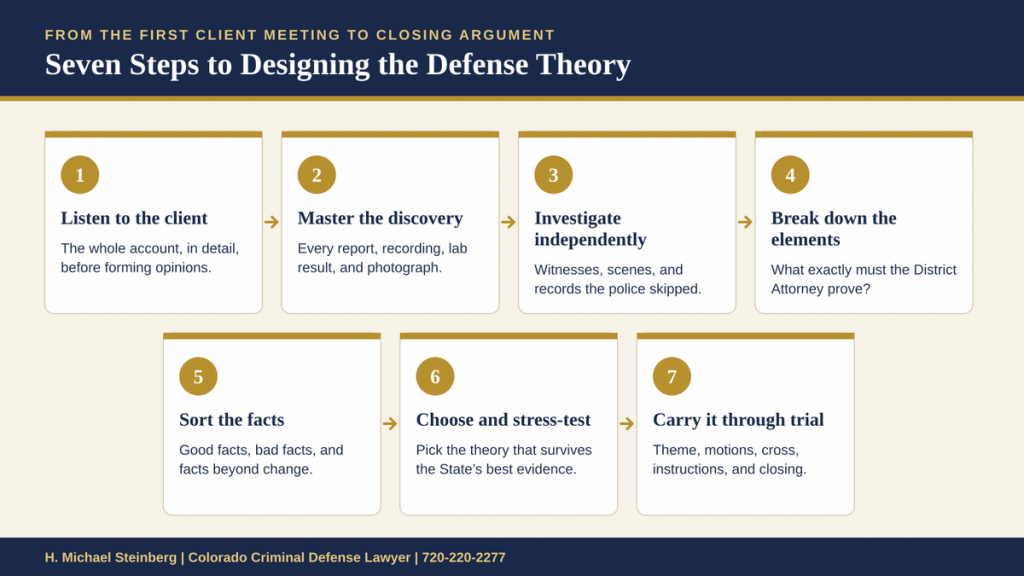
The same method applies whether the charge is a felony or a misdemeanor. For an example in a single practice area, see developing a case theory in Colorado DUI cases and our guide to defending drug crime prosecutions.
Designing a theory is not only a matter of persuasion. Colorado’s discovery rule imposes deadlines, and missing them can cost the defense its best evidence. Under Crim. P. 16, Part II(c), the defense must disclose to the prosecution the nature of any defense, other than alibi, that it intends to use at trial, along with the names and addresses of its witnesses. The court sets the deadline when the not guilty plea is entered. It can be no later than 35 days before a felony trial, or 7 days before a non-felony trial, absent good cause.
In People v. Dye, 2024 CO 2, the Colorado Supreme Court held that “any defense” means what it says. The rule is not limited to affirmative defenses, and it reaches an alternate suspect defense, including the identity of the alternate suspect. The court also held that the rule does not require the defense to turn over all of the evidence supporting that defense.
Alibi has its own rule. Under Crim. P. 16, Part II(d) and C.R.S. § 16-7-102, the defense must serve a written statement of the place the accused claims to have been and the witnesses who will support it, as soon as practicable and no later than 35 days before trial. If the notice is not given, the court must exclude the alibi evidence unless good cause is shown.
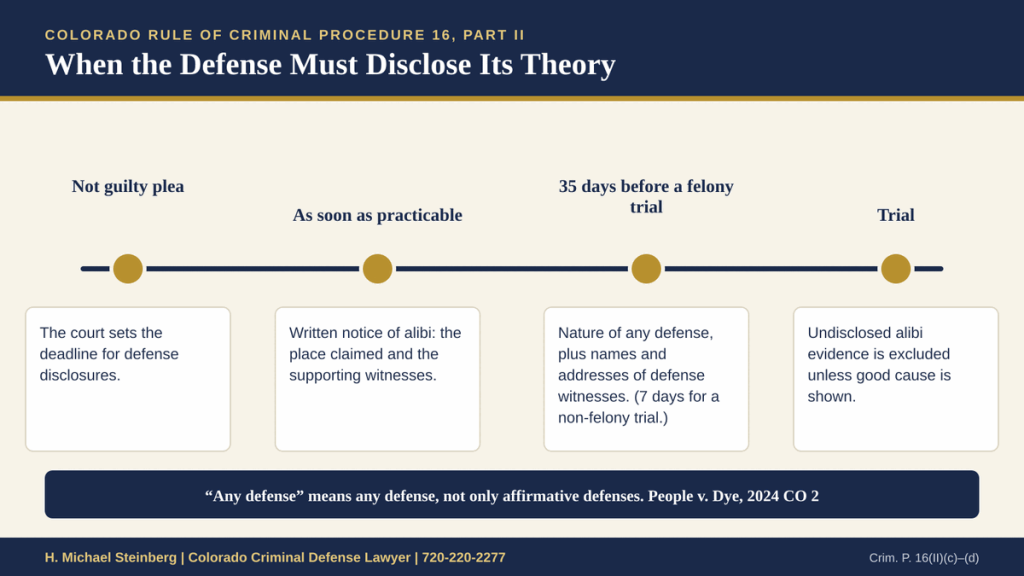
| Type of defense | What must be disclosed | Deadline |
|---|---|---|
| Any defense other than alibi (self-defense, alternate suspect, entrapment, and others) | The nature of the defense; names and addresses of defense witnesses | Set by the court; no later than 35 days before a felony trial or 7 days before a non-felony trial |
| Alibi | Written statement of the place claimed; names and addresses of alibi witnesses | As soon as practicable; no later than 35 days before trial |
| General denial (the State cannot prove its case) | A not guilty plea puts every element at issue | The deadlines above still govern any defense witnesses |
The practical lesson is that the theory must be settled well before trial. A defense discovered the week before jury selection may be a defense the jury never hears.
At the end of a trial, the judge reads the jury its instructions on the law. Colorado gives the accused a valuable right at that moment: an instruction that states the defense theory in the court’s own voice. In People v. Nunez, 841 P.2d 261 (Colo. 1992), the Colorado Supreme Court held that an instruction embodying the defendant’s theory of the case must be given if the record contains any evidence to support it.
There are limits. The instruction must be in proper form. A court may decline one that is argumentative, that merely restates the evidence, or that is already covered by the other instructions. But Nunez also places a duty on the trial judge. When a tendered instruction is flawed, the court is expected to work with defense counsel to correct it, or to incorporate its substance into an instruction of the court’s own drafting.
This is one more reason the theory must be designed early and stated simply. A theory that can be written as a short, neutral, legally accurate paragraph is a theory the judge can read to the jury.
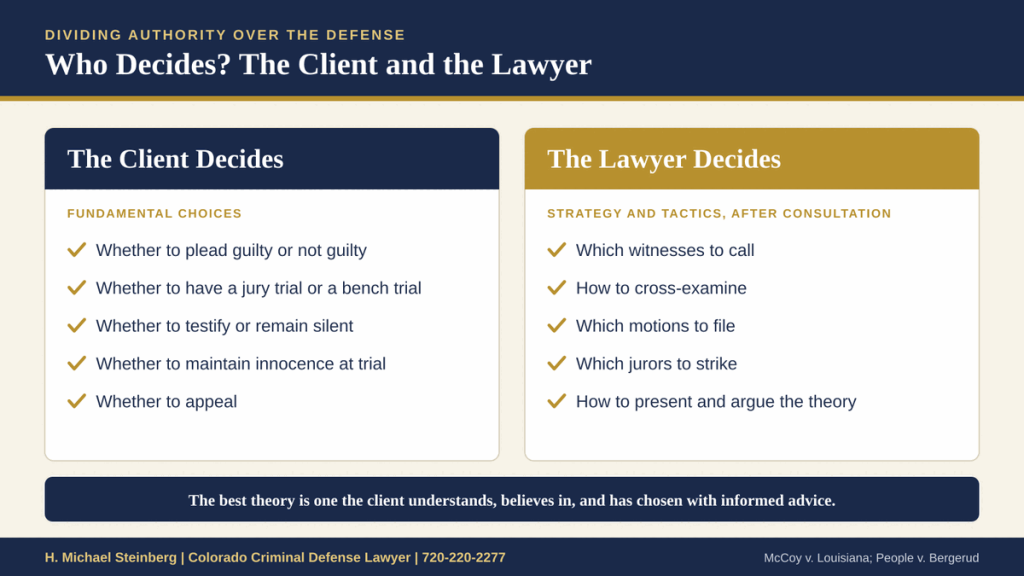
The defense theory belongs to the client’s case, and the law is careful about who controls it. Certain decisions are the client’s alone. In People v. Bergerud, 223 P.3d 686 (Colo. 2010), the Colorado Supreme Court explained that fundamental choices, such as whether to plead guilty, whether to testify, and whether to waive a jury, must be made by the accused, while defense counsel directs trial strategy. Counsel’s strategy may not be used to take those fundamental choices away.
The United States Supreme Court drew a similar line in McCoy v. Louisiana, 584 U.S. 414 (2018). A lawyer may not concede the client’s guilt to the jury over the client’s express objection, even when the lawyer believes that concession is the best strategy. The objective of the defense is the client’s to set.
Within those boundaries, strategy is the lawyer’s responsibility, and courts give informed strategic judgments wide latitude. Under Strickland v. Washington, 466 U.S. 668 (1984), strategic choices made after a thorough investigation of the law and the facts are rarely second-guessed. The word that matters is “after.” A theory chosen without investigation is not a strategy at all.
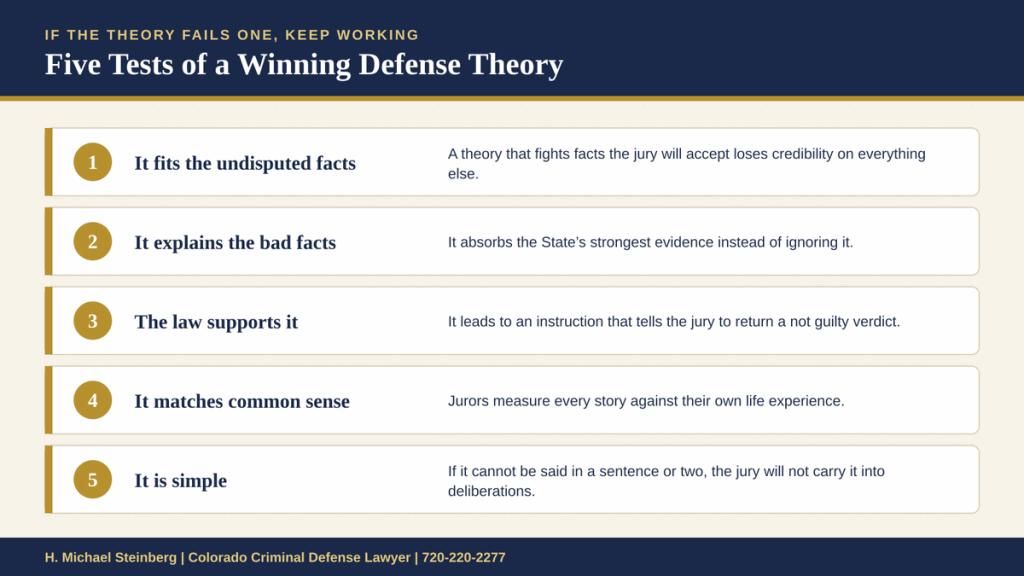
Before a theory is adopted, it should pass five tests.
Most Colorado criminal cases end in a negotiated disposition, not a verdict. That does not make the theory less important. It makes it more important. A District Attorney evaluates a case by asking what will happen in front of a jury. A defense lawyer who can show the prosecutor a credible theory, supported by investigation and backed by the law, changes that calculation. Dismissals, reduced charges, and favorable plea agreements are the result of leverage, and a well-designed theory is where leverage comes from.
It is the defense’s short, logical explanation of what happened and why, under the law, the accused is not guilty of the crime charged. It combines the facts the evidence will support with the legal reason those facts require acquittal.
The theory is the reasoning of the defense, usually a few sentences long. The theme is a word or short phrase that captures the theory and is repeated throughout the trial so that jurors remember it.
In part. Crim. P. 16, Part II(c) requires the defense to disclose the nature of any defense it intends to use and the names and addresses of its witnesses, generally no later than 35 days before a felony trial or 7 days before a non-felony trial. Alibi requires separate written notice.
Yes. Under People v. Nunez, a Colorado trial court must give a properly worded theory of the case instruction if any evidence in the record supports it.
The client makes the fundamental decisions, including how to plead, whether to testify, and whether to maintain innocence. The lawyer, after consulting with the client, makes the strategic and tactical decisions about how the defense is presented.
As early as possible, ideally before charges are filed. Early involvement allows the defense to preserve evidence, locate witnesses, and avoid statements to the police that could undermine the best available defense.
Charged With a Crime in Colorado? Start Building the Defense Now.
H. Michael Steinberg has defended Colorado criminal cases for more than forty years, in Denver and throughout the metro area. If you or someone you love is under investigation or has been charged, call 720-220-2277 or contact the firm to discuss your case. You can also review our practice areas and more articles on the Colorado Criminal Lawyer Blog.Contact Us Now
Disclaimer: This article is provided for general educational purposes only. It is not legal advice and does not create an attorney-client relationship. Colorado criminal law changes frequently, and the outcome of any case depends on its specific facts. If you are facing criminal charges, consult a qualified Colorado criminal defense attorney about your situation.